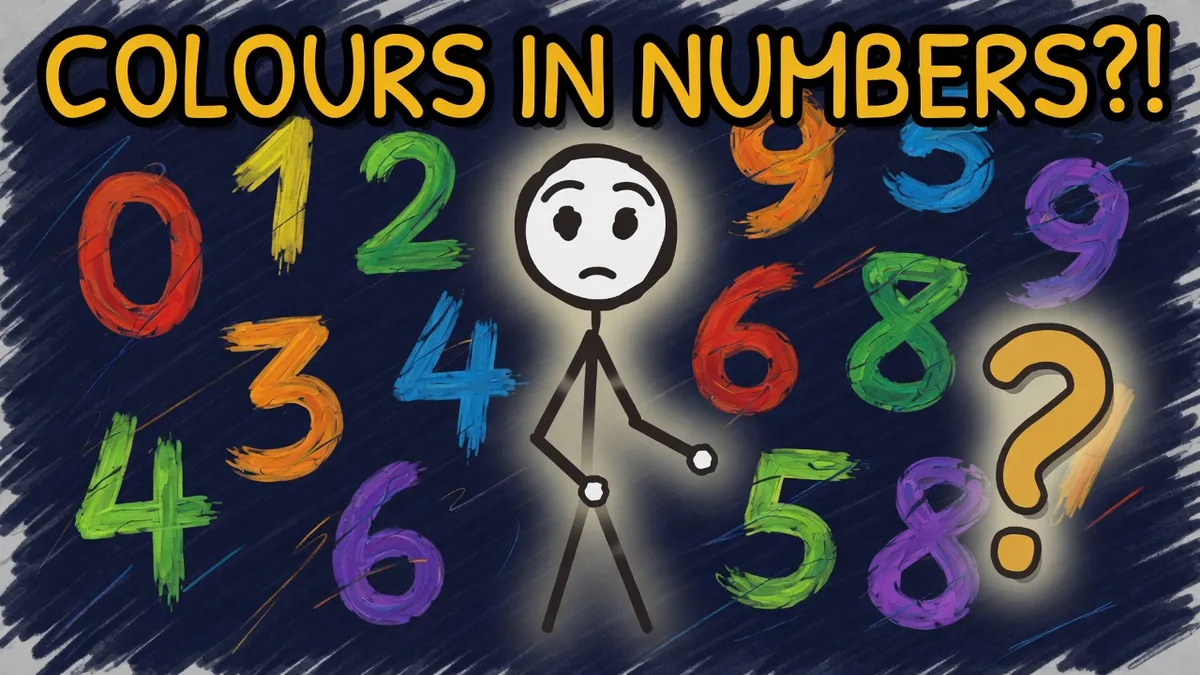
Ask most people what colour the number 5 is and they'll look at you strangely, because the question doesn't parse. A 5 isn't any colour. It's a 5. But ask a certain slice of the population, maybe one in every twenty-five people, and they'll answer without hesitating: green, obviously, a settled leaf-green they've seen on that digit their whole life. They're not being poetic and they're not playing along. To them the number simply arrives wearing a colour, the way a lemon arrives yellow. This is synaesthesia, and it is one of the most quietly astonishing things a human brain can do.
01 · The experienceWhen one sense drags another along
The word comes from the Greek for “joined sensation,” and that’s exactly what it is: one sense automatically triggering another. In the most common form, seeing a letter or number also produces a colour. In another, hearing a piece of music floods your vision with hues. In a rarer, stranger version, hearing a word fills your mouth with a specific taste. The crucial words are automatically and involuntarily. A synaesthete isn’t choosing to link a 5 with green, any more than you choose to hear a car alarm as loud. The extra sensation just happens, unbidden, every single time.
And it is not, to be clear, a disorder or a disease. It causes no harm, needs no treatment, and most synaesthetes are rather fond of it. It’s best thought of as a trait: a different, richer way of wiring the same equipment the rest of us have.
02 · The proofHow we know they're not making it up
The obvious sceptical response is that people are just imagining it, or mistaking a vague association for a real perception. Researchers had the same worry, so they built a beautifully simple test. You ask a synaesthete which colour goes with each letter of the alphabet. Then, without warning, you ask them again, weeks or months or sometimes years later. The synaesthete lands on almost exactly the same colours both times. A control group, told to invent and memorise their own pairings, drifts all over the place by comparison.
That reliability is the whole game. This consistency over time is the field’s gold-standard proof of the real thing, because it is extraordinarily hard to fake a private colour code and reproduce it perfectly a year later without a genuine perception anchoring it. If the letter J is pale blue for you today, and pale blue again next spring, and pale blue the spring after that, something real is doing the anchoring.
03 · The mechanismTwo brain regions that won't stop talking
So what’s the anchor? The leading explanation is a lovely piece of neural geography. The area that recognises letters and numbers sits right next door to an area that processes colour, both tucked into a fold called the fusiform gyrus. In 2001, neuroscientists V. S. Ramachandran and Edward Hubbard proposed that in synaesthetes these neighbouring regions are unusually well connected, so activity in the letter zone spills straight into the colour zone. They called it cross-activation: the brain reads a 5, and because the wiring next door is hair-triggered, it also renders green.
Now, honesty compels a hedge. The theory is elegant and influential, but the brain-imaging evidence has been messier than the tidy story suggests. Some studies find the extra connectivity, others don’t, and it may involve broader networks rather than one neat local short-circuit. The core idea, that separate regions end up cross-wired, holds up well. The exact map is still being drawn.
04 · The varietyColoured sounds, tasted words, numbers in space
Grapheme-colour (the letters-and-numbers kind) gets the headlines, but it’s one of more than sixty documented flavours. In chromesthesia, sound triggers colour: a chord blooms into a shade, which is why so many musicians report it. The composer Kandinsky and producer Pharrell Williams both describe seeing music. In spatial-sequence synaesthesia, the months of the year or the number line aren’t abstract at all, they hang in physical space around the body, a permanent mental calendar you can practically point to.
And then there’s the one that sounds invented until you meet someone who has it: lexical-gustatory synaesthesia, in which words trigger tastes. Not the meaning of the word, oddly, but its sounds. The synaesthete James Wannerton has said the word “speak” has tasted of bacon for as long as he can remember, and, like every form of the trait, that flavour never changes. A name, a place, a stray remark: each arrives seasoned, whether he wants it or not.
05 · The inheritanceIt runs in the family
Synaesthesia clearly travels down bloodlines. It shows up in early childhood and clusters in families, and the writer Vladimir Nabokov, a grapheme-colour synaesthete who wrote gorgeously about his coloured alphabet, noted that his mother and his son had it too. Gene-hunting studies have flagged several stretches of chromosome that seem linked to the trait.
But here’s the subtlety. What’s inherited is the tendency, not the code. A synaesthetic parent and child will both live in a coloured world, yet their private dictionaries can be completely different: her 5 is green, his is orange, and neither is wrong. The genes seem to build a brain prone to cross-wiring, then leave the specific pairings to be filled in early, nudged a little by things as ordinary as childhood letter magnets on the fridge.
One serious hypothesis says every baby is born a synaesthete, with all the senses bleeding together, and that most of us simply prune those connections away in the first few months. Synaesthetes, on this view, aren't the odd ones out. They're the ones who kept it.
06 · The pruningWe may all start out this way
That twist deserves unpacking, because it flips the whole question on its head. The infant brain is spectacularly over-connected, a riot of links between regions that will later live in strict separation. The neonatal synaesthesia hypothesis, proposed by Daphne and Charles Maurer, argues that a newborn genuinely experiences a blur across the senses, sounds carrying colour, sights carrying texture, everything a little mixed. Then, over roughly the first four months, the brain prunes: it snips the surplus connections and walls the senses off into their own tidy departments.
If that’s right, synaesthesia isn’t an extra feature bolted onto a normal brain. It’s a failure to fully prune, a bit of the original newborn wiring that survived into adulthood. The theory is genuinely contested, and not everyone buys that infants are meaningfully synaesthetic. But it reframes the trait in the most humbling way: not as a rare glitch in the few, but as a common inheritance in the many, mostly edited out before we could remember having it.
07 · The payoffSo why do they see colours in numbers?
Because in their brains the wall between “number” and “colour” was never fully built, or never fully held. A region that reads digits sits beside a region that renders colour, and in perhaps one in twenty-five people the two are cross-wired tightly enough that you cannot fire one without lighting the other. So the 5 shows up green, reliably, involuntarily, for life, and a decade of testing can’t shake it loose. It isn’t imagination and it isn’t a defect. It’s a small, elegant reminder that the neat, separate senses you take for granted are a thing your brain builds, and that some brains, quietly, build them a little differently. The next time someone tells you their favourite number is a particularly nice shade of blue, believe them. They’re just showing you a room in the mind the rest of us had walled off before we turned one.
The animated version
Same answer, told as a little animated story with the strange little stickman acting it out. Dry, quick, and, obviously, correct.
Quick questions
What is synaesthesia?
It's a neurological trait in which one sense automatically and involuntarily triggers another. A synaesthete might see a colour whenever they see a number, taste a flavour whenever they hear a word, or perceive a hue for every musical note. The extra sensation is real to them, not imagined, and it's consistent over a lifetime.
Why do some people see numbers as colours?
This is grapheme-colour synaesthesia, the most common form. For these people, letters and digits carry a fixed colour: a 5 might always look green, an A always red. The leading explanation is cross-activation, where the brain region that recognises letters and numbers sits right next to a colour-processing region, and the two are unusually well connected, so seeing a digit also lights up a colour.
Is synaesthesia real or are people imagining it?
It's real, and there's a neat way to prove it. Synaesthetes are tested twice, sometimes years apart, on which colour goes with which letter. They match their own answers far more consistently than people who are simply told to invent and memorise pairings. That reliability, the 'gold standard' test for the trait, is very hard to fake.
Can you taste words?
Yes, in a rare form called lexical-gustatory synaesthesia. Words trigger specific, involuntary tastes, often tied to the sounds in the word rather than its meaning. James Wannerton, a well-known synaesthete, has said the word 'speak' has tasted of bacon for as long as he can remember, and those flavours stay the same for life.
How common is synaesthesia?
Estimates vary by how you count and which forms you test, but a large 2006 study put the overall figure at around 4%, with grapheme-colour synaesthesia at roughly 1 to 2% of people. So somewhere in the low single-digit percentages: uncommon, but far from rare.
Is synaesthesia genetic?
It strongly appears to be. It runs in families and is usually present from early childhood. Vladimir Nabokov, who had it, noted that his mother and his son did too. Studies have flagged several chromosome regions linked to it, though no single 'synaesthesia gene' explains the whole picture, and the specific pairings (which colour goes with which letter) are not inherited, only the tendency.
What are the different types of synaesthesia?
Researchers have catalogued more than 60. The common ones include grapheme-colour (letters and numbers have colours), chromesthesia (sounds trigger colours), and spatial-sequence (months or numbers laid out in space). Rarer forms include lexical-gustatory (words taste of things) and even personality-based ones where letters feel like they have genders or temperaments.
Is synaesthesia a disorder or a disease?
Neither. It's not classed as a disorder: it causes no harm, and most synaesthetes rather enjoy it or don't think about it. It's better described as a trait or a different mode of perception. In fact it can come with perks, like stronger memory for the things that carry colours.
What causes synaesthesia in the brain?
The leading model is cross-activation: two brain regions that are usually kept separate are extra-connected in synaesthetes, so activity in one spills into the other. For grapheme-colour, that's the letter-and-number area and a colour area sitting close together in the fusiform gyrus. The evidence is real but imaging results are mixed, so the exact wiring is still debated.
Do synaesthetes agree on which colours go with which letters?
Not really, but they're not random either. Every synaesthete has their own private, fixed set of pairings. Across people, though, there are faint statistical tendencies (A skews red, O skews white, and letters early in the alphabet often get brighter colours), possibly nudged by childhood letter toys and how often letters appear.
Can you develop synaesthesia, or learn it?
True synaesthesia usually shows up in childhood and is thought to be largely inborn. It can, more rarely, be acquired after brain injury, stroke, or certain drugs. Some studies suggest people can be trained to form colour-letter associations, but whether that produces the full, automatic, involuntary experience is doubtful.
Is synaesthesia linked to creativity?
There's a real, if modest, association. Synaesthesia is more common among artists, writers and musicians than in the general population, and famous synaesthetes include Nabokov, Kandinsky, and musicians like Pharrell Williams and Billie Eilish. Whether the trait fuels creativity or just tends to travel with it isn't settled.
Are babies born with synaesthesia?
Possibly all of them, according to one influential hypothesis. The idea, from Daphne and Charles Maurer, is that newborn brains are so richly interconnected that the senses blur together, and most of us prune those links away in the first months of life. Synaesthetes, on this view, simply keep more of them. It's a compelling theory but still debated.
Does synaesthesia help memory?
For some forms, yes. If a phone number comes pre-tagged with a string of colours, it gives you an extra hook to remember it by. Studies find synaesthetes often have better memory for exactly the material their synaesthesia colours, digits, words, names, though the boost is specific, not a general super-memory.
Take the quiz on this
A quick 4-question check on what you just read. Get them right to earn XP: no points for just scrolling.
Our sources 11 checked
// every claim on this page was checked before it went up