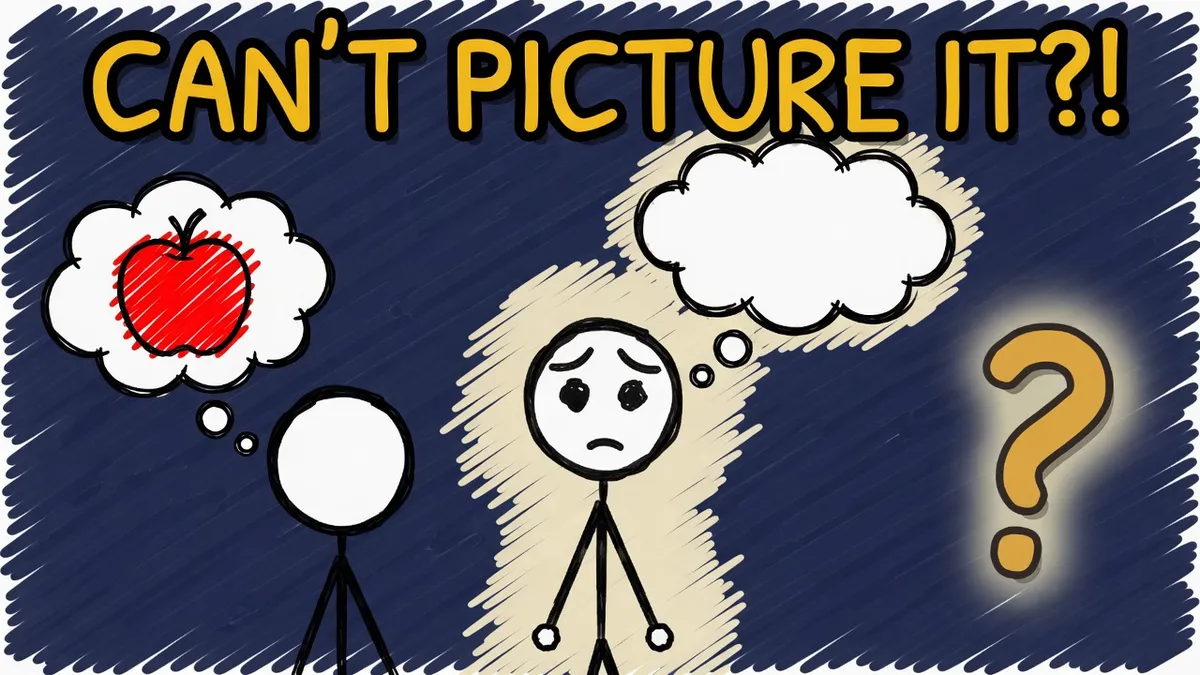
Try this right now. Close your eyes and picture an apple, a real one, sitting on a table in front of you. For most people, an apple obligingly appears: red skin, the little dimple at the top, maybe a glint of light on the curve. You can even spin it around. But for a sizeable minority of people reading that exact same instruction, absolutely nothing happens. No apple. No colour. No picture at all, just the dark behind their eyelids and a flat, wordless sense of what an apple is. And here's the genuinely strange part: until about ten years ago, neither group had any idea the other one existed.
01 · The blankSome people see nothing at all
We so casually say “picture it in your mind” that most of us assume everyone can. They can’t. Some people have no mind’s eye whatsoever. Asked to visualise a beach, or a loved one’s face, or that apple, they get exactly zero image. They still know everything about the apple: that it’s red, roughly round, sweet, that it grows on trees. The knowledge is all there. What’s missing is the picture. It’s the difference between remembering a fact and actually seeing it play out behind your eyes, and for these people, the seeing simply never comes.
02 · The nameIt's called aphantasia
In 2015, a neurologist named Adam Zeman finally gave this a name: aphantasia. He borrowed Aristotle’s word phantasia, the mind’s eye, and stuck the Greek “a-” in front, for “without.” A blind mind’s eye. And it is not some vanishingly rare curiosity. Estimates vary with how strictly you define it: complete absence of imagery runs at roughly 0.7 to 1% of people, but if you include weaker, patchier imagery, something like 3 to 4%, about one in twenty-five, have it to some degree. That’s at least one person in almost every room you’ve ever been in, quietly nodding along to “picture this” and picturing nothing.
03 · The first to askGalton and the breakfast table
The first person to even think to ask was Francis Galton, back in 1880. He mailed out a survey asking people to picture their breakfast table from that morning and rate how vivid the image was, a study now often called the first psychological questionnaire. The replies stunned him. Some described the scene as sharp and colourful as a photograph. Others insisted the whole notion of a “picture in the mind” was nonsense, a mere figure of speech, that they had nothing of the sort. Same simple question, wildly different inner worlds, and a century before anyone had a word for it.
04 · The spectrumAll the way up to hyperphantasia
Because it turns out this is a whole spectrum, not two camps. At one end, aphantasia: no image at all. In the broad middle, most of us: a decent but slightly hazy, flickery picture that won’t quite hold still. And at the far other end, hyperphantasia, people whose mental images are so intense and detailed they can be almost as vivid as actually seeing the thing in the room. Two people can say “yes, I can picture an apple” and mean experiences that are worlds apart in richness.
05 · The obvious objectionIsn't this just words?
At which point a fair, stubborn doubt appears. Isn’t this just people describing the same experience with different vocabulary? Maybe we all see the same faint apple, and some folks are simply being modest, or literal, about how “real” it looks. It’s a genuinely reasonable worry: self-reports about private experience are notoriously slippery. So researchers went looking for a way to test the difference without relying on anyone’s description at all. And they found not one but two.
Your pupils can rat you out. Imagining a bright light makes most people's pupils shrink automatically, reacting to a light that isn't there. In aphantasics, they barely budge. And you cannot fake a pupil.
06 · Proof oneThe pupil doesn't lie
When you look at something bright, your pupils shrink. That’s an old, involuntary reflex. The beautiful finding, from a 2022 study by Kay, Keogh and colleagues, is that the reflex also fires on imagined brightness: when most people merely picture a blazing white light or the sun, their pupils constrict a little, automatically, responding to a brightness that exists only in the mind. When people with aphantasia try the very same thing, their pupils barely move. And a pupil is a reflex, running completely outside conscious control. You can’t decide to make it react, and you can’t fake it for a lab. So the difference shows up in a muscle you don’t even own the keys to.
07 · Proof twoThe story that makes you sweat
The second test is, if anything, better. Read someone a frightening story in the dark, a hand slowly closing around their ankle. In most people the body reacts before the story’s even over: their skin starts to sweat, measurably, because they’re picturing it and the picture feels dangerous. Read that exact same story to someone with aphantasia, and their sweat response stays almost flat. Crucially, the same aphantasics do react normally when shown genuinely scary images with their eyes, so it isn’t that they feel less. It’s that, with nothing but words to go on, there’s no picture in their head for the body to panic about.
08 · The twistThey still dream in pictures
Now here’s the part that genuinely bends the mind. Ask people with aphantasia about their dreams, and many say the same thing: at night, they dream in full, vivid pictures. So the image-making machinery is clearly all there, fully working. It just won’t come when called. Aphantasia, it seems, is about voluntary imagery: summoning a picture on purpose. That one deliberate switch is the part that’s missing. Asleep, when the brain’s involuntary networks take over, the images pour in on their own. (It isn’t universal: some aphantasics report fewer or dimmer dreams too, but the split between “can’t summon” and “can still dream” is the striking pattern.)
09 · Beyond picturesA whole silent cinema
And for a lot of people it goes further than sight. Many aphantasics also can’t replay a favourite song in their head, can’t summon the smell of the sea or the taste of a lemon from memory. The whole private cinema, sound, smell, taste and all, is simply dark and quiet. Which sounds bleak from the outside, but it usually isn’t from the inside. That leads to the most important thing to understand about all of this.
10 · Not brokenA dark mind is not an empty one
Please don’t read any of this as broken, because it emphatically isn’t. Most people with aphantasia sail through their whole lives never noticing, assuming “picture it in your mind” was just something people said, the way we say we’re “starving.” They remember, they reason, they solve problems, they create. One of the people who discovered he had it, floored by it in his thirties, had already helped co-create the web browser Firefox. Blake Ross, who went public about it in 2016 and made the whole phenomenon click for thousands of others. A mind without pictures is not a mind without power.
11 · The payoffTwo worlds, one sentence
So sit with the real answer. Some people can’t picture anything not because anything’s wrong, but because the specific ability to conjure images on demand just isn’t part of their equipment, even though, asleep, the same brain paints in full colour. Two people can read the identical sentence, “picture an apple”, and live in completely different universes. One is holding a bright red apple in a private little theatre. The other is sitting in a calm, wordless dark. And for almost all of human history, neither one had the faintest idea the other was even possible.
The animated version
Same answer, told as a little animated story with the strange little stickman acting it out. Dry, quick, and, obviously, correct.
Quick questions
What is aphantasia?
Aphantasia is the inability to voluntarily create mental images, a 'blind mind's eye.' Someone with it can be asked to picture an apple and experience no picture at all, only a factual, wordless sense of what an apple is. The term was coined in 2015 by neurologist Adam Zeman.
How common is aphantasia?
Estimates vary with how you define it. Complete absence of visual imagery is rare, around 0.7 to 1% of people, but if you include weaker imagery, roughly 3 to 4% (about 1 in 25) have it to some degree. So it's uncommon at the extreme, but not remotely a freak condition.
Is aphantasia real or just people describing things differently?
It's real, and there are involuntary tests to prove it. Imagining a bright light makes most people's pupils constrict automatically, aphantasic pupils barely react. And reading a frightening scenario spikes most people's skin sweat via mental imagery, while aphantasics stay much flatter. You can't fake a pupil reflex.
Do people with aphantasia dream in pictures?
Often, yes, and that's the twist. Aphantasia concerns voluntary imagery, the kind you summon on purpose. During sleep the brain's involuntary networks take over, so many aphantasics report vivid, picture-filled dreams even though they can't call up a single image while awake. (It varies: some report fewer or dimmer dreams.)
Is aphantasia a disorder or a problem?
No. It's a variation, not a deficit. Most people with aphantasia go through life never noticing, assuming 'picture it in your mind' was just a figure of speech. They remember, reason and create perfectly well. Blake Ross, a co-creator of Firefox, only discovered his in his thirties.
How do you test for aphantasia?
The classic self-report tool is the VVIQ, the Vividness of Visual Imagery Questionnaire (David Marks, 1973), which asks you to rate how vivid your mental images are. The quick informal version is simply: close your eyes, picture an apple, and notice whether you see anything at all.
How do I know if I have aphantasia? The 'apple test'
Close your eyes, try to picture an apple, and rate what you see on a scale of 1 to 5, from a perfectly clear, vivid, rotatable apple (1) to no image at all, only the abstract knowledge that an apple exists (5). People who land on 'nothing there' likely sit on the aphantasia spectrum. This is the informal apple test, a rough self-check rather than a diagnosis; the formal questionnaire is the VVIQ. If you're unsure, it's worth talking to a clinician, though for most people it needs no treatment at all.
What is hyperphantasia?
It's aphantasia's mirror image: mental imagery so intense it can almost rival actually seeing. Ask a hyperphantasic to picture an apple and they get a bright, detailed, spinnable one, sometimes down to the glint of light on the skin. It was named by the same Exeter team that coined 'aphantasia,' and estimates put it at roughly 3 to 6% of people depending on where you draw the line, one large international sample landed near 6%.
Can aphantasia be cured or developed?
There's no established cure, and for most people it isn't something that needs curing. A few small studies (including imagery-training work at the University of Plymouth) hint that targeted practice can nudge vividness upward for some people, but results are inconsistent and it's early days, treat 'you can train it back' as a hopeful maybe, not a settled fact. Congenital aphantasics have usually never had voluntary imagery in the first place, so there's nothing to switch back on.
What causes aphantasia?
For most people it's congenital, present from birth, and it appears to run in families, which hints at a genetic component, though no clear genes have been pinned down and at least one study found no significant genetic link, so this is genuinely unsettled. A smaller group acquire it later, after brain injury, stroke or occasionally psychological trauma. Brain-imaging points to weaker communication between the front of the brain and the visual networks, but the full mechanism is still being worked out.
Is aphantasia linked to autism?
There's a modest statistical overlap. Several studies, including Zeman's, find aphantasics report somewhat more autistic traits on average, and autistic people score a little lower on imagery vividness. But it's a weak, tentative association, not a rule: most aphantasics aren't autistic and most autistic people aren't aphantasic. Hold it loosely.
Does aphantasia affect memory?
Often, a little. Aphantasia is linked on average to weaker autobiographical memory, recalling your own past can feel more like knowing facts about it than reliving it, and some aphantasics report trouble recognising faces too. The effects are real but modest and not universal, and the evidence is still mixed (some studies find broader memory differences, others find the face-recognition link is small). It doesn't touch general intelligence or factual knowledge.
Which famous people have aphantasia?
Plenty, often in famously visual jobs. Ed Catmull, co-founder of Pixar, has said 'my mind's eye is blind' and found other aphantasic animators at the studio. Craig Venter, who led the first sequencing of the human genome, has it. So does Blake Ross, co-creator of Firefox, whose 2016 essay brought the whole phenomenon to a wide audience. Fair proof that a blank mind's eye is no bar to a wildly creative one.
Take the quiz on this
A quick 4-question check on what you just read. Get them right to earn XP: no points for just scrolling.
Our sources 14 checked
// every claim on this page was checked before it went up