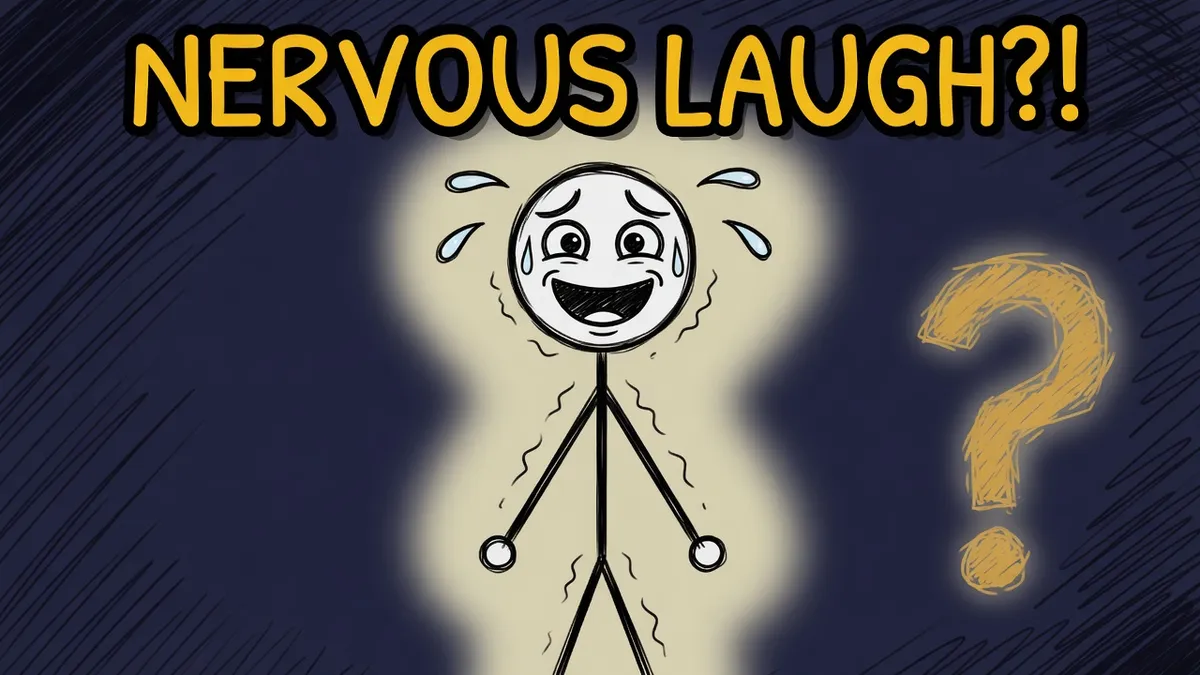
Here is a small betrayal your own face is capable of. Someone delivers genuinely bad news, or you watch a person take a nasty tumble, or a doctor lowers their voice to say something serious, and you feel, rising up from somewhere you didn't authorise, the horrible urge to laugh. Not because any of it is funny. It clearly isn't. And yet the giggle is right there, straining against your teeth, arriving at the single worst possible moment. So what is going on? Why does the brain answer fear and tension with something that looks, from the outside, exactly like joy?
01 · The evidenceIt's real, and it shows up under pressure
Start with the fact that this is a genuine, documented thing, not a personal defect. Some of the clearest evidence comes from one of psychology’s most infamous experiments. In Stanley Milgram’s 1963 obedience study, participants were pushed into acute moral distress, pressured to deliver what they believed were painful shocks to another person. They sweated, trembled, dug their nails into their palms. And 14 of the 40 subjects broke into nervous laughter, some of it so intense it looked bizarre and out of place. Nobody in that room found anything funny. The laughter was the sound of a nervous system with more tension than it could hold.
02 · The misunderstandingLaughter was never really about "funny"
The first thing to unlearn is the assumption that laughter means amusement. It mostly doesn’t. When the psychologist Robert Provine eavesdropped on more than a thousand real-world laughs, he found that the overwhelming majority followed utterly mundane remarks, “okay, see you later,” not punchlines. Laughter, it turns out, is primarily a social signal, a way of managing connection and easing tension between people, and only occasionally a reaction to something clever. Once you see laughter as a social and emotional tool rather than a humour-meter, the nervous version stops being a paradox. It’s just that tool being reached for at a moment of stress rather than delight.
03 · The regulationA release valve for a feeling that's too big
So what is the tool doing when you’re nervous? The leading account is emotional regulation. When a feeling, fear, embarrassment, grief, tension, swells past the level you can comfortably carry, the brain looks for a way to bleed off some of the pressure, and laughter is one of its fastest options. On this view the nervous laugh isn’t a misfire at all; it’s a coping response, a way of discharging a spike of emotion so you can keep functioning in the moment. It’s why the laugh gets stronger precisely when the situation gets more unbearable, and why it so often arrives paired with a wave of relief.
The brain may be doing something stranger than venting: deliberately firing the opposite expression to yank an overwhelming feeling back down, the very same trick that makes people cry when they're happy.
04 · The oppositeWhy joy makes you cry and fear makes you laugh
This is where a fascinating line of research comes in. Yale psychologist Oriana Aragón has studied what she calls dimorphous expressions, the odd cases where people show one emotion while plainly feeling another. Think of wanting to squeeze something unbearably cute, or bursting into tears at a wedding, or, yes, laughing when you’re terrified. Aragón’s evidence suggests these aren’t random glitches but a form of self-correction: when an emotion runs too hot, the brain deploys the expression of its opposite to help level things out and bring you back to balance. If that’s right, then crying at good news and laughing at bad news are two versions of the same mechanism, an emotional thermostat, overshooting on purpose to cool you down. It’s worth stressing this is a leading interpretation rather than the final word, but it’s a strikingly good fit for the nervous laugh.
05 · The false alarmA deeper, and more speculative, idea
There’s a bolder theory about where laughter came from in the first place. In 1998, the neuroscientist V.S. Ramachandran proposed that laughter evolved as an “all clear” signal. The logic: our ancestors needed alarm cries to warn the group of danger, but they’d also need a signal to cancel a false alarm, to announce that the snake was only a stick and everyone could relax. Laughter, he suggested, is that “never mind, no real threat” broadcast, which is why it’s loud, sudden, and catches on across a group. It’s an elegant idea, and it dovetails neatly with why we laugh at a startle that turns out fine, or at someone’s harmless pratfall. But it’s important to be honest here: this is a hypothesis, published in a journal literally called Medical Hypotheses, not an established fact. File it under “plausible and unproven.”
06 · The wiringWhy you can't just stop it
Whatever laughter is for, the reason a nervous one escapes before you can catch it comes down to plumbing. Laughter isn’t controlled by a single switch. Your brain runs it on two largely separate pathways: a voluntary one, based in the frontal cortex, that you use to produce a polite social chuckle on cue, and an involuntary, emotional one, routed through the older limbic system and brainstem, that fires spontaneously when feeling takes over. A genuine, unstoppable laugh comes up through that second, emotional route, which is exactly why willpower struggles against it. The nervous laugh at the worst possible moment is that involuntary circuit tripping, reacting to your internal state faster than the sensible, deliberate part of you can intervene.
07 · The payoffSo why do you laugh when you're nervous?
Because laughter was never really the language of joy: it’s the language of managing feeling, and of telling the people around you where things stand. When stress or fear or sheer emotional overload builds past what you can hold, the brain reaches for its fastest release valve and vents the surplus as a laugh, possibly, if the dimorphous-expression idea holds, by firing the exact opposite of what you feel to pull you back to level. It runs up an involuntary circuit older than language, faster than restraint. So the giggle at the funeral, the snort when someone falls, the grin when the news is grim: none of it means you’re heartless or broken. It means your brain, handed more emotion than it could carry, did the most human thing available: it laughed, so you could cope.
Quick questions
Why do I laugh when I'm nervous?
The leading explanation is emotional regulation. When anxiety, tension or fear builds beyond what you can comfortably process, your brain releases some of it as laughter, a fast, involuntary pressure valve. It doesn't mean you find the situation funny; the laugh is your nervous system trying to bring an overwhelming feeling back down to a manageable level.
Is nervous laughter normal?
Yes, it's very common and not a sign that anything is wrong with you. It's a recognised coping response to stress and awkwardness, and it's been documented in classic psychology experiments. Most people do it at least occasionally, particularly in high-tension or emotionally confusing situations.
Why do I laugh at funerals, bad news or other inappropriate moments?
Because those moments load you with intense, hard-to-process emotion, and laughter is one of the ways the brain discharges it. The 'wrongness' of the moment is exactly the point: the bigger the mismatch between how you feel and how you're supposed to act, the more likely a nervous laugh is to slip out. It's a release, not a verdict on the situation.
Can you stop nervous laughter?
You can dampen it but rarely switch it off on command, because it's driven partly by an involuntary emotional pathway. Techniques that help include slow breathing, naming the feeling to yourself, briefly pausing before you respond, or a small physical grounding action. But since the reflex can fire before conscious control catches up, occasional slips are normal and not something to be ashamed of.
Why do I laugh when I'm being told off or in an argument?
High-stress confrontations flood you with adrenaline and social threat, and nervous laughter is a common release under that pressure. It can also serve as an unconscious appeasement signal, an attempt to defuse the tension or show you're not a threat. Unfortunately it often reads as mockery, which is why laughing during a telling-off tends to backfire even though you can't fully help it.
Is nervous laughter a sign of anxiety?
It can accompany anxiety, but on its own it isn't a diagnosis of anything. It's a normal stress response that most people show sometimes. It's only worth discussing with a professional if it's frequent, distressing, feels genuinely uncontrollable, or clearly clashes with your actual mood, which can occasionally point to a separate neurological cause.
What is the 'false alarm' theory of laughter?
It's a hypothesis proposed by neuroscientist V.S. Ramachandran in 1998. The idea is that laughter evolved as an 'all clear' signal: when something looks alarming but turns out to be harmless, a stick you mistook for a snake, laughter tells the group there's no real danger. It's an elegant, widely cited idea, but it remains a speculative theory rather than an established fact.
Why do people laugh when someone falls or gets hurt?
A few things overlap. There's often a jolt of alarm followed by relief that no one's seriously hurt, which can trip laughter, consistent with the 'false alarm' idea. There's also incongruity: a sudden, absurd break from what you expected. And in a tense moment, laughter can be a nervous discharge rather than genuine cruelty, even though it can look unkind.
Is laughing when nervous a defense mechanism?
In everyday terms, yes, it's frequently described as a defence mechanism that protects you from being overwhelmed by anxiety in a difficult moment. Psychologically, it works as a form of emotion regulation, letting you keep functioning under stress. The label 'defence mechanism' is a useful description rather than a precisely measured mechanism, but the protective, tension-releasing role is well recognised.
Why do some people cry when they're happy?
It appears to be the same underlying quirk as nervous laughter, running the other way. Yale psychologist Oriana Aragón calls these 'dimorphous expressions', showing one emotion's expression while feeling another. Her research suggests the brain sometimes fires the opposite reaction to help rein in an overwhelming feeling, which is why intense joy can produce tears and intense stress can produce laughter.
What is it called when you can't stop laughing or crying involuntarily?
When laughing or crying becomes genuinely uncontrollable and disconnected from how you actually feel, it may be a neurological condition called pseudobulbar affect (PBA). It's caused by damage or disease affecting the brain pathways that regulate emotional expression, and is seen with conditions like stroke, MS, ALS, Parkinson's and brain injury. It's distinct from ordinary nervous laughter and is worth medical assessment.
Do animals laugh when they're nervous?
Great apes and even rats produce laughter-like sounds during play and tickling, so the raw machinery for laughter is ancient and shared. Whether any animal laughs specifically out of nervousness, however, isn't established. That particular use of laughter is essentially undocumented outside humans, so it's best treated as an open question.
Why is laughter contagious?
Laughter is fundamentally a social signal, and hearing it tends to prime you to join in, a bonding mechanism that spreads through a group. Research by Robert Provine found that most everyday laughter isn't a response to jokes at all but follows ordinary conversation, underlining that its main job is social connection rather than humour. That social, catching quality is part of why a nervous laugh can ripple around a tense room.
Take the quiz on this
A quick 4-question check on what you just read. Get them right to earn XP: no points for just scrolling.
Our sources 10 checked
// every claim on this page was checked before it went up