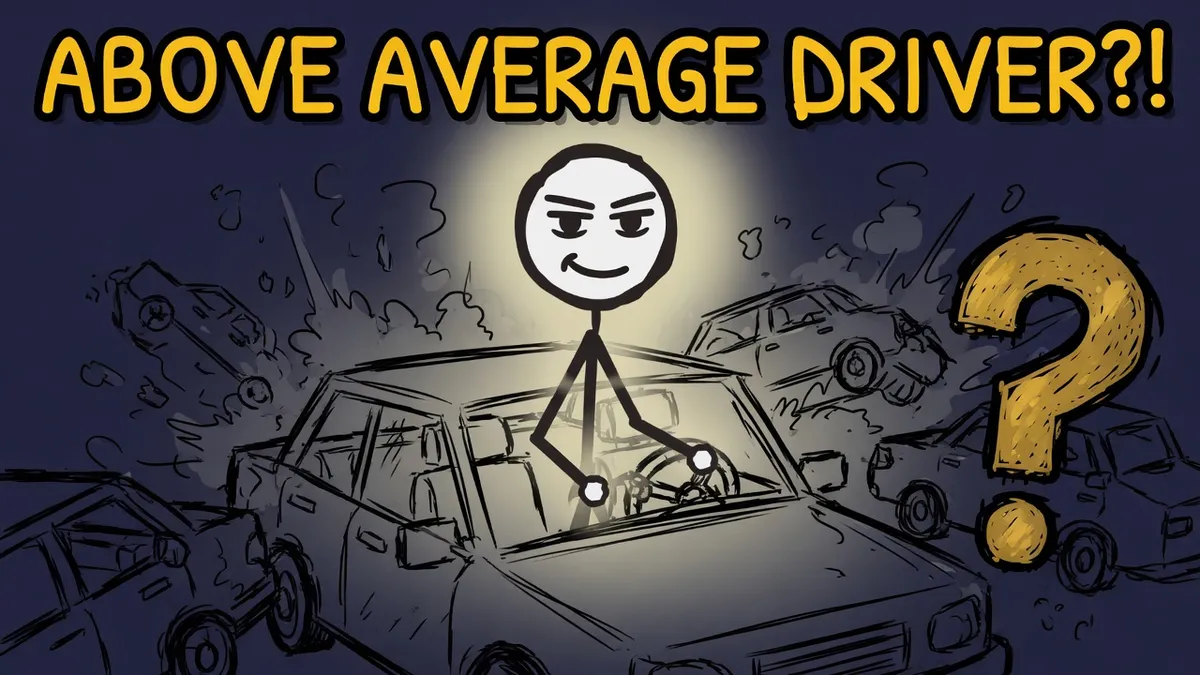
Ask a room full of people to raise a hand if they're an above-average driver, and almost every hand goes up. It feels reasonable: you've never caused a serious crash, you keep your distance, you're the calm one when everyone else is being an idiot. The trouble is that everyone else in the room is thinking exactly the same thing. And they can't all be right. In a famous survey, more than nine in ten drivers put themselves in the safer, more skillful half of the road, a claim that, for more than about half of them, is simply not possible.
01 · The numberThe maths that can't add up
The classic evidence comes from a Swedish psychologist named Ola Svenson, who in 1981 asked students in the United States and Sweden to rank themselves against the other drivers in the study. The results are the kind you remember. Among the American participants, 93% rated themselves in the top 50% for driving skill; 88% put themselves in the safer half. The Swedish figures were lower but still lopsided, 69% for skill, 77% for safety. Sit with that for a second. A group in which more than nine out of ten people are in the top half is not a group; it’s a contradiction. By the plain meaning of “the middle,” only about half of any set of people can be above it. The rest are, definitionally, below.
02 · The nameThe better-than-average effect
This isn’t a driving quirk. It’s one of the most reliable findings in psychology, and it has a name: the better-than-average effect, also called illusory superiority or, more fondly, the “Lake Wobegon effect”, after Garrison Keillor’s fictional town where “all the children are above average.” Ask people to rate themselves on almost any positive, comparative trait, intelligence, honesty, health, how well they get on with others, and the average self-rating drifts up above the midpoint. Driving is just the most quoted example because the impossibility is so stark and the stakes are two tonnes of metal.
03 · The whyYou know yourself; you're guessing about everyone else
So why does the brain do it? The most persuasive explanation, worked out by Justin Kruger in 1999, is almost embarrassingly simple: egocentrism. When you’re asked to compare yourself to “the average driver,” you have a rich, detailed, first-person sense of your own driving, every careful merge, every time you let someone in. But “the average driver” is a vague grey blob you can barely picture. So the comparison quietly collapses into a judgement of yourself, and since you’re competent enough at an everyday task, you come out ahead. Two other things pile on. “Good driver” is gloriously undefined, so you can lean on whatever you happen to be good at. And driving gives you almost no honest feedback: the near-misses you caused rarely send you a report card.
04 · The flipNow watch it run in reverse
Here’s the part that turns the whole thing from “people are vain” into “the brain has a specific, predictable bug.” If the effect were just ego, it would push everyone above average at everything. It doesn’t. Ask people to rate themselves at genuinely hard things, computer programming, telling a joke that lands, drawing, and the numbers invert. Now most people rate themselves below average. Kruger called this the “below-average effect,” and it’s the same egocentrism seen from the other side: on a hard task, you’re painfully aware of your own struggle and still barely thinking about how badly everyone else is doing too. The bias isn’t “I’m great.” It’s “I’m mostly thinking about me.”
The exact same mental shortcut that makes you an above-average driver makes you a below-average juggler, not because your skills differ that way, but because your brain forgets, in both cases, to actually look at everyone else.
05 · The mix-upNo, this isn't the Dunning-Kruger effect
Almost everyone reaches for “Dunning-Kruger” here, and almost everyone is wrong to. The driving illusion is the broad better-than-average effect: nearly everyone nudges themselves up a bit. The Dunning-Kruger effect is a much sharper, separate claim, that the least skilled overrate themselves the most, because the very skills you’d need to notice your own incompetence are the ones you’re missing. It’s a tidy idea, and in the original 1999 data the bottom performers really did overshoot wildly. But it’s now genuinely contested: several reanalyses argue the famous curve is largely a statistical mirage, regression to the mean plus the fact that everyone is a noisy self-judge, rather than proof that stupidity is self-concealing. Dunning maintains the pattern survives. The honest summary is that the driving fact is rock-solid, and the “too incompetent to know it” story stapled to it is much shakier than the memes suggest.
06 · The payoffSo why does everyone think they're above average?
Because when your brain sizes you up against “everyone else,” it isn’t really doing a comparison at all. It’s looking hard at the one driver it knows intimately, you, and squinting at a crowd it can barely see. On an easy, feedback-poor task with a fuzzy definition of “good,” that self-focus tips you over the line almost every time. The unsettling bit isn’t that people are arrogant; most of these self-ratings are honest. It’s that the feeling of being a solid, above-average driver is produced by the same machinery whether or not it’s true, which means the feeling itself tells you almost nothing. The genuinely above-average move is to distrust the verdict, go looking for the feedback you never get, and drive like someone who knows the maths.
The animated version
Same answer, told as a little animated story with the strange little stickman acting it out. Dry, quick, and, obviously, correct.
Quick questions
What is the better-than-average effect?
It's the tendency to rate yourself as better than the typical person on a given trait, a form of illusory superiority, also called the above-average effect or the 'Lake Wobegon effect,' after the fictional town where 'all the children are above average.' It shows up for driving, intelligence, honesty, health, and more. It becomes a paradox for comparative traits: since these are judged against a median, it's logically impossible for the large majority of people to be above the middle.
What percentage of drivers think they're above average?
In psychologist Ola Svenson's classic 1981 study, 93% of the American participants and 69% of the Swedish participants placed themselves in the top 50% for driving skill; for safety it was 88% (US) and 77% (Sweden). Later surveys keep finding similar things: the great majority of drivers consistently rate themselves as safer and more skilled than their peers.
Isn't it statistically impossible for most people to be above average?
For the median, essentially yes, by definition only about half of people can be in the top half. (Averages are slightly subtler: on a lopsided measure most values can sit above the arithmetic mean, as with income.) But driving-skill surveys ask people to rank themselves against other drivers, so 80 to 90% putting themselves in the top half is a genuine statistical impossibility, and a clean fingerprint of bias.
Why do people overrate their own driving specifically?
Several things stack up. 'Good driver' is vague, so you can weight whatever you happen to be good at (I'm calm / I've never crashed / I'm quick). You get very little honest feedback, near-misses rarely announce themselves. And most driving is genuinely easy most of the time, which is exactly the condition under which the better-than-average effect is strongest.
What is the egocentrism explanation?
Proposed by Justin Kruger in 1999: when you compare yourself to others, you focus almost entirely on your own ability, which you know in vivid detail, and barely factor in the comparison group, which you picture only fuzzily. On an easy task where you're competent, that self-focus makes you feel above average; on a hard task where you struggle, the same self-focus makes you feel below average.
Do people ever rate themselves as below average?
Yes, reliably, on hard or rare skills. Kruger's 1999 work found people rated themselves below the median at things like computer programming, telling jokes well, and drawing. This 'worse-than-average effect' is the mirror image of the driving illusion, and it appears whenever a task feels difficult for almost everyone.
Is this the same as the Dunning-Kruger effect?
No, and the two get muddled constantly. The better-than-average effect says nearly everyone overrates themselves a bit. The Dunning-Kruger effect makes a sharper claim: that the least skilled overrate themselves the most, because the skills you'd need to spot your own incompetence are the very ones you lack. Driving surveys show the broad better-than-average effect, not the specific Dunning-Kruger pattern.
Is the Dunning-Kruger effect real?
It's genuinely contested. Several analyses (Nuhfer and colleagues, 2016 to 2017; Gignac & Zajenkowski, 2020) argue the famous chart is largely a statistical artefact, a mix of regression to the mean and the fact that everyone is a noisy judge of themselves, rather than proof that incompetence specifically blinds you. David Dunning has responded that the miscalibration pattern still holds. Treat the crisp 'the dumb are too dumb to know it' version with real caution.
Does being confident make you a worse driver?
Not automatically, but over-confidence is linked to riskier choices. Drivers who most overrate their skill tend to report more speeding and risk-taking, and young men, a group with elevated crash rates, often show some of the largest gaps between confidence and record. Rating yourself highly isn't the danger; letting that rating license risky habits is.
Does the effect get weaker with experience or age?
It's stubborn. The better-than-average effect shows up across ages and cultures, though its size varies (Svenson found it far stronger in his American sample than his Swedish one). Interestingly, some studies suggest older and more experienced drivers still rate themselves highly even as certain reaction-based skills decline: the confidence doesn't track the ability very tightly.
Is thinking you're above average always a bad thing?
Not necessarily. A modest 'positive illusion' about yourself is common in mentally healthy people and can support motivation and resilience. The problem is specifically when inflated self-belief drives real risk, on the road, in money, in medicine, because there the gap between what you think and what's true can actually cost you.
How can you tell if you're overrating yourself?
You mostly can't from the inside, that's the trouble. The practical fixes are external: seek honest feedback, track objective outcomes rather than your gut sense, and notice the tell-tale conditions (an easy-feeling task, a vague yardstick, little feedback) where the bias thrives. Assuming you're probably a bit above-average-biased is, ironically, the more accurate stance.
Take the quiz on this
A quick 4-question check on what you just read. Get them right to earn XP: no points for just scrolling.
Our sources 11 checked
// every claim on this page was checked before it went up