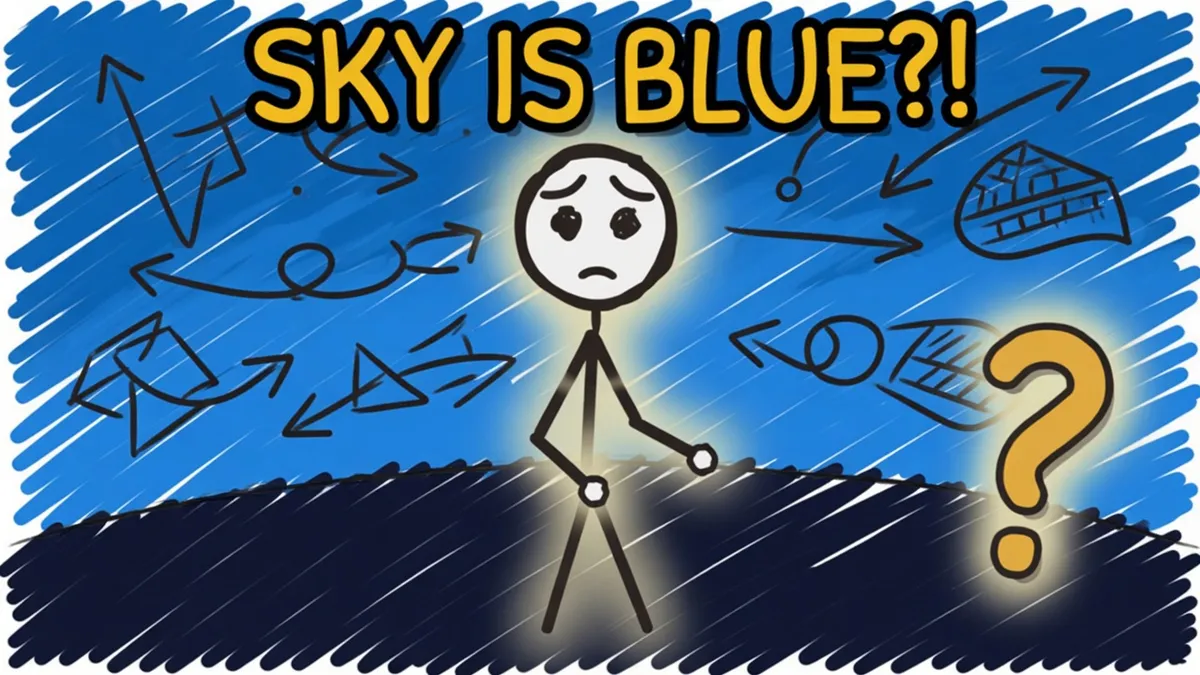
It's the classic child's question, the one that sounds simple until someone actually asks you to answer it. The sky is not painted blue. The air has no colour. Nothing up there is glowing blue on its own. And yet look up on a clear day and the whole enormous dome is drenched in it, corner to corner. The reason is a single trick of light happening in the empty air above your head, billions of times over, and it comes within a whisker of turning the sky violet instead.
01 · The setupWhite light is a disguise
Start with the Sun. Its light looks white, but white is a costume: it’s every colour of the rainbow travelling together, from long, lazy red waves to short, tight violet ones. A prism, or a raindrop, can pull them apart and show you the whole spread. So the light pouring down onto the atmosphere already contains all the blue you’ll ever see. The only question is why the sky sorts that light and hands your eye the blue.
02 · The real causeAir throws blue light around
Here’s the mechanism. The atmosphere is a thin ocean of gas, mostly nitrogen and oxygen molecules, each far tinier than a single wavelength of light. When sunlight streams through, it jostles these molecules and they re-radiate the light in all directions. That’s scattering. The crucial part is that scattering is wildly fussy about colour: the shorter the wavelength, the more violently it gets scattered. Blue light, being short, gets flung about far more than long, sluggish red light. So blue is peeled off the sunbeam and sprayed across the entire sky, and no matter which patch of sky you look at, scattered blue is arriving from it into your eye.
03 · The savage mathsOne over wavelength, to the fourth
Just how lopsided is this? Lord Rayleigh worked it out in the 1870s, and the answer is brutal. The amount of scattering rises as one over the wavelength to the fourth power. Blue light has a wavelength roughly 1.7 times shorter than red, and 1.7 raised to the fourth power is about ten. So blue is scattered on the order of ten times more strongly than red. That single exponent is the whole reason the sky is a bold, saturated blue rather than a faint, washed-out lilac. Nature rarely hands you a clean number like this, and here it’s doing almost all the work.
04 · The near missWhy it isn't violet
Now the part almost nobody knows. If shorter wavelengths scatter more, and violet is shorter than blue, then by rights the sky should be violet. So why isn’t it? Three things gang up to rescue the blue. First, the Sun simply puts out less violet light than blue, so there’s less of it to scatter. Second, and more importantly, your eyes are far less sensitive to violet: the colour-detecting cones in your retina barely register it. Third, a chunk of the incoming violet is absorbed high in the atmosphere before it ever gets to you. Between the weaker source and your own unresponsive eyes, all that heavily scattered violet gets quietly outvoted, and the sky settles on blue. The sky is blue partly because of physics and partly because of the peculiar wiring of the human eye.
The sky isn't reflecting the sea, and the sea isn't reflecting the sky. They're both blue for entirely separate reasons, one by scattering blue and one by absorbing red, and neither one causes the other. It's one of nature's great coincidences hiding in plain sight.
05 · The sunsetSame trick, run long
The best proof of all this is the sunset, because it’s the exact same physics turned inside out. At noon the Sun is overhead and its light punches straight down through the thinnest slice of atmosphere. But at sunset the Sun sits low on the horizon, and now its light has to skim sideways through a vastly longer path of air to reach you. Over that long haul, the scattering that gives you a blue noon runs to completion: nearly all the blue is scattered away sideways, out of your line of sight, long before the light arrives. What limps through to your eye is the leftover, the oranges and reds that scatter least. So the red sky at sunset and the blue sky at noon are the same effect, just measured at different distances.
06 · The white daysWhy haze kills the blue
If air scatters blue so beautifully, why is a muggy or polluted sky a flat, colourless white? Because the selectivity only holds when the scattering particles are much smaller than a wavelength, like clean air molecules. Load the air with bigger stuff, water droplets in haze and cloud, dust, smog, and those larger particles scatter all colours about equally. Light bounced back at you in a full mix of colours looks white. That’s why a clear, dry day gives the deepest blue, and a humid or hazy one bleaches the sky pale. The blue is a sign of clean, fine air.
07 · The other skiesBlack Moon, butterscotch Mars
Want to be sure the air is doing this and not something further out in space? Leave the air behind. On the Moon, which has essentially no atmosphere, the daytime sky is jet black even with the Sun blazing, because there are no molecules to scatter the light and hand it to your eye. Mars, with its thin, dusty air, scatters light differently again and wears a pale butterscotch or pinkish sky by day, and, wonderfully, glows blue near the Sun at sunset, the mirror image of Earth. Change the air and you change the colour of the sky. That’s the whole case, written across the Solar System: the blue isn’t out there in space, it’s made right here in the air over your head.
08 · The payoffSo why is the sky blue?
Because sunlight is secretly every colour, and the air is a sieve that flings the blue ones around hardest. Countless molecules of nitrogen and oxygen scatter short blue wavelengths ten times more fiercely than long red ones, filling the whole dome with blue light that arrives at your eye from every direction. It very nearly comes out violet, and would, if the Sun were a touch different or your eyes a touch keener, but the blue wins. Next time a child asks, you can tell them the truth: the sky is blue because the air is quietly sorting sunlight, and your own eyes cast the deciding vote.
Quick questions
Why is the sky blue in simple terms?
Sunlight looks white but is really a blend of all colours. When it enters the air, it bumps into countless tiny molecules of nitrogen and oxygen. These molecules scatter blue light much more strongly than red, so blue gets bounced all over the sky. Everywhere you look, some of that scattered blue is heading toward your eye, and the whole dome looks blue.
What is Rayleigh scattering?
It's the scattering of light by particles much smaller than the light's own wavelength, like the gas molecules in air. The key fact is how steeply it depends on wavelength: the amount of scattering rises as one over the wavelength to the fourth power. Because blue light has a much shorter wavelength than red, that fourth-power rule means blue is scattered roughly ten times more strongly, which is why the sky is blue and not red.
Why isn't the sky violet if violet has an even shorter wavelength?
Good catch, and it nearly is. Violet is scattered even more than blue. But two things pull the balance back: the Sun puts out less violet light than blue to begin with, and your eyes are far less sensitive to violet. Some of the violet is also absorbed high in the atmosphere. Add it all up and the mix of scattered light your brain receives reads as blue with a hint of violet, not pure violet.
Why does the sky turn red and orange at sunset?
Because of the angle. At sunset the Sun sits low, so its light skims through a far thicker slice of atmosphere to reach you than it does at noon. Over that long path almost all the blue and violet gets scattered away sideways, out of your line of sight, and what survives the journey to your eye is the leftover orange and red. The same scattering that makes noon blue makes sunset red.
Why is the sky sometimes white or grey instead of blue?
Because of bigger particles. Clean, dry air is full of tiny molecules that scatter blue selectively. But when the air holds larger particles, water droplets in cloud or haze, dust, pollution, those scatter all colours of light roughly equally. Light that comes back mixed in every colour looks white or grey. That's why an overcast or hazy sky loses its blue and washes out to pale.
Is the sky blue because it reflects the sea?
No, and it's a common mix-up. The two are unrelated, and in fact the sky was blue long before there was anyone by the sea to notice. The sky is blue because air scatters blue light toward you. The sea is blue for a completely different reason: water itself absorbs red light. If anything the influence runs the other way, since a calm sea can mirror the blue sky, but neither one causes the other.
What colour is the sky on the Moon or Mars?
On the Moon, black, even in daytime, because there's essentially no atmosphere to scatter sunlight, so there's nothing to make a blue sky and the Sun just glares against black. Mars is stranger: its thin, dusty air scatters light differently, giving a butterscotch or pinkish daytime sky, and famously the Martian sunsets glow blue near the Sun, the reverse of Earth. It's a neat proof that the sky's colour is made by the air, not the space beyond it.
Why is the sky darker blue high on a mountain or from a plane?
Because there's less air above you. The blue of the sky is built up by sunlight scattering off air molecules, so the more atmosphere overhead, the more scattered blue (and haze) you see. Climb a mountain or fly high and much of that air is now below you, so there's less scattering and the sky deepens toward a darker, richer blue. Keep going to space and it turns black.
Does the sky have a colour of its own?
No. The air itself is essentially colourless and transparent. The sky has no pigment and emits no light. Its blue is borrowed entirely from the Sun: it's sunlight that has been redirected toward your eye by scattering. Switch off the Sun and the sky is simply dark. The blue is a process happening in the air, not a property of it.
Who first explained why the sky is blue?
The modern explanation was worked out in the 1870s by the British physicist Lord Rayleigh (John William Strutt), which is why the effect carries his name. He showed mathematically that scattering by very small particles depends on the fourth power of wavelength, favouring blue. Later work by Einstein and others tied it precisely to scattering by the gas molecules of the air themselves.
Why is the sky blue and not violet, if violet light scatters even more?
Three reasons stack. The Sun puts out less violet than blue, human eyes are much less sensitive to violet, and some violet is absorbed high in the atmosphere. The mix that reaches you therefore reads as blue rather than purple.
Why is a cloudy or polluted sky white or grey instead of blue?
Larger particles such as water droplets and dust scatter all visible wavelengths roughly equally (Mie scattering). That washes out the blue preference of Rayleigh scattering by air molecules, so haze and cloud look white or grey.
Our sources 8 checked
// every claim on this page was checked before it went up