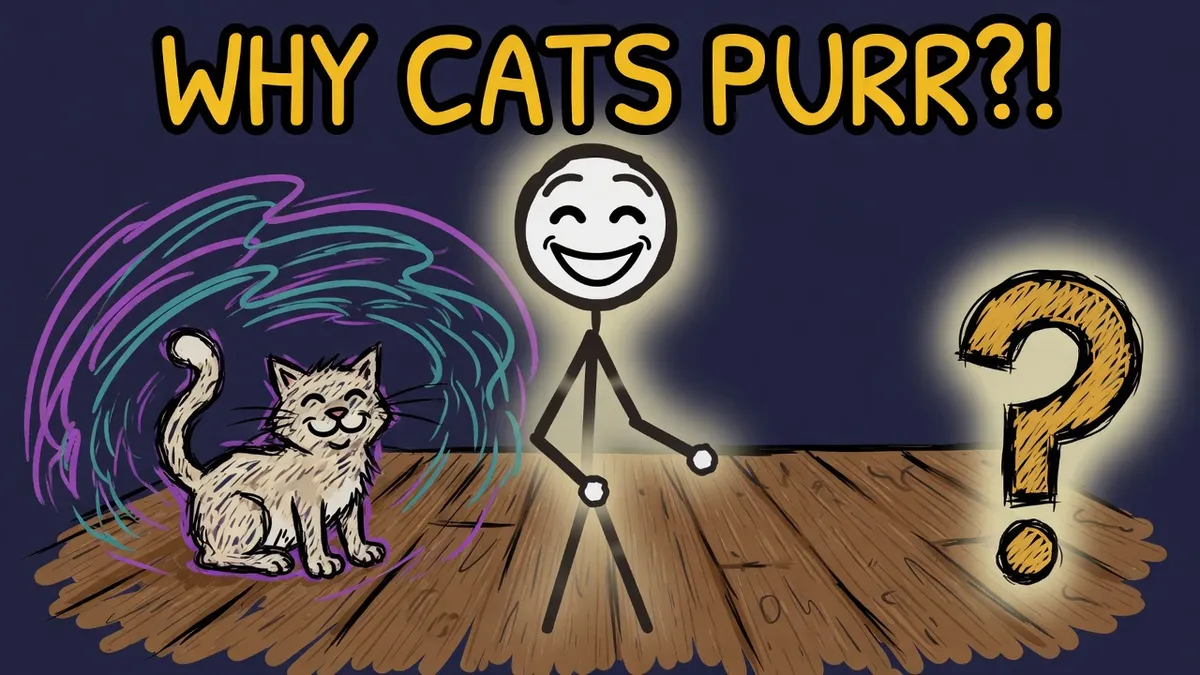
Here is a fact that quietly undoes everything you thought you knew about the friendliest sound in the house. A cat purrs on your lap, warm and happy, and you assume the purr simply means "content." But a cat also purrs when it is injured. When it is terrified at the vet. When it is giving birth. Sometimes when it is dying. A single sound that shows up in both bliss and agony is not a mood. It is doing a job, and biologists are still arguing about exactly what that job is.
01 · The machineHow a cat builds a purr
Start with the mechanism, because it is genuinely odd. The purr is made in the voice box. A little rhythm generator in the cat’s brain fires off bursts of signals to the muscles of the larynx, roughly 25 times a second, and those muscles snap the vocal folds together and apart at that speed. Air rushing past gets chopped into the rumble you feel more than hear. The clever part is that a cat purrs on the in-breath and the out-breath, which is why the sound can run on and on without a pause, like an engine idling. A meow only happens on the way out. A purr never stops for breath.
02 · The puzzleThe sound that shows up at the worst moments
If the purr just meant “happy,” the story would end there. It does not. Cats purr through fear, pain, illness, labour and the final hours of life. Vets hear it from cats that are clearly suffering. That is a real biological riddle: why would evolution wire the same signal into a cat basking in the sun and a cat in an emergency? The answer that fits both is that the purr is not mainly a message about mood at all.
03 · The leading ideaA cat comforting itself
The explanation that makes sense of all those situations is self-soothing. A purr may be a way for a cat to calm and steady itself, to regulate its own stress and breathing when things are frightening or painful, the way a person might hum or rock. Under that reading, the happy-lap purr and the vet-table purr are the same tool used for the same reason: to settle the animal producing it. The comfort you feel hearing it is almost a side effect. The cat is soothing the cat.
04 · The strangest theoryA sound that might mend bone
Now the part that sounds like a myth but is a real, if unproven, scientific idea. The purr lives in a low frequency band, roughly 25 to 150 Hz. Separately, researchers studying bone have found that gentle vibration in almost exactly that range can strengthen bone and speed healing. Put those two facts side by side and you get an irresistible hypothesis: that a cat, purring through injury and illness, might be running a kind of built-in physiotherapy on its own body. It would neatly explain the pain purr.
It is a lovely idea, and it is not proven. The frequencies match, but nobody has shown that a cat's own purr actually heals the cat. File it under fascinating maybe, not fact.
05 · The con artist purrThe cry hidden in the rumble
Cats have also learned to weaponise the purr against us. Researchers analysing house cats found that some mix a high, urgent, almost cry-like frequency into their purr when they want feeding. It is subtle, buried under the pleasant rumble, but it hooks into the same part of the human brain that snaps to attention at a baby’s wail. That is why a hungry cat’s purr at 6am feels physically difficult to ignore. Your cat is, in the gentlest possible way, running a manipulation routine tuned by thousands of years of living off humans.
06 · The mechanism reopensMaybe the throat does it alone
Just when the textbook seemed settled, a 2023 study reopened the whole question. Working with cat voice boxes, researchers found they could produce purr-like low tones with no ongoing signal from the brain at all, hinting that special pads in the vocal folds may let the tissue itself generate the frequency, closer to how humans make a low “vocal fry.” It does not throw out the muscle-twitch story so much as complicate it. The most familiar animal sound on Earth, and we are still working out how it is made.
07 · The payoffSo why do cats purr?
Because the purr was never really about happiness. It is a self-soothing signal an animal aims at itself, first learned as a newborn kitten pressed against its mother, and carried into every high-stress moment of a cat’s life: the fear, the pain, the birth, the end. It may double as a comfort broadcast to the humans a cat has chosen to trust, and, just possibly, as a low hum of self-repair whose frequencies happen to match the ones that mend bone. The next time a cat purrs on your chest, remember it is not only telling you it is content. It is running one of the oldest, oddest and least understood self-help routines in the animal kingdom, and letting you listen in.
Quick questions
How does a cat actually make a purr?
In the voice box (larynx). A rhythm generator in the brain fires bursts of signals about 25 times a second to the laryngeal muscles, which snap the vocal folds together and apart. Air passing through on both the in-breath and the out-breath gets chopped into the continuous rumble you hear.
Why can a cat purr non-stop while breathing?
Because the purr is made on both the inhale and the exhale, unlike a meow, which only happens on the out-breath. That two-way trick is why a purr can run on and on with no gaps.
Do cats only purr when they are happy?
No, and that is the whole mystery. Cats also purr when injured, ill, frightened, giving birth and even close to death. A sound that appears in both a lap-nap and a vet emergency clearly means more than 'I am content.'
Why would a hurt or scared cat purr?
The leading idea is self-soothing: purring may help a stressed or injured cat calm itself, steady its breathing, and cope. Some researchers also suspect the low vibrations could aid the body directly, though that part is unproven.
Can a cat's purr really heal bones?
It is a real hypothesis, not a settled fact. Purr frequencies sit in the 25 to 150 Hz range, and separate studies show vibration in that band can boost bone density and healing. Whether a cat's own purr meaningfully heals the cat is genuinely unproven, so treat 'cats heal themselves by purring' as a fascinating maybe, not a fact.
What is a solicitation purr?
It is a purr cats use to get fed. Researchers found that some house cats mix a high, urgent, almost cry-like frequency into their purr when they want food. It taps into the same nerve we react to in a human baby's cry, which is why a hungry cat's purr can feel weirdly hard to ignore.
Do big cats like lions purr?
Not the way house cats do. Broadly, cats that purr continuously (like domestic cats, cheetahs and pumas) tend not to roar, and the great roaring cats (lions, tigers) do not purr in the same sustained way. The anatomy of the voice box differs between the two groups.
At what age do kittens start purring?
Very early, within the first days of life. Kittens purr while nursing, and mother cats purr back, so the purr works as a close-range signal between a mother and her litter before the kittens can even see well.
Is purring voluntary or automatic?
Somewhere in between. It is driven by a rhythmic pattern generator rather than conscious, word-by-word control, which is why cats can purr so steadily. A 2023 study even showed cat voice boxes can produce purr-like tones without continuous brain input, suggesting the tissue itself does part of the work.
Why do cats purr when you stroke them?
Gentle contact and safety cues seem to switch on the same calming, bonding response that a nursing kitten shows. For a social, once-wild animal, a purr during friendly touch is both a comfort to the cat and a signal to you that it feels safe.
Do cats purr to communicate with humans on purpose?
Partly. The purr almost certainly evolved for cat-to-cat and mother-to-kitten signalling, but domestic cats clearly aim purrs at us too, especially the food-soliciting version. Living with humans has shaped how and when they deploy it.
Is purring ever a sign something is wrong?
It can be. Because cats purr when in pain or distress, a cat that purrs constantly while also hiding, off its food, breathing oddly or clearly unwell may be self-soothing through something serious. The purr is reassuring to hear, but it is not proof the cat is fine.
Take the quiz on this
A quick 4-question check on what you just read. Get them right to earn XP: no points for just scrolling.
Our sources 6 checked
// every claim on this page was checked before it went up