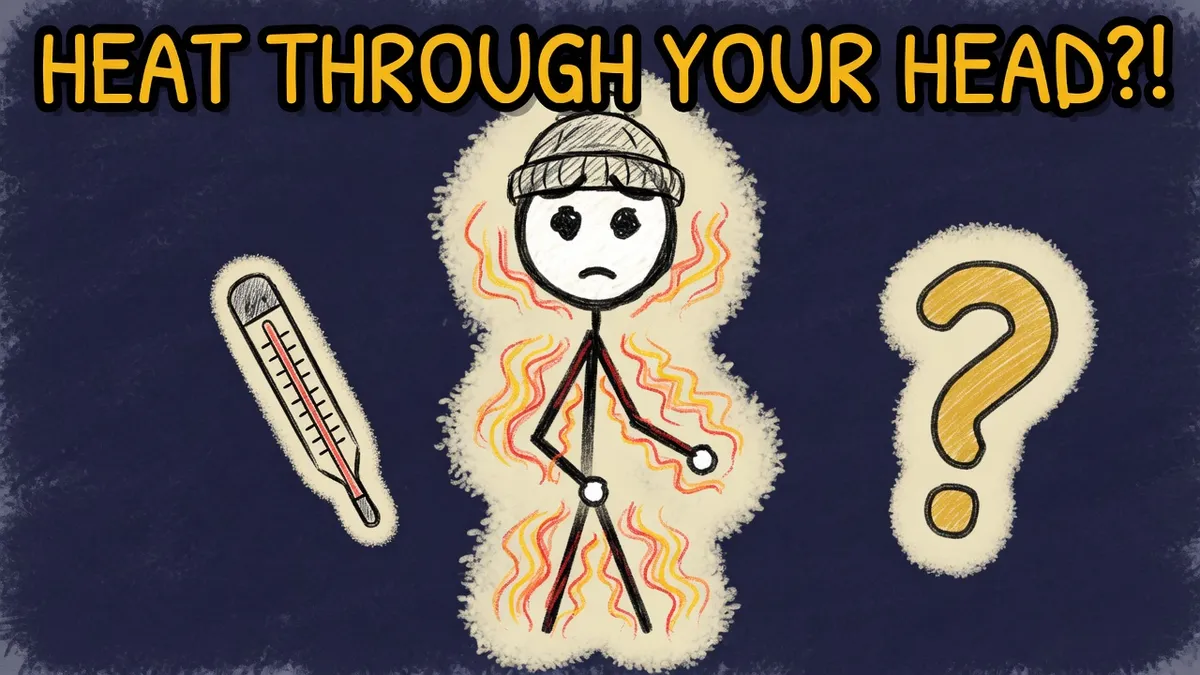
Put a hat on, your mother said, you lose most of your body heat through your head. It's one of the most repeated pieces of cold-weather wisdom there is, usually with a confident figure attached: 40, maybe 45 percent, streaming out of the top of your skull like heat off a radiator. It sounds scientific. It even comes with a whiff of military authority. And it's wrong, off by a factor of about five, and the reason it's wrong is a small masterclass in how a single badly-designed experiment can fool the world for decades.
01 · The simple physicsHeat leaves skin, everywhere
Start with how heat loss actually works, because it’s refreshingly straightforward. Your body sheds heat through exposed skin, and roughly in proportion to how much skin is exposed. A patch of bare arm loses heat at about the same rate as an equal patch of bare leg, or bare head. There’s no organ that acts as a special release valve. So the question “how much heat do you lose through your head” has a boring, geometric answer: however much of your total skin the head is. And your head is only about 7 to 10 percent of your body’s surface area. So you lose roughly 7 to 10 percent of your heat through it. Not 45. Not most. A modest slice, proportional to its modest size.
02 · The flawed experimentWhere 45% came from
So where did that dramatic 40-to-45-percent figure come from? It’s usually traced to a US Army survival manual, which in turn seems to rest on cold-weather experiments from the 1950s. And here’s the flaw that ruined everything: in those tests, subjects were dressed in full arctic survival gear, thick insulated suits covering their entire bodies, with only their heads left bare. Well, of course the head then accounted for a huge share of the heat loss. It was the only part not insulated. It’s like sealing every window in a house except one, measuring where the draught comes from, and concluding that window is magically draughty. The head wasn’t special. It was just the only thing left uncovered.
There's a beautifully simple test that exposes the myth instantly. If you genuinely lost 45 percent of your heat through your head, then going out in the cold wearing a warm hat and no trousers should keep you about as cosy as wearing trousers and no hat. Picture that for a second. It's obviously nonsense, you'd freeze from the waist down, because your legs are a far bigger patch of skin than your head. That thought experiment is the whole debunking in one image: heat loss follows surface area, and your head just isn't very much of it. Had those army subjects worn swimsuits instead of arctic suits, the head would have accounted for only about 10 percent, exactly as the geometry predicts.
03 · Why the hat still worksThe grain of truth
Now, the myth survives partly because hats genuinely do help, so it feels true. But the reason is mundane. When it’s cold, you wrap up, coat, scarf, gloves, trousers, and the one bit of skin you commonly leave bare is your head. So in practice, your uncovered head really is where a lot of your remaining heat is escaping, not because it’s special, but because it’s the only exposed skin left. Cover it and you plug your biggest remaining leak. But cover an equal patch of any other bare skin and you’d get exactly the same benefit. The hat isn’t sealing a magic radiator. It’s just covering the part you forgot.
04 · Why it feels so dramaticYour head is a drama queen
There’s one more reason the myth feels right in your body. Your head, face and neck are packed with temperature-sensitive nerves, far more than, say, your thighs. So when cold air hits your bare head, it feels intensely, urgently cold, and when you cover it, the relief feels enormous. That vivid sensation tricks you into thinking a huge amount of heat is involved. But sensation and physics are different things. Your head is loudly reporting the cold, not necessarily leaking more of it. It’s not that more heat is escaping there; it’s that your head is far better at complaining about it than your legs are.
05 · The one real exceptionBabies are different
Before you throw out the advice entirely, there’s a genuine exception worth knowing: babies. A newborn’s head is a much larger fraction of its total body than an adult’s, proportionally huge, so a baby really does lose a significant share of heat through the head, and struggles to regulate temperature besides. This is why hospitals put hats on newborns, and studies confirm insulated baby caps cut heat loss substantially. So the “cover the head” instinct isn’t useless; it’s just been over-generalised from the one group where it strongly applies (infants) to everyone, with a wildly inflated number attached.
06 · The payoffSo do you lose most of your body heat through your head?
No. You lose heat roughly in proportion to exposed skin, and your head is only about a tenth of you, so it accounts for about a tenth of your heat loss, not 45 percent, not “most,” nothing close. The famous figure was an accident, born of an experiment where the head happened to be the only bare thing on an otherwise bundled-up body. Wear a hat, absolutely, it covers real exposed skin, shields your ears and nose from frostbite, and feels wonderful. Just wear the coat and trousers too, because your head was never the secret escape hatch. It’s just the loudest, and the one you keep leaving out in the cold.
Quick questions
Do you lose most of your body heat through your head?
No. This is a myth. When the rest of your body is clothed, your head accounts for only about 7 to 10% of heat loss, roughly its share of your skin surface. It is not a special escape route for warmth.
What percentage of body heat is lost through the head?
For a clothed adult, around 7 to 10%. The famous 40 to 45% figure is wrong. That number came from studies where only the head was left uncovered, which exaggerated its share.
Where did the head heat loss myth come from?
It is usually traced to a US Army survival manual that claimed 40 to 45% of body heat escapes through the head. That in turn appears to rest on 1950s cold-weather experiments in which subjects wore arctic suits with only their heads exposed, so the head naturally lost the most heat.
Does wearing a hat keep you warmer?
Yes, but not because the head is magic. A hat helps because your head is usually the bit you leave uncovered. Covering any equally sized patch of bare skin would keep you just as warm. Hats also protect ears and nose from frostbite.
Do babies lose more heat through their heads?
Yes, genuinely. A baby's head is a much larger fraction of its total body than an adult's, so proportionally more heat can escape there. Insulated baby hats have been shown to cut newborn head heat loss substantially, which is why hats matter for infants.
Is the head special for heat loss?
No. Heat leaves bare skin roughly in proportion to exposed area, and the head loses heat at a similar rate to any other uncovered part. It is not uniquely vascular in a way that dominates heat loss, and the idea that warmth pours out because the brain runs hot is a red herring.
How much heat do you actually lose through your head?
About 7 to 10% for an adult whose body is otherwise covered. If more of your body were bare, the head's share would fall, because the larger exposed areas would lose more.
Would you lose more heat through a bare chest than a bare head?
Yes. The chest presents a larger surface area than the head, so with both exposed the chest would lose more heat. That is a simple way to see why the head is not special.
Why does covering my head feel like it makes such a big difference?
Because the face, head and neck are more sensitive to temperature change than, say, your legs. Covering them feels more dramatic, even though covering an equivalent area elsewhere gives the same thermal benefit.
Did the head heat loss myth come from the military?
The most cited origin is a US Army survival manual, which likely drew on 1950s military cold-exposure trials. In those trials subjects were bundled in arctic gear with only the head bare, so the head showed the greatest heat loss, an artefact of the setup rather than a real property of the head.
Do you lose 40 to 50% of your body heat through your head?
No. That is the classic version of the myth and it is false for adults. The real figure is closer to 7 to 10%. A 2008 BMJ paper listed this among common medical myths.
Should I still wear a hat in cold weather?
Absolutely. An uncovered head is exposed skin losing heat, and hats also shield ears, nose and face from frostbite. Just remember the benefit comes from covering exposed skin generally, not from the head being a special heat leak, so cover the rest of you too.
Our sources 7 checked
// every claim on this page was checked before it went up