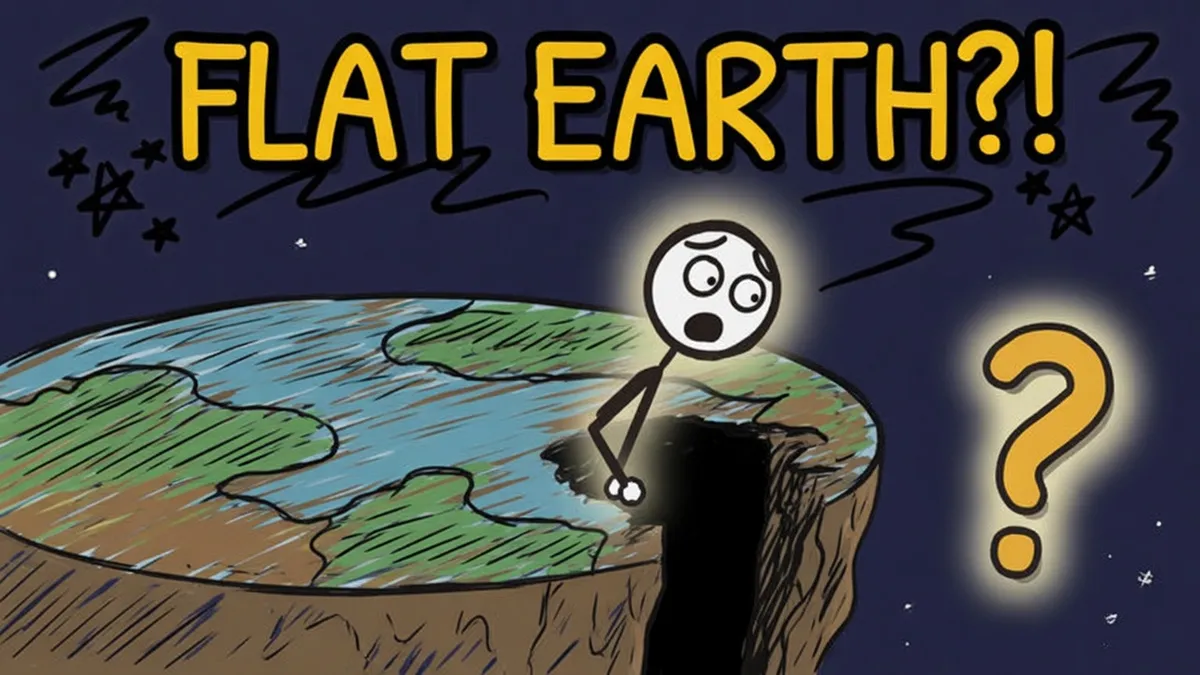
You know the story. A brave Columbus stands before a room of scowling churchmen who insist the world is flat and that his ships will tumble off the edge of the sea. He argues for a round Earth, sails west, and proves them all wrong. It is a fantastic tale: science against superstition, one clever man against a dark age. There is only one problem with it. Almost none of it happened, and the part everyone remembers most, the flat Earth, is close to pure invention.
01 · The mythThe showdown that never took place
Let us be blunt about the twist up front, because it is the whole point: educated people did not think the Earth was flat. Not in Columbus’s time, not in the medieval centuries before it. The dramatic hearing where Columbus faces down flat-Earth priests is not a slightly exaggerated real event. It is essentially fiction, and we can even name the author. But to see why the myth is so wrong, you have to see how old the truth actually is.
02 · The ancient answerThe Greeks got there first
The round Earth is not a modern discovery. The ancient Greeks had settled it by roughly the time of Aristotle, and they did it with evidence anyone can check. During a lunar eclipse, the shadow the Earth throws across the Moon is always curved. Ships do not shrink to dots as they leave harbour, they sink hull-first below the horizon, as if going over a hill. Travel south and new stars climb into view that you could never see from home. Put those together and only one shape works: a sphere.
03 · The measurementA man, two shadows, and the size of the world
It gets more impressive. Around 240 BC, a Greek scholar named Eratosthenes did not just know the Earth was round, he measured it. He noticed that at noon on the summer solstice the sun shone straight down a well in one Egyptian city, casting no shadow, while at the same moment a stick in another city to the north cast a small one. From that difference in angle and the distance between the cities, using nothing but geometry, he calculated the circumference of the entire planet, and came startlingly close to the real number. That is roughly seventeen centuries before Columbus was born.
04 · The real argumentNot the shape, the size
So what were Columbus and the experts actually shouting about? Distance. Everyone agreed the Earth was a ball. The question was how big the ball was, and therefore how far you would have to sail west to reach Asia. Columbus, working from figures that suited his ambitions, insisted the crossing was short and survivable. His critics did the sums and said it was far too long: no ship could carry enough supplies to reach Asia going west. And here is the deliciously awkward truth. His critics were right. The only reason Columbus lived is that two entire continents he knew nothing about sat exactly where he expected empty ocean. He was saved by being wrong.
The learned men who doubted Columbus were not flat-Earth fools holding back progress. They were the ones who had the maths right. He got the geography catastrophically wrong and got lucky.
05 · The inventorWhere the flat Earth actually came from
If the medieval world knew better, who gave us the flat-Earth story? Largely a novelist. In 1828, the American writer Washington Irving, better known for Sleepy Hollow, published a popular life of Columbus and dressed it up with invented drama, including a stirring, fictional scene of Columbus defending a round Earth against ignorant clergy. It was gripping. It was also made up. But readers swallowed the fiction as history, and the image of the lonely genius versus the flat-Earth priests was born fully formed, roughly three hundred years too late to be true.
06 · The propagandaWhy the lie had legs
A good invented story still needs a reason to spread, and the late 1800s supplied one. Writers like John William Draper and Andrew Dickson White were pushing the idea that science and religion had always been locked in war, the so-called conflict thesis. The flat-Earth tale was perfect ammunition: brave rational Columbus, dogmatic Earth-is-flat Church. It did not matter that it was false. It was useful, and a useful story that flatters the present will always outrun a complicated true one. That is why you were taught it in school.
07 · The payoffSo why do we think people thought the Earth was flat?
Not because they did, but because we were told a better story than the truth. The real history is almost the reverse of the myth: the Earth’s roundness was ancient, well measured, and never seriously in doubt among the educated, while the flat Earth was a nineteenth-century invention pinned onto the past to make a point. It is a small, clean lesson in how history actually reaches us. The confident thing everyone knows, the tidy tale with a hero and a villain, is exactly the kind of thing most worth checking. The Greeks measured the planet with a stick and a shadow. It took a novelist to flatten it.
Quick questions
Did medieval people really think the Earth was flat?
No, not the educated ones. Throughout the Middle Ages, scholars, universities and the Church generally taught that the Earth is a sphere. The widespread 'everyone thought it was flat' belief is a modern myth, not medieval reality.
When did people work out the Earth is round?
The ancient Greeks. By roughly the time of Aristotle (4th century BC), a spherical Earth was the educated view, supported by evidence like the round shadow the Earth casts on the Moon during an eclipse and ships vanishing hull-first over the horizon.
Who measured the size of the Earth first?
Eratosthenes of Cyrene, around 240 BC. Using the different angles of the noon sun at two Egyptian cities, he estimated the Earth's circumference, and came impressively close to the modern value for an experiment done with shadows and geometry.
So the Columbus story is false?
The dramatic version is. Columbus did not have to convince anyone the Earth was round, because everyone already agreed it was. The scene where he faces down flat-Earth churchmen is essentially fiction.
Then what were Columbus and his critics actually arguing about?
The size of the Earth and the distance to Asia. Columbus argued the ocean crossing to Asia was short and doable. His critics argued, correctly, that it was far too far. Nobody knew an entire pair of continents sat in the way, which is the only reason he survived.
Where did the flat-Earth myth come from?
Largely from the American writer Washington Irving. In his 1828 book on Columbus, he invented a gripping (and fictional) scene of Columbus defending a round Earth against ignorant clergy. Readers took the drama as history.
How did the myth spread so widely?
It was picked up in the late 1800s by writers like John William Draper and Andrew Dickson White, who used it to push a 'conflict thesis' of science forever at war with religion. A tidy tale of brave science versus flat-Earth priests was too useful to check.
Did anyone in history actually believe in a flat Earth?
Yes, a few. Some early cultures pictured a flat world, and a small number of early Christian writers, like Lactantius and Cosmas Indicopleustes, argued for a flat Earth. But they were outliers, not the mainstream medieval view, which is exactly why the myth misleads.
Doesn't the Bible describe a flat Earth?
Some verses use flat-Earth-sounding imagery, but medieval Christian scholars overwhelmingly still taught a spherical Earth, reconciling the poetry with the science of the day. The Church was not the flat-Earth villain the myth needs it to be.
Why does the flat-Earth myth still get taught?
Because it is a great story with a clear hero and villain, and it flatters us: it makes the past look foolish and the present look enlightened. Simple, dramatic and morally satisfying beats complicated and true almost every time.
How do we actually know the Earth is round?
Endless independent ways: ships disappearing hull-first, the curved shadow on the Moon in a lunar eclipse, stars that change with latitude, circumnavigation, and, since the 20th century, photographs from space. The evidence was strong enough for the Greeks and is overwhelming now.
Is the modern Flat Earth movement connected to the medieval world?
No. Today's flat-Earth belief is a recent phenomenon, not a survival of medieval thinking. Ironically, the medieval scholars it imagines as allies would have firmly disagreed with it.
Take the quiz on this
A quick 4-question check on what you just read. Get them right to earn XP: no points for just scrolling.
Our sources 7 checked
// every claim on this page was checked before it went up