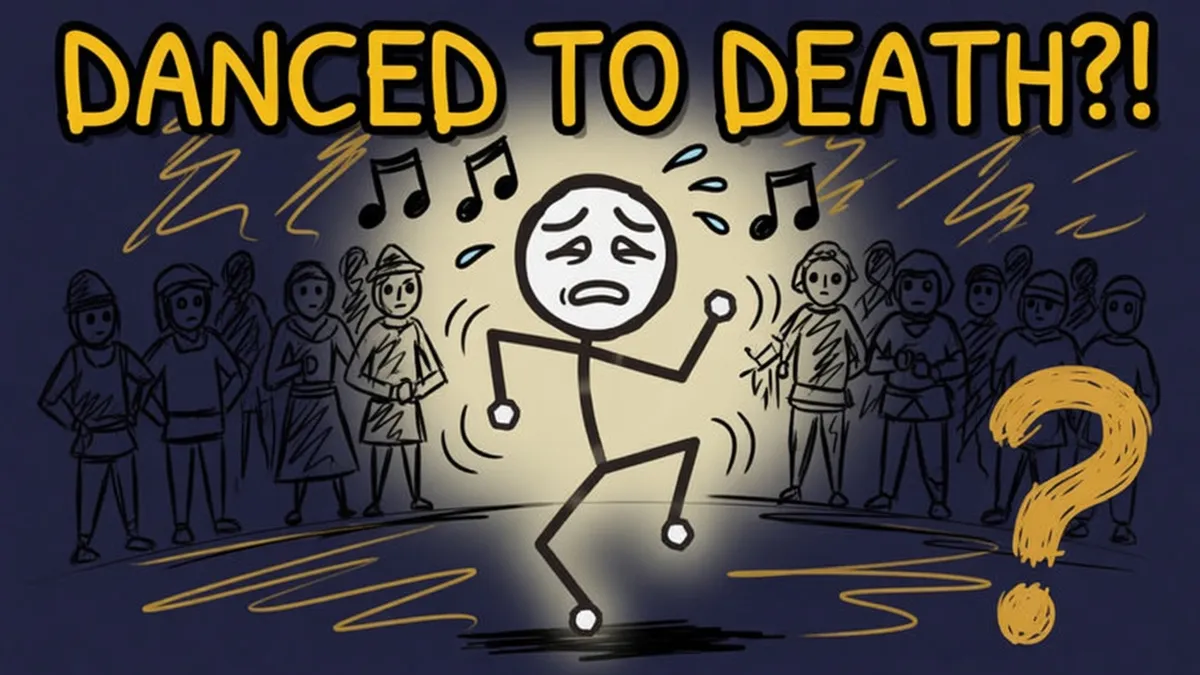
Here is one of the strangest true stories in European history. In the summer of 1518, in the city of Strasbourg, a woman stepped out into the street and began to dance. There was no music. She wasn't smiling. And she didn't stop, not for hours, not as the sun went down, not the next morning. By the third day her feet were bruised and bleeding, and she was still going. Then, one by one, her neighbours started to join her. Within weeks, by some accounts, as many as four hundred people were dancing, helplessly, through the streets, and nobody had the faintest idea why.
01 · The outbreakOne woman, and then a crowd
The woman is remembered as Frau Troffea, and she began some time in July 1518. What makes the account so unnerving is how ordinary the setting was: a busy, real city, on a normal summer’s day. She simply started to move and couldn’t stop. Within a week, more than thirty people had caught it. Within a month, the numbers had swelled dramatically: the figures in the sources range from dozens to as many as four hundred, so the exact scale is genuinely uncertain. But the core of it is not in doubt: hundreds of ordinary people found themselves unable to stop dancing, for days on end.
02 · The deathsDid they really dance themselves to death?
This is the famous, gruesome detail, and it’s the one you should hold most loosely. Later chronicles claimed that people were dropping dead from strokes, heart attacks and sheer exhaustion, some accounts putting it as high as fifteen deaths a day at the peak. It’s a chilling image, and it’s the reason the story is usually told the way it is.
But here’s the catch. The sources that mention those deaths are all later accounts. The city’s own records from 1518, the contemporary paperwork, don’t confirm a single fatality. So while the dancing itself is well documented, the death toll is disputed. It may have happened. It may have been exaggerated by chroniclers writing afterwards. When someone tells you exactly how many people died, they’re reaching past what the evidence can actually support.
03 · The cureThe official remedy was… more dancing
The response of the authorities is where the story tips from tragic into almost unbelievable. Strasbourg’s physicians ruled out sin and astrology, and decided this had to be a natural disease of “overheated blood”, the kind of thing you had to burn off. So their prescribed cure was, and this really is true, more dancing. They cleared guild halls, converted a grain market, built a wooden stage, and hired pipers and drummers to keep the afflicted moving until it worked its way out of them.
Predictably, throwing a live band at the problem made everything worse. The music and the official blessing seem to have validated the behaviour and drew more people in. What began as one woman in a street became, with the city’s active encouragement, a mass event.
04 · The bread theoryWhy "poisoned rye" doesn't hold up
So what was actually happening? The most famous theory is poisoned bread. Damp rye can grow a mould called ergot, which is chemically related to LSD and can trigger violent hallucinations. A whole town accidentally tripping at once, case closed?
Not quite. Because ergot also chokes off the blood supply to your limbs, causing burning agony and even gangrene. You physically cannot dance on it for days. And a poison would never make hundreds of people perform the same, sustained, coordinated behaviour, turning up, moving in the streets, responding to music. The historian John Waller, who wrote the definitive modern account, sets the ergot theory firmly aside. The bread, it turns out, is a red herring.
05 · The real answerA town at breaking point, and one specific fear
To find the leading explanation, you have to look at what Strasbourg was actually living through. Waller pieced it together, and the picture is grim: years of failed harvests and real famine, wave upon wave of disease, smallpox, syphilis, the ever-present dread of plague. This was a population pushed right to the edge of what a mind can quietly endure.
Now add one specific, deeply held belief. The people of this region lived in genuine terror of Saint Vitus, a saint they were certain could punish sinners with a curse of wild, uncontrollable dancing. To them this wasn’t a metaphor. It was as real and as physically possible as catching the plague.
Push an exhausted mind to its breaking point, have it truly believe a curse could strike at any second, and it can tip into a dissociative trance, the body moving on its own. Psychologists call it mass psychogenic illness. One woman danced, everyone knew what it meant, and the dread turned out to be contagious.
That’s the mechanism, as best the evidence supports it, and it’s worth flagging that this is the leading theory, not a proven fact you could put under a microscope. It can’t be, five centuries on. But it fits the evidence far better than poison or the supernatural: the belief spread from person to person, and it made itself come true.
06 · Not uniqueIt had happened before, and it still does
Here’s the part that should really unsettle you: 1518 wasn’t even the first time. These dancing manias, choreomania, flared up across Europe for centuries. Back in 1374, an even bigger outbreak erupted in Aachen and swept along the Rhine, through Cologne, Utrecht and beyond, pulling in huge numbers of people. And almost every outbreak landed in the same soil: a region already broken by famine, flood or disease. 1518 wasn’t a freak event. It was the last, and most famous, of a long, strange pattern.
And before you file this under medieval superstition, the same thing still happens. In 1962, in what is now Tanzania, three girls at a boarding school in Kashasha started laughing and couldn’t stop. It spread. Within weeks it had swept through the school and out into nearby villages, affecting around a thousand people and forcing more than a dozen schools to close for months. Doctors ran every test they could think of and found nothing physically wrong. Same mechanism: a group under enormous pressure, and one contagious spark.
07 · The payoffSo why did they dance?
The dancing plague almost certainly wasn’t a poison, wasn’t a demon, and wasn’t a disease in any ordinary sense. The best explanation is that it was a town so utterly crushed by suffering, and so completely convinced of a supernatural curse, that the sheer terror of the dancing was enough to make hundreds of people genuinely do it.
And the detail that ties the whole thing in a knot: the remedy that finally seemed to end it was to load the exhausted dancers into wagons and carry them to a shrine, dedicated to Saint Vitus. The very saint they were all terrified of in the first place. Curing the curse by driving everyone straight to the curse. And, unsettlingly, it more or less worked. It stands as one of history’s clearest, and most chilling, demonstrations that under enough pressure, the mind really can rewrite the body’s reality.
The animated version
Same answer, told as a little animated story with the strange little stickman acting it out. Dry, quick, and, obviously, correct.
Quick questions
Did people really dance themselves to death in 1518?
It's genuinely uncertain. Hundreds really did dance uncontrollably for weeks. That much is well documented. But the deaths come from later chronicles that claim people died of strokes, heart attacks and exhaustion, sometimes 'fifteen a day.' Strasbourg's own records from 1518 don't confirm a single death, so the toll is best treated as disputed.
What actually caused the dancing plague of 1518?
The leading theory, from medical historian John Waller, is mass psychogenic illness (mass hysteria). A population worn down by years of famine and disease, and steeped in a real fear of Saint Vitus's dancing curse, tipped into a stress-induced dissociative state that spread from person to person.
Was the dancing plague caused by poisoned bread (ergot)?
Almost certainly not. Ergot, a mould on damp rye, chemically related to LSD, is the famous theory, but ergotism also chokes off blood flow to the limbs, causing burning pain and even gangrene. You couldn't dance on it for days, and a poison wouldn't make hundreds perform the same coordinated behaviour.
How did the dancing plague of 1518 end?
After the 'more dancing' cure backfired, authorities banned public dancing and carried the exhausted dancers to a shrine dedicated to Saint Vitus, the very saint they feared. Removing the music and the social sanction, and channelling the belief through ritual, seems to have let it burn out.
Has anything like the dancing plague happened since?
Yes. The same mechanism, mass psychogenic illness, appears through history. The clearest modern case is the 1962 Tanganyika laughter epidemic, which began at a girls' school, spread to around 1,000 people, closed 14 schools, and had no physical cause doctors could find.
What was the dancing plague of 1518?
It was a real, documented outbreak in which the people of Strasbourg danced uncontrollably for days at a time. It began in July 1518 with a single woman and, over roughly two months, pulled in dozens to as many as a few hundred others, some of whom danced until they collapsed. The dancing itself is recorded in the city's own paperwork; the mass deaths are a later, disputed addition to the story.
Where did the dancing plague happen?
In Strasbourg, a city in the Alsace region. In 1518 it was a free city of the Holy Roman Empire; it has been part of France since the 1680s. The outbreak spilled through its streets, guild halls and a converted grain market, where the authorities set up a stage for the dancers.
Who was Frau Troffea?
She's the woman remembered as the first dancer. She stepped into a Strasbourg street in July 1518 and danced for days without stopping, ignoring her husband's pleas. History records almost nothing else about her. Some accounts say the authorities carted her roughly 30 miles to a shrine of Saint Vitus at Saverne to be cured. Hold the vivid details loosely; the reliable core is simply that she existed and started it.
How long did the dancing plague last?
Roughly two months: it began in July 1518 and had faded by September. That doesn't mean anyone danced non-stop for weeks: individuals collapsed, rested and (in the worst cases) were injured, while the outbreak as a whole rolled on and gradually burned itself out.
Is mass hysteria real?
Yes, though clinicians now prefer the term mass psychogenic illness (or mass sociogenic illness). It's a recognised phenomenon in which real, medically unexplained symptoms spread socially through a group under stress. Documented modern cases include the 1962 Tanganyika laughter epidemic and a 2011 to 12 outbreak of tic-like symptoms among teenagers in Le Roy, New York, where investigators searched for an environmental or infectious cause and found none.
Could a dancing plague happen today?
A literal weeks-long dancing epidemic is unlikely, that one leaned on a very specific medieval belief in Saint Vitus's curse. But the underlying mechanism is alive and well: clusters of unexplained fainting, tics, nausea or twitching still surface in schools and workplaces under stress, and social media can now spread the trigger faster than any medieval town ever could.
What was the dancing plague of 1518?
A mass outbreak of compulsive dancing that began in Strasbourg in July 1518 with a woman remembered as Frau Troffea and grew over weeks to dozens or, by some accounts, hundreds of people. Later chronicles claim deaths from exhaustion, but the city's own 1518 records do not confirm any. The leading modern explanation is mass psychogenic illness under extreme stress and a belief in Saint Vitus's curse, not ergot poisoning alone.
Was Saint Vitus linked to the dancing plagues?
Yes in the popular mind of the time. Sufferers and onlookers often blamed a curse of Saint Vitus (or Saint John), and 'dancing mania' was sometimes called Saint Vitus's dance. That religious frame helped the behaviour spread as a shared expectation of what the affliction looked like.
Take the quiz on this
A quick 4-question check on what you just read. Get them right to earn XP: no points for just scrolling.
Our sources 12 checked
// every claim on this page was checked before it went up