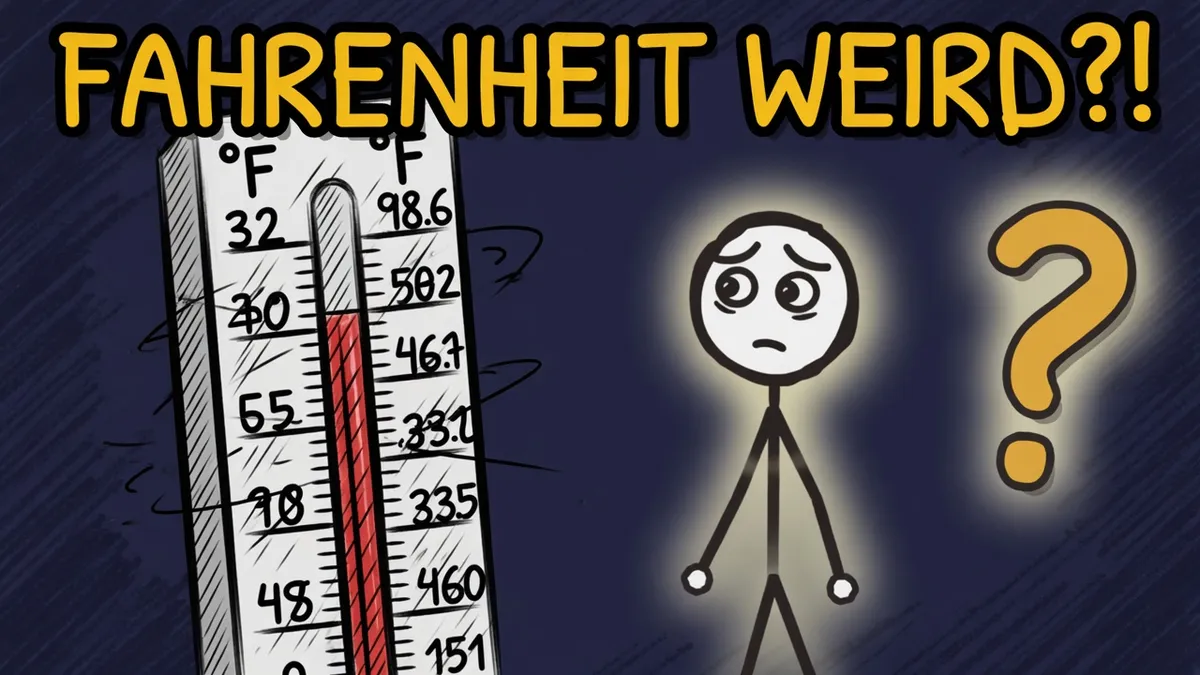
Look at the Fahrenheit scale cold, with no habit softening it, and it is genuinely deranged. Water freezes at 32. It boils at 212. Your body sits at 98.6. Not one of those is a round number, and there is no obvious reason they should be the numbers they are. Celsius, by comparison, looks like it was designed by someone sober: 0 to freeze, 100 to boil, done. So the natural assumption is that Fahrenheit was just worse at this. Here is the twist that changes the whole story: Fahrenheit never chose 32 or 212. They are not decisions. They are accidents that fell out of his scale years later.
01 · The real achievementHe wasn't building a scale, he was building an instrument
Start with what actually mattered, because it isn’t the numbers. Before Fahrenheit, thermometers were close to useless for science, not because nobody had drawn a scale on them, but because no two of them agreed. Fill a tube with alcohol, mark it however you like, and your neighbour’s tube marked the same way would read something different. “Degrees” didn’t travel. A measurement taken in one city meant nothing in another.
Fahrenheit’s fix, around 1714, was the mercury-in-glass thermometer. Mercury has two quietly heroic properties: it expands very evenly as it warms (so equal steps of heat give equal steps of movement up the tube), and it stays liquid across a huge range, roughly minus 39 to 357 °C, where alcohol would freeze solid or misbehave. Put those together and you get an instrument that is reproducible: two thermometers, made carefully, finally read the same. That, not the scale, is why we still say his name. He made temperature into a number you could measure the same way twice.
02 · ZeroThe coldest thing he could bottle
Now to the scale, and the first number people mock. Fahrenheit needed anchor points he could recreate on demand, because a scale is only as good as your ability to find the same spot again tomorrow. For the bottom of his scale he reached for the coldest temperature he could reliably produce in a workshop: a slushy brine of ice, water and ammonium chloride, a common salt. Mixed together, that mush settles at a stable low temperature all by itself and holds there, which makes it a beautifully repeatable anchor. He called that point zero.
So Fahrenheit zero isn’t arbitrary at all. It’s “the coldest I can make and hit again every single time.” It just happens to sit well below the point where plain water freezes, which is why ordinary freezing ends up at the faintly ridiculous 32.
03 · Ninety-six-ishWhy body heat, and why that number
For the top anchor he used the human body, and set it close to 96. This is the part historians argue about, so hold it a little loosely: some accounts say he first tried 90 and later revised upward, and the precise sequence of tinkering is not fully settled. But the appeal of 96 is real and mathematical. With the ice point sitting at 32 and body heat at 96, the gap between them comes out to exactly 64 degrees. And 64 is the friendliest number imaginable for someone marking a scale by hand, because you can find the midpoint, then the midpoint of that, and so on, halving cleanly six times over (64, 32, 16, 8, 4, 2, 1) until every degree line is drawn. On a scale you graduate by repeated bisection, 96 is not strange. It’s convenient.
04 · The reshuffleWhere 32 and 212 actually came from
Here is the move that produced the numbers everyone laughs at. Body heat, it turns out, is a lousy anchor: it wanders about, person to person and hour to hour, so it’s a shaky thing to pin a whole scale to. Water is far more obliging. So the scale was later recalibrated to lean on two extremely reproducible points instead: the temperature at which pure water freezes, and the temperature at which it boils. Freezing was fixed at 32, boiling at 212, leaving a deliberately tidy 180 degrees between them.
And this is the crucial bit. Once you nail the scale down onto water like that, everything else has to shuffle slightly to fit. The old body-heat mark, which had sat neatly at 96, got dragged along in the recalibration and landed at roughly 98.6. Nobody measured a healthy human and got 98.6. It’s a number that came out in the wash when the scale was re-pegged to freezing and boiling water.
That famous 98.6 °F is precise-looking nonsense. It is nothing but 37 °C converted into Fahrenheit (37 times 9/5, plus 32, lands exactly on 98.6). The suspiciously specific decimal isn't a careful reading, it's an artifact of the arithmetic. And it's built on a number that is itself drifting.
05 · The 98.6 problemA conversion of a rounding of a 19th-century average
Follow the 98.6 back and it dissolves in your hands. The figure descends from Carl Wunderlich, the German physician who, around 1851, took a vast pile of readings and concluded that normal body temperature was about 37 °C. Thirty-seven is the round number. Convert that clean Celsius figure into Fahrenheit and you get 98.6, whose fussy little decimal makes it look like the more precise of the two when it’s actually the same number wearing a disguise.
Then it gets better, because even 37 may no longer be true. A 2020 study in eLife (Protsiv and colleagues) worked through decades of American records and found that average body temperature has genuinely fallen since Wunderlich’s day, not because his thermometers were bad, but because we really do seem to run a touch cooler now, plausibly linked to less chronic inflammation and steadier indoor climates. Large modern datasets put the everyday average nearer 97.9 °F. So the strangest number on the Fahrenheit scale is a conversion, of a rounding, of a 170-year-old average, that has since moved.
06 · The backwards rivalCelsius wasn't so clean either
Before Fahrenheit gets singled out as the odd one, it’s worth knowing that the tidy-looking scale had a chaotic start of its own. When Anders Celsius published his version in 1742, he set it up the wrong way round: 0 for the boiling point of water and 100 for freezing, so that temperature counted down as things got hotter. He genuinely meant it that way. The familiar orientation, 0 to freeze and 100 to boil, only arrived around the time of his death in 1744, and the history books can’t fully agree on who flipped it. The credit is variously handed to the physicist Jean-Pierre Christin, to the botanist Carl Linnaeus, and to the instrument maker Daniel Ekström working with the astronomer Mårten Strömer. Pick whichever your source prefers, and hedge it, because the honest answer is that it’s contested.
07 · Why America kept itPath dependence, with one decent excuse
Which leaves the modern puzzle: given that Celsius won almost everywhere, why does the United States still quote the weather in Fahrenheit? The unglamorous answer is the same force that keeps the QWERTY keyboard around: path dependence. Fahrenheit got embedded in American thermometers, ovens, forecasts and habits long before switching to metric was ever a serious prospect, and once a whole country’s instincts are calibrated to a scale, the cost of re-teaching everyone dwarfs the benefit.
There is, in fairness, one genuinely nice argument for keeping it, at least for weather. Across the range of temperatures humans actually stand around in, 0 °F is punishingly cold and 100 °F is punishingly hot, so everyday weather sits inside a neat 0-to-100 band, with more degrees of resolution across that band than Celsius offers. It’s an ergonomic accident rather than a design triumph, but it’s a real one, and it’s part of why the scale has its defenders.
08 · The payoffSo why is it so strange?
Because we’ve been blaming the wrong thing. The Fahrenheit scale looks irrational only if you assume 32 and 212 were chosen, and they weren’t. Fahrenheit chose a reproducible cold brine for zero and the human body for the top, built the finest thermometer in the world to read them, and drew a scale that made perfect sense on its own terms. The numbers we sneer at, 32, 212, 98.6, are downstream: leftovers of a later recalibration onto water, and in the case of body heat, a Celsius figure converted, rounded, and quietly going out of date. The scale isn’t strange because its inventor was careless. It’s strange because it’s a two-hundred-year-old machine still running on the settings of the last people who bothered to adjust it.
Quick questions
Why does water freeze at 32 in Fahrenheit and not 0?
Because Fahrenheit didn't build his scale around water's freezing point. His zero was a much colder thing: a salt-and-ice brine, the coldest temperature he could reliably reproduce in the lab. Plain water's freezing point simply landed 32 degrees above that zero. It only became a defining point of the scale later, when the whole thing was recalibrated onto water.
Why does water boil at 212 in Fahrenheit?
For the same reason 32 looks odd: it's a consequence, not a choice. Once freezing was fixed at 32 and the scale was recalibrated so there were a round 180 degrees between water's freezing and boiling points, boiling had to land at 32 plus 180, which is 212. The gap is the tidy number, not the endpoints.
Who was Daniel Gabriel Fahrenheit?
A physicist and instrument maker (1686 to 1736), born in Danzig (now Gdańsk) and mostly based in the Dutch Republic. He is famous for the scale, but his lasting contribution was the mercury-in-glass thermometer, the first instrument accurate and consistent enough that two people in two cities could actually get the same reading.
Why did Fahrenheit use mercury instead of alcohol?
Because mercury behaves. It expands and contracts very evenly as temperature changes (so the marks along the tube are reliably spaced), and it stays liquid across a wide range, roughly minus 39 to 357 °C. Earlier alcohol thermometers froze in real cold and expanded less predictably. Mercury is what made Fahrenheit's instruments reproducible, which was the real revolution.
What was Fahrenheit's zero point actually based on?
The coldest temperature he could reliably recreate: a frigorific mixture of ice, water and ammonium chloride (a salt). Mixed together, that slush settles at a stable low temperature on its own, which made it a repeatable anchor. He set that point to 0.
Why is human body temperature 96 on the original scale?
Fahrenheit used body heat as an upper anchor and set it near 96. The appeal of that number is that the span from the ice point up to body heat came out as 64 degrees, and 64 halves cleanly all the way down (64, 32, 16, 8, 4, 2, 1), which suits a scale you mark out by repeatedly bisecting. Some accounts say he first tried 90 before settling on 96, so treat the exact story as debated.
How did the scale change to give 32 and 212?
Later refinement pinned the scale to two very reproducible points, water freezing (32) and water boiling (212), with a clean 180 degrees between them. That recalibration stretched things slightly, which is why the original body-heat mark drifted from 96 up to about 98.6.
Is 98.6 °F really normal body temperature?
Not really, and the number is misleading. 98.6 is simply 37 °C converted into Fahrenheit, so its decimal looks precise but is an artifact of the maths, not a careful measurement. Large modern studies put the true average lower, closer to 97.9 °F, and it varies by person, time of day and how it's measured.
Did the Celsius scale really run backwards at first?
Yes. When Anders Celsius published his scale in 1742, he set 0 for the boiling point of water and 100 for freezing, the exact reverse of today. It was flipped to the familiar version around him, after his death in 1744. Credit for the flip is contested: Jean-Pierre Christin, Carl Linnaeus and the instrument maker Daniel Ekström (via Mårten Strömer) are all named in different accounts.
Why does the United States still use Fahrenheit?
Mostly path dependence: it was entrenched in everyday life, industry and instruments before metric conversion became a live option, and there was never enough pressure to force the switch. There's also a mild ergonomic argument people like: across ordinary weather, 0 to 100 °F roughly maps to 'brutally cold' to 'brutally hot', so the everyday range sits neatly inside two round numbers.
Is Fahrenheit better than Celsius for weather?
It's a matter of taste, not fact. Fans argue Fahrenheit gives finer resolution for air temperature (more degrees across the range people actually feel) and that 0 to 100 conveniently brackets habitable weather. Celsius wins for anything scientific, because 0 and 100 are water's freezing and boiling points. Neither is 'wrong'; they were built for different jobs.
What's the formula to convert Fahrenheit to Celsius?
Subtract 32, then multiply by 5/9. So (°F minus 32) times 5/9 gives °C. Going the other way: multiply °C by 9/5 and add 32. The 32 in there is exactly the freezing-point offset that makes Fahrenheit look strange in the first place.
Why are there 180 degrees between freezing and boiling in Fahrenheit?
By design, once the scale was recalibrated onto water. Fixing freezing at 32 and boiling at 212 leaves a span of 180 degrees, a number that divides very cleanly. Celsius chose 100 for the same span, which is why one Celsius degree is 1.8 Fahrenheit degrees.
Did Fahrenheit invent the thermometer?
No, thermometers existed before him. What he invented was the practical mercury thermometer and a consistent way to graduate it, which together made temperature something you could measure the same way twice. Before that, two thermometers rarely agreed, so 'degrees' didn't travel between people. That reproducibility is his real legacy.
Take the quiz on this
A quick 4-question check on what you just read. Get them right to earn XP: no points for just scrolling.
Our sources 11 checked
// every claim on this page was checked before it went up