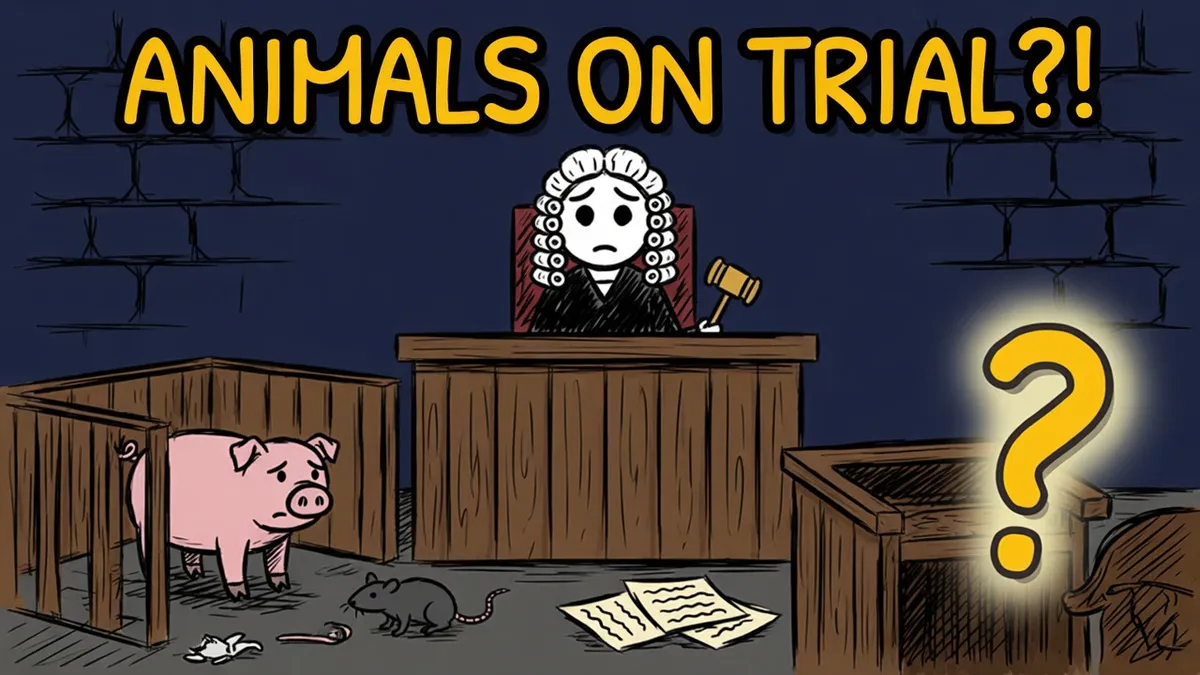
Picture a courtroom. A judge, sworn witnesses, a capital charge, a verdict read out to a hushed crowd. Now picture the defendant in the dock: a pig. Not a fable, not a satire, not a children's story. For something like five hundred years, European legal culture sometimes put real animals into the full machinery of justice, and then pulled the lever. The pig in the dock is one of history's most genuinely baffling facts, and the reason behind it is more interesting than the joke.
01 · The shockWhen the docket had hooves
From the later Middle Ages into early modern times, communities across Europe, and France especially, prosecuted animals in court. The records are patchy and scattered, but there are enough of them, with enough procedural detail, that historians long ago stopped treating it as a one-off curiosity. Domestic animals were tried by secular courts for violence against people. Pests were pursued by church courts for eating the harvest. And the surviving paperwork carries the straight face of the law: charges, testimony, deliberation, sentence.
02 · Two courtroomsFarmyard murder and holy infestation
There were really two different scripts. Secular courts handled the bloody local tragedy: a pig mauls a toddler, a bull gores a farmhand. A single animal was seized, tried like a person, and if convicted, executed in public. Church courts handled the swarm: rats in the barns, weevils in the grain, caterpillars stripping a vineyard. You cannot hang a plague of insects, so the language shifted, toward formal warnings, deadlines to leave, and finally curses, anathemas and excommunication-shaped remedies. One court wanted a culprit punished. The other wanted the moral order of creation put back in its place.
03 · A case that sticksThe sow and the spared piglets
The most quoted case is almost unbearably tidy. In 1457, in the Burgundy village of Savigny, a sow was arrested after a young child was killed and, by the record, partly eaten. She was charged with murder, tried, found guilty, and executed. Her six piglets, found bloodied at the scene, were charged too, but the court acquitted them, reasoning that they were too young to know better and had simply been led astray by the bad example of their mother. Read that again. A medieval court applied a careful, almost tender theory of youthful innocence, to a litter of pigs. Whatever this was, it was not thoughtless cruelty. It was a community using the full form of the law to answer a horror.
The strange part is not that people wanted a dangerous pig dead. The strange part is that they believed the right response was a trial, with witnesses, a defence, and a verdict, for a pig.
04 · The defence lawyersSomebody had to speak for the rats
It gets stranger, and more human. In the church cases, the accused pests were sometimes given a real human advocate, and some of those advocates were brilliant. The French jurist Bartholomew Chassenee built his early reputation defending the rats of Autun. When his clients failed to appear in court, he argued, reasonably, that they were scattered across the countryside and had not all received the summons, and then that they could not be expected to travel safely to court at all, given the number of cats lying in wait along the way. He was not being absurd. He was working the procedure, exactly as he would for a human client, and winning delays.
05 · Why pigs, and why botherOrder is the real product
Two questions hang over all of this. Why pigs, and why the whole ritual? The pig is the easy one: medieval pigs roamed free through streets and yards, were big enough to kill, and lived cheek by jowl with unwatched children. When a child died, the pig was a real, physical agent in a world that badly wanted an agent rather than blind accident. The ritual is the deeper answer. A trial is a machine for turning something senseless into something answerable: charge, evidence, verdict, sentence. It reassured a shaken community that the world still had rules. It warned careless owners to control their beasts. And in the church cases, it set the relationship between people, creatures and God back into its proper order. The trial was never really about the animal. It was about the people watching.
06 · What it was notNot a cartoon, not everywhere
It is worth being careful. These trials were not weekly village entertainment, and they were not universal. The records cluster in particular times and places, and plenty of the lurid detail comes down to us through E. P. Evans’ great 1906 catalogue, which modern historians correct and query case by case. Wild wolves and bears were generally hunted, not tried. And the lazy conclusion, that medieval people were simply stupid, is wrong. They were solving real problems of grief, blame and social order with the legal and religious tools their world handed them.
07 · The payoffSo why put a pig on trial?
Because a trial is how humans force the world to answer them back. When a child died under a pig’s hooves, or a harvest vanished under a tide of weevils, the response was to reach for the one machine that turns chaos into a sentence, and to aim it at a non-human body. From here it looks like dark comedy. From inside the period it could look like justice, theology and public safety all wearing the same robe. The pig in the dock is not really a fact about pigs at all. It is a fact about how badly we need the world to make sense, and how far we will go to make it confess.
Quick questions
Did medieval people really put animals on trial?
Yes. Surviving records, especially from France and nearby regions, describe formal legal proceedings against animals from around the 13th century into the early modern period. It was a real, if uneven, part of European legal life.
What kinds of animals were tried?
In secular courts, most often pigs, but also cows, bulls, horses, dogs and even a rooster. In church courts, it was usually pests: rats, mice, weevils, locusts, caterpillars and other creatures ruining the harvest.
What were the animals charged with?
Large domestic animals were charged with killing or injuring people, effectively homicide. Swarms of pests were charged, in effect, with destroying crops and defying the community. The paperwork borrowed the exact language of human crime.
What happened to a guilty animal?
A convicted pig could be publicly executed, usually by hanging, sometimes with grim ceremony meant to mirror a human execution. The point was a visible, official ending, not a quiet culling.
Is the story of a pig dressed in clothes true?
It comes from a famous 1386 case at Falaise, where a pig that killed a child was reportedly dressed in human clothes before being hanged. The detail reaches us through later accounts and illustrations, so it is best treated as a strong tradition rather than a fully documented fact.
Why were pigs on trial so often?
Medieval pigs roamed streets and yards freely, were large, powerful and omnivorous, and lived close to unattended children. When a tragedy happened, the pig was a real, physical culprit in a world that wanted someone answerable.
Did the animals actually get lawyers?
In some church cases against pests, yes. Communities appointed human advocates to defend the animals. The French jurist Bartholomew Chassenee made his name defending the rats of Autun, arguing they could not safely obey a summons because of all the cats.
How could you put insects 'on trial' at all?
Church courts did not need the defendant in the room. They issued formal warnings ordering the pests to leave by a deadline, and if they refused, pronounced a curse, anathema or excommunication-style remedy. It was a legal and religious ritual aimed at restoring order, not a beetle in a witness box.
Were these trials just superstition?
Calling it superstition is too easy. The trials sat inside real legal cultures that cared deeply about procedure, responsibility and, in church cases, the proper relationship between people, nature and God. It was a serious answer to a serious problem, using the tools of the age.
When and why did animal trials stop?
They faded unevenly as legal systems modernised, thinning out through the 1600s and 1700s. As ideas about guilt, intention and criminal responsibility changed, the notion of a guilty animal slowly stopped making legal sense.
Did wild animals like wolves get tried too?
Generally not in the same way. The records are dominated by domestic animals and by crop pests. Wild predators were usually hunted or dealt with outside the courtroom, not put through the full legal script.
How do we even know about these trials?
Mostly from surviving court notices, legal treatises and later compilations, above all E. P. Evans' 1906 book that gathered hundreds of cases. Modern historians re-check his catalogue, correcting errors, but the core phenomenon is well established.
Take the quiz on this
A quick 4-question check on what you just read. Get them right to earn XP: no points for just scrolling.
Our sources 7 checked
// every claim on this page was checked before it went up