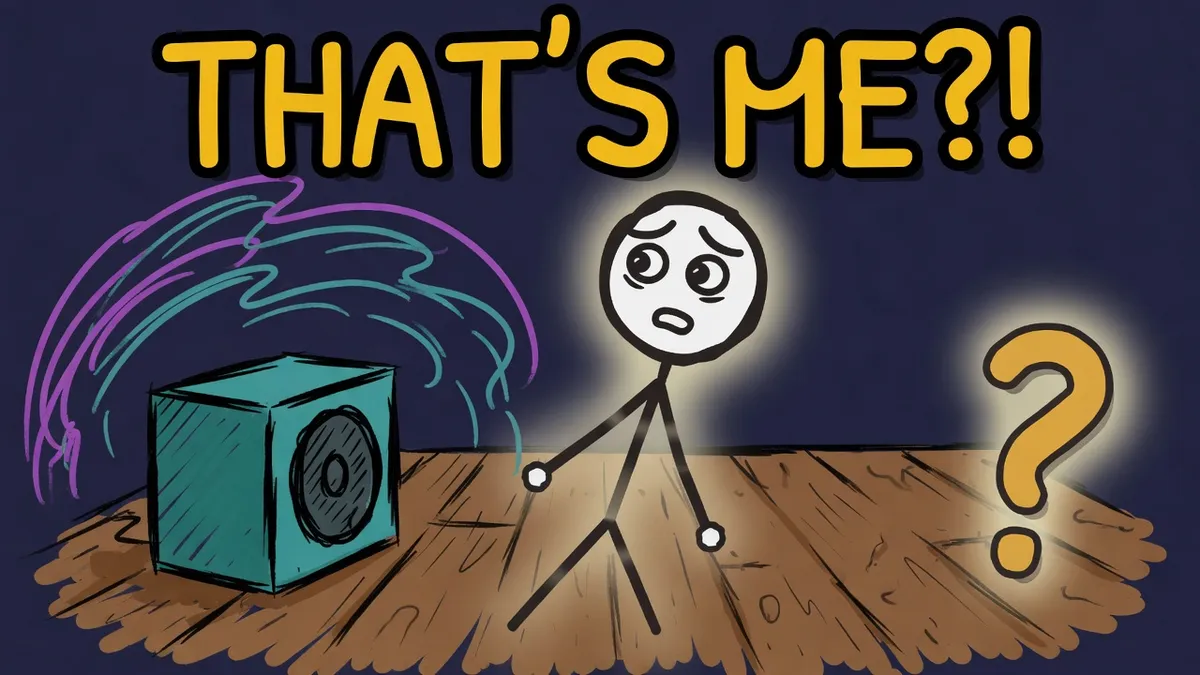
Here's a strange one to sit with: you have never actually heard your own voice. Not once, in your whole life. Everyone else has (it's the only version they know), but the you-shaped person doing the talking has only ever heard a private, remastered edition that nobody else on Earth will ever hear. Which is why, the moment your voice comes out of a speaker, your first thought is instant, full-body horror: do I really sound like that? Meanwhile everyone in the room just shrugs. Yes. Obviously. That's exactly what you sound like. So why does the recording sound like a total stranger to the one person who hears you most?
01 · Two pathsSound reaches your ears two ways
When you speak, the sound gets to your own ears by two completely different routes at once. The first is air conduction: the sound leaves your mouth, travels out through the air, and arrives back at your eardrums. That’s the ordinary path, the exact same one everyone else in the room is using to hear you. But you have a second, private route that nobody else can access: bone conduction. As you talk, your vocal folds set the bones of your skull vibrating, and those vibrations travel straight up through the bone and into your inner ear directly, skipping the air entirely. Everyone gets the first path. Only you get both.
02 · The bass upgradeYour skull carries the low notes
That bony shortcut changes everything, because your skull happens to be brilliant at carrying low frequencies. It passes along the deep, bassy parts of your voice far more generously than thin air ever could. So the version playing inside your head arrives with a free upgrade: a whole layer of warm, rich, cinematic bass that literally no one outside your skull will ever get to hear. You’ve spent your entire life listening to a director’s cut of your own voice, remastered, low-end boosted, and mixed for an audience of exactly one.
03 · The microphoneNo skull, no bass
A microphone, though, does not have a skull. It can only ever pick up the sound travelling through the air. So the moment you play a recording back, all of that lovely bone-conducted bass is simply gone. What’s left is the thinner, higher, air-only version of you, and to your bass-spoiled ears, it sounds wrong. Tinnier. Higher. Somehow younger, and vaguely embarrassing. Nothing has actually changed about your voice; the recording just refuses to add the private bass you’ve been quietly enjoying your whole life.
That recording isn't the wrong version. It's the real one. The thin, wince-inducing voice on the playback is the precise voice every single person you've ever spoken to has always heard, and the deep, confident one in your head is the fake.
04 · The twistThe recording is the real you
This is the part that gets absolutely everyone. The version that makes you flinch is the honest one. The bone-boosted voice in your head is a bonus track that has only ever had an audience of one, you. Every person you’ve ever met has been listening to the thin stranger on the recording, and to them, that is you; there was never any other. So when you recoil at a playback and everyone else says “that’s just you,” you are, quite literally, hearing two different people at once. And only one of them is real. It is, sadly, not the one you were hoping for.
05 · The cringeWhy it hits so hard
The wince runs deeper than pitch, though, and there’s a study for it. Back in 1966, two psychologists, Philip Holzman and Clyde Rousey, played people recordings of their own voices, watched them squirm, and gave the reaction a name: voice confrontation. What they found is that the discomfort isn’t only about the sound being higher than expected. A recording quietly exposes a set of “extra-linguistic cues”, the hesitation, the flatness, little tells of your mood and your nerves, that you simply can’t hear from inside your own head. So the honest version doesn’t just sound wrong. It feels less like a recording and more like an accusation: here is what you actually give away every time you open your mouth. And if that makes you flinch, you’re squarely in the majority: in a 2023 survey of more than 1,500 US adults, around 57% said they were dissatisfied hearing a recording of their own voice, comfortably more than disliked their everyday speaking one.
06 · The mercyIt fades if you let it
There’s one small kindness at the end, though. That flinch isn’t permanent. Psychologists call it the mere-exposure effect: the more often you encounter something, the more you warm to it, no reason required, just repetition. It’s why singers, podcasters and radio hosts stop hating their own voices. They haven’t changed how they sound; they’ve simply heard the real version so many times that it finally starts to feel like them. Play your recordings back enough, and the stranger slowly becomes you.
07 · The payoffSo which one is really you?
So sit with this for a second. Everyone you have ever met is walking around with their own secret, bass-boosted director’s cut playing only inside their own head, each of them quietly convinced that that is how they sound, and every last one of them is gently, unavoidably wrong. The slightly-too-thin stranger on the recording is the only version the rest of the world has ever actually met. You’ve simply never been introduced. The good news is you can be: play it back enough, and the voice you’ve been dreading turns out to have been you all along.
The animated version
Same answer, told as a little animated story with the strange little stickman acting it out. Dry, quick, and, obviously, correct.
Quick questions
Why does my voice sound higher and thinner on a recording?
Because a recording captures only the sound that travels through the air. The voice you're used to also includes bone-conducted sound, which carries the deep, low frequencies especially well and gives your in-head voice extra bass. Strip that away and what's left is the higher, thinner, air-only version, which sounds wrong to you but is exactly what everyone else hears.
Which voice is the real one, the recording or the one in my head?
The recording. It's the version that leaves your mouth, travels through the air, and reaches every other person's ears. The richer voice you hear internally is a private mix boosted by your own skull, an audience of exactly one. So the recording isn't a distortion; it's the honest one.
Why do I hate the sound of my own voice?
Partly the pitch shock, and partly something deeper. Psychologists Holzman and Rousey called it "voice confrontation" in 1966: hearing your recorded voice clashes with the self-image built around the version in your head. They also found recordings expose "extra-linguistic cues", hints of hesitation, mood and nerves you can't hear from the inside, so it can feel less like a recording and more like an accusation.
Does your recorded voice ever start to sound normal?
Yes. It's the mere-exposure effect: the more you hear something, the more you warm to it. It's why singers, podcasters and radio hosts stop wincing at their own voices: they've simply heard the real one enough times that it starts to feel like them. Play your recordings back often enough and the stranger slowly becomes you.
What is bone conduction?
It's sound reaching your inner ear through the vibrating bones of your skull rather than through the air. When you talk, your vocal folds set your skull ringing, and those vibrations travel straight to your inner ear, a route that carries low frequencies well and is private to you. It's also how bone-conduction headphones work, sending audio through your cheekbones instead of your eardrums.
What does my voice actually sound like to other people?
Like the recording. The air-conducted version a microphone captures is, essentially, the voice everyone else has always heard. The richer one in your head is the private, bass-boosted mix only your own skull produces. The one caveat is gear: a cheap phone mic, heavy compression and a bad room can thin or colour a recording further, so a decent recording in a quiet space is the truest mirror you'll get.
Do other people hear my voice the way I hear the recording?
Pretty much, and, importantly, they have never heard your in-head version. Everyone else only ever receives the air-conducted voice, the same one on the playback; they don't get your private skull-bass, and they never have. So the recording isn't just closer to the truth, it's the only 'you' the rest of the world has ever met.
Is there a way to hear your real voice without recording it?
Sort of. A popular trick is to cup your hands behind your ears, or press them flat beside your jaw, while you talk. It nudges what you hear toward the air-only version others get. It's a rough approximation, though. The only genuinely accurate way to hear yourself as others do is still to record your voice and play it back.
Does everyone hate their recorded voice?
Not everyone, but you're in good company. In a 2023 survey of over 1,500 US adults, about 57% said they were dissatisfied hearing a recording of their own voice, noticeably more than disliked their everyday speaking voice. So the wince is common but not universal, and it says more about the mismatch with your bass-boosted in-head voice than about how you actually sound.
Why does my voice sound even worse on video calls and phone recordings?
Two things pile on top of the missing bone-conducted bass. Call and phone audio is heavily compressed, which trims the low and high ends and flattens your voice, and small built-in mics plus a live, hard-surfaced room can add a thin, boxy or nasal colour. So a video-call playback is the air-only version of you, then squeezed, a worse likeness than a clean recording, not a truer one.
Can you change how your recorded voice sounds?
You can't add back the skull-bass you hear internally, that's physics, not technique. But your recorded voice is your actual instrument, and it responds to the ordinary things: good posture and breath support, warming up, slowing down, and not straining for a pitch that isn't yours. A better microphone and a quieter, softer-furnished room flatter it considerably too. Mostly, though, people don't need to change their voice, they need to get used to it.
What is voice confrontation?
The discomfort of hearing your own recorded voice. Holzman and Rousey named it in 1966; it is not only the missing bone-conducted bass, but also the jolt of hearing how you sound to others, including speech habits you do not notice from inside your head.
Do most people dislike their recorded voice?
A large share do. In a 2023 survey of about 1,500 US adults, roughly 57% reported dissatisfaction with a recording of their own voice, far more than when judging other people's voices. Repeated exposure usually softens the aversion.
Take the quiz on this
A quick 4-question check on what you just read. Get them right to earn XP: no points for just scrolling.
Our sources 8 checked
// every claim on this page was checked before it went up