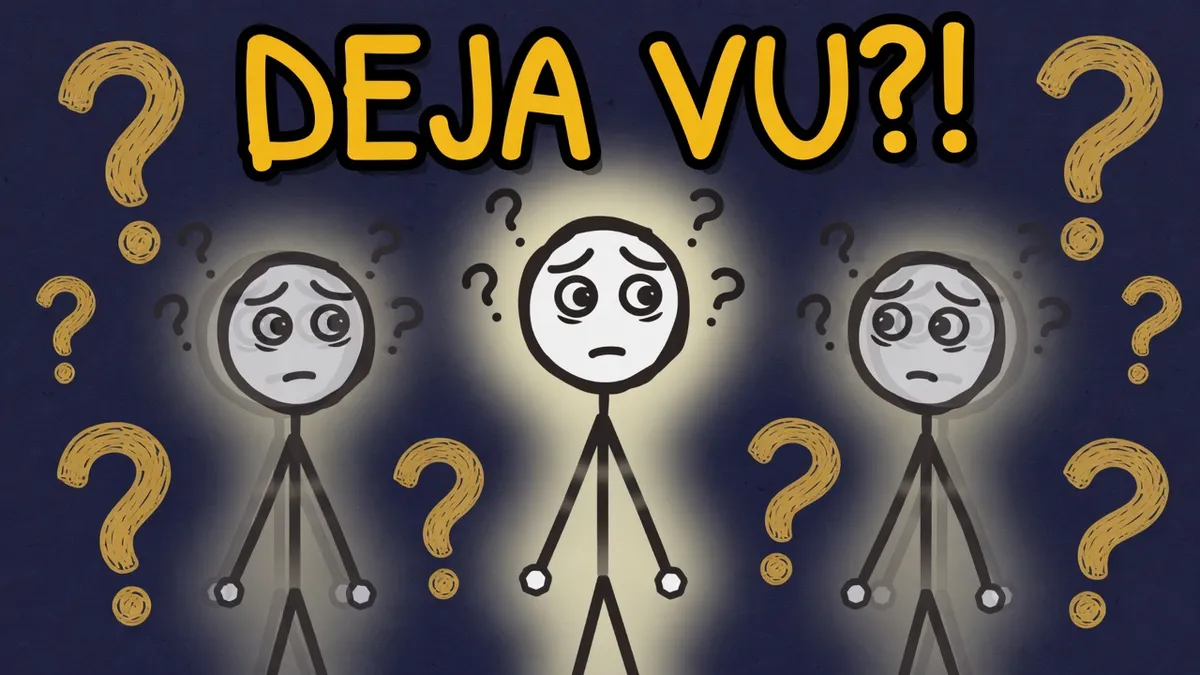
You walk into a room you have never been in, a stranger's house, a new hotel, a city you've never set foot in, and the moment you step inside, you stop. Because you have been here before. You know this room. The light. What they're about to say. For three or four seconds the present moment feels exactly like a memory. And then it's gone. It's one of the eeriest sensations the mind can produce, and for most of history we blamed ghosts. The real answer is stranger, and, oddly, far more comforting.
01 · The feelingRemembering something that never happened
Déjà vu is French for already seen, and around two out of three people get it, most often in the late teens and twenties. For most of history the explanations reached upward and outward: past lives, premonitions, a crack in the simulation. But every one of those assumes the feeling is coming from outside you. The first real clue said the opposite. Whatever déjà vu is, it’s happening inside the machinery of your own memory.
02 · The clueWhat epilepsy revealed
That clue came from medicine. Some people with a particular kind of temporal-lobe epilepsy get a wave of intense déjà vu in the seconds before a seizure, a small electrical storm in the memory regions of the brain. That’s a striking fact, because it means déjà vu can be generated from the inside, by nothing more than electrical activity in the right patch of tissue. No mysterious room required. Which told scientists where to look: not to the beyond, but to the brain’s memory system itself.
03 · The machineryYour two memory systems
And that system runs on two separate channels. The first is recollection: I remember this, I know exactly when and where. The second is familiarity, a vaguer signal that just murmurs I know this, with no details attached. Normally they fire together. You see an old friend and you feel they’re familiar and you remember their name, your history, last Tuesday, both lights on at once. This two-process picture of recognition is one of the most well-established ideas in memory science, and it’s the key that unlocks déjà vu.
04 · The glitchWhen the two come apart
Déjà vu, on the leading account, is what happens when those two channels split. The familiarity alarm goes off, loud, certain, we know this place, but recollection comes back with absolutely nothing. No when. No where. Just the feeling. And so you’re left holding the strangest sensation your mind can produce: the vivid conviction that you’re remembering something that has, in fact, never happened to you.
05 · The triggerWhy an unfamiliar place feels familiar
So what sets off that alarm in a place you’ve genuinely never been? Often, the answer is the layout. A psychologist named Anne Cleary built virtual rooms to test exactly this. When a brand-new scene secretly shared the precise spatial configuration of an old one people had already forgotten, same shapes, same spacing, different contents, familiarity spiked, and so did reports of déjà vu. The new hotel lobby happens to be arranged just like your grandmother’s hallway from twenty years ago, and your brain quietly insists we’ve been here, without ever being able to say why. It recognises the shape of the space while completely failing to place it.
You'd assume déjà vu is your memory breaking. In 2016, scientists watched it happen inside a brain scanner, and the regions that lit up weren't the memory areas at all.
06 · The twistNot a glitch, a fact-check
In a 2016 study out of the University of St Andrews, researchers coaxed déjà vu into happening inside an fMRI scanner. The obvious prediction is that the memory centres would light up as they misfired. Instead, the regions that activated were the frontal ones, the parts that monitor, check, and resolve conflict. The fact-checkers. Which flips the whole thing on its head. Déjà vu might not be your memory making a mistake; it might be your brain catching one. The frontal cortex spots the false familiarity alarm, and the feeling of déjà vu is that conflict being flagged, quality control, caught in the act. (This is the leading interpretation of a still-young line of research, not a closed case, so it’s worth holding lightly, but the brain data genuinely point this way.)
07 · The evidenceWhy it fades with age
And a second fact fits that picture neatly. Déjà vu is most common in young people with sharp memories, and it slowly fades as you get older, which is exactly backwards from how a memory problem should behave. If it were simple decay, it would get worse with age, the way forgetting does. Instead it acts like a system that needs a healthy, well-monitored memory to run at all. And the people who almost never get it aren’t broken either; the leading guess is simply that their internal fact-checker runs a little quieter.
08 · The payoffSo why do we get déjà vu?
Because, on the best current science, your memory hit a genuine conflict, a strong sense of familiarity with nothing to back it up, and your brain caught it. The eeriest few seconds your mind can serve up, the ghostly certainty that you’ve lived this exact moment before, probably isn’t a ghost or a past life or a crack in reality. It looks like close to the opposite of a glitch. It’s your memory raising its hand to say: I’m here. I’m checking. I’m working. Which is a genuinely comforting thought to sit with, right up until it happens again, and you get the faint, creeping feeling that you have heard all of this before.
The animated version
Same answer, told as a little animated story with the strange little stickman acting it out. Dry, quick, and, obviously, correct.
Quick questions
What causes déjà vu?
The leading explanation is a split between two memory systems. Recognition normally combines a feeling of familiarity with actual recollection of when and where. In déjà vu, the familiarity signal fires strongly on its own, without any matching memory, so a genuinely new place feels intensely known, with no details to explain why.
Is déjà vu a sign of a memory problem?
Probably the opposite. A 2016 brain-scan study found that déjà vu activates the frontal, conflict-monitoring regions of the brain rather than the memory areas, suggesting it may be your brain detecting and flagging a false familiarity signal. It's also most common in young people and fades with age, which is backwards from how a memory fault would behave.
Why does a place I've never been feel familiar?
Often it's the layout. Psychologist Anne Cleary built virtual-reality scenes with identical spatial arrangements but different contents. When a new scene secretly matched the configuration of an earlier one people had forgotten, familiarity, and déjà vu, spiked. Your brain recognises the shape of the space without being able to place where it saw it.
How common is déjà vu?
Roughly two-thirds of people report experiencing it, and most people have felt it at least once. It's most frequent in the late teens and twenties and becomes less common with age.
Why is déjà vu linked to epilepsy?
Some people with temporal-lobe epilepsy get an intense wave of déjà vu just before a seizure, caused by electrical activity in the brain's memory regions. That clinical clue is a big part of how scientists realised déjà vu is generated inside the machinery of memory itself, rather than coming from anything supernatural.
What's the difference between déjà vu and jamais vu?
They're mirror images. Déjà vu ('already seen') is a novel situation that feels intensely familiar. Jamais vu ('never seen') is the reverse, a familiar thing, like a common word or your own street, suddenly feeling strange and unrecognised.
Can déjà vu predict the future?
It can feel like it, but no. In a 2018 study, psychologist Anne Cleary induced déjà vu in the lab and then asked people what would happen next: around half felt a strong sense of premonition, yet their guesses were no better than chance. The feeling of 'I know what's coming' is real; the actual foresight isn't. It's a prediction illusion, not a glimpse ahead.
What triggers déjà vu, does being tired or stressed make it more likely?
Often, yes, though this rests mostly on people's own reports rather than hard experiments. Fatigue, stress and poor sleep are the most commonly named triggers, which is why déjà vu tends to spike during exam season or busy, sleep-short stretches. The leading guess is that a tired, overloaded brain is a little more prone to the familiarity-without-memory mismatch. Treat these as strong associations rather than proven causes.
When should I worry about déjà vu?
For almost everyone, never: occasional déjà vu, a few times a year, is completely normal and healthy. It's worth mentioning to a doctor if it becomes frequent or intense, lasts more than a few seconds, or arrives with other symptoms like blank staring, an odd smell or taste, or losing track of time. Those can point to a temporal-lobe seizure rather than everyday déjà vu.
Can you trigger déjà vu on purpose?
Scientists can, in the lab. One method uses virtual reality: show someone a scene secretly laid out like an earlier one they've forgotten, and familiarity, and déjà vu, climb. Another uses hypnosis to plant a false sense of familiarity. There's no reliable trick to summon it at will in everyday life, though.
Are there other kinds of déjà vu, like déjà rêvé?
Yes, déjà vu is just the famous one. Researcher Vernon Neppe catalogued around 21 related 'déjà experiences,' including déjà vécu ('already lived,' a richer, more detailed version), déjà rêvé ('already dreamed'), déjà entendu ('already heard') and déjà senti ('already felt'). They're all variations on the same theme: a feeling of familiarity arriving with no memory to justify it.
Do blind people get déjà vu?
Yes. In 2006, researchers documented a healthy blind man who clearly experienced déjà vu, triggered by sounds, touch and smell rather than sight (sometimes called déjà entendu or déjà senti). It mattered scientifically because it ruled out an old theory that déjà vu depends on a delay in the visual pathway. The feeling lives in memory, not the eyes.
Take the quiz on this
A quick 4-question check on what you just read. Get them right to earn XP: no points for just scrolling.
Our sources 12 checked
// every claim on this page was checked before it went up