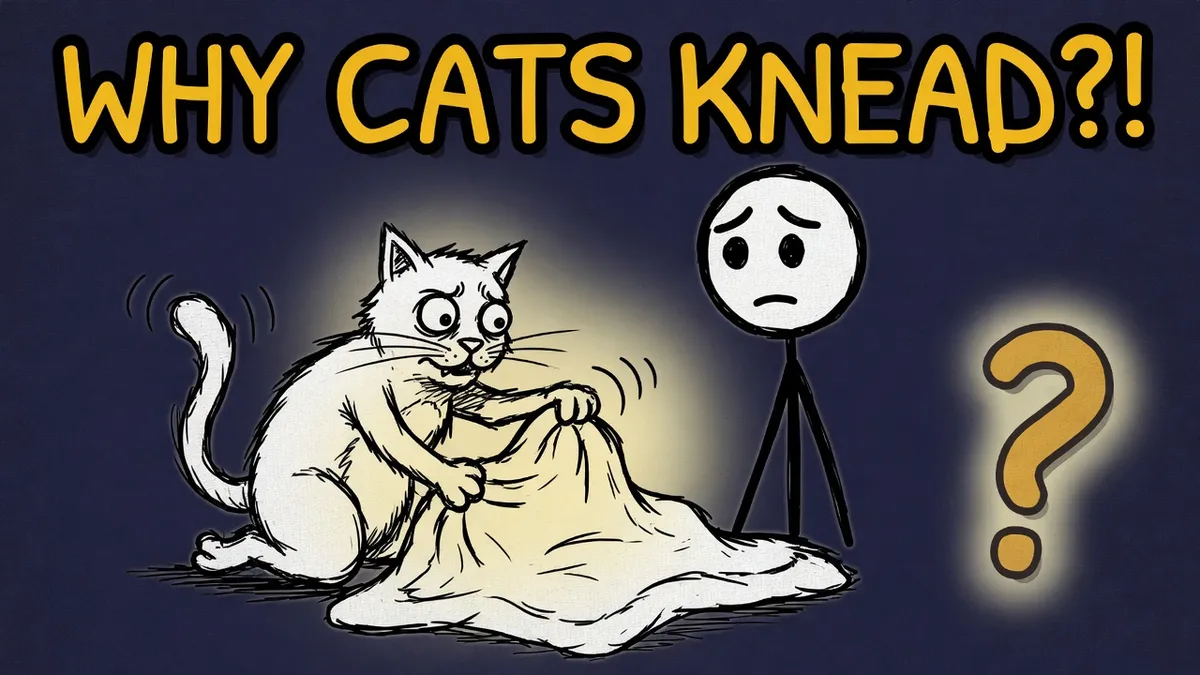
Your cat climbs onto your lap, fixes you with a dreamy half-closed stare, and starts pushing its paws into you, one, then the other, slow and rhythmic, like a tiny baker working dough. People call it making biscuits, and it looks like just another adorable cat quirk. It isn't. That motion is a message sent from the very first days of your cat's life, a scent stamp being pressed into your leg, and, if you read it right, a small declaration that you belong to the cat.
01 · The first pawsA memory from the milk
To understand kneading, rewind to when your cat was a blind, days-old kitten. To feed, nursing kittens push their front paws against their mother’s belly, alternating left and right, because that pressing helps the milk flow. It’s the very first useful thing a kitten’s paws ever do, and it’s wired, from the start, to the best things a kitten knows: warmth, a full belly, safety, mother. That bond between the motion and pure comfort never really switches off. The grown cat kneading your lap is running the oldest, happiest program it has.
02 · The grown-up habitWhy it never stops
Most animals leave their infant behaviours behind. Cats keep this one because the association is too good to lose. Kneading stays fused to the feeling of being safe and content, so an adult cat reaches for it whenever it’s deeply relaxed: on a warm blanket, in a sunny spot, or on the lap of a person it trusts. This is why kneading is such a reliable mood-reading. A kneading cat is, almost by definition, a happy cat. It’s not thinking about milk. It’s just doing the thing its body has always done when life is good.
03 · The scent stampMarking you as theirs
Now the part most owners never realise. Cats run much of their social world through smell, and they carry scent glands tucked between and around their paw pads. So every time your cat kneads, it’s not only getting comfortable, it’s pressing its personal scent into whatever it’s working, be that a cushion, a favourite chair, or you. In cat terms, that’s a signature. It’s quietly labelling the surface as familiar, safe and mine. When your cat kneads your leg, part of what’s happening is a small, affectionate act of ownership. You’ve been claimed.
That kneading before your cat flops down for a nap may be tens of thousands of years old. Its wild ancestors are thought to have trodden down grass and leaves to flatten a soft, safe nest before resting. Your cat pawing at the sofa cushion may be tidying an imaginary patch of long grass that no longer exists.
04 · The nest instinctPatting down a bed
That ancestral angle is worth sitting with. Before there were laps and blankets, a wild cat settling down for the night would tread the ground first, pressing down grass and foliage to check for hidden trouble and to shape a comfortable hollow to curl into. Kneading a blanket before sleep looks a lot like a faded copy of that ritual. So the very same motion may be doing three jobs at once across time: bringing back the comfort of nursing, laying down a scent-mark of ownership, and rehearsing an ancient instinct to build a safe bed. One little gesture, layered deep.
05 · The whole packageBiting, suckling and bliss
You may notice kneading rarely travels alone. A truly blissed-out cat might knead a blanket while gently suckling or nibbling it, eyes shut, purring hard. That’s the whole kitten-at-the-mother bundle resurfacing in an adult, the blanket standing in for mum. It tends to appear at peak relaxation, and it seems to be genuinely self-soothing: behaviourists link kneading to the release of calming endorphins, which is why it so often ushers in a nap. The act doesn’t just show your cat feels good. It may help make it feel good, a comforting little ceremony it performs on itself.
06 · The payoffSo why do cats knead?
Because the first thing your cat’s paws ever learned was that pushing brings comfort, and that lesson never left. Now the grown cat kneads when it feels safe, pressing its scent into the things and people it counts as its own, perhaps echoing a wild instinct to pat down a bed, and soothing itself into a contented calm along the way. So when your cat settles on your lap and starts making biscuits, take the compliment. It’s telling you, in the oldest language it has, that you’re warm, you’re safe, and you’re theirs.
Quick questions
Why do cats knead, in simple terms?
It starts in kittenhood. Nursing kittens push their paws against their mother's belly to help the milk flow, so from day one the kneading motion is tied to warmth, food and safety. Cats carry that association into adulthood, so a grown cat kneads when it feels calm and content, often on a soft blanket or on a person it trusts. It's a comfort behaviour, essentially a happy habit from babyhood.
Why do cats knead on people?
Usually because they're happy and they trust you. Kneading is linked to the contentment of nursing, so when a cat climbs onto your lap and starts pressing its paws, it's a sign it feels safe and relaxed with you. There's a second layer too: cats have scent glands in their paws, so kneading you also marks you with their scent, quietly claiming you as part of their territory. It's a compliment on both counts.
What does it mean when a cat kneads you, is it affection?
Yes, it's generally a strong sign of affection and trust. Cats tend to knead when they're at ease and content, and directing that at a person is a bit like a cat version of a hug or a purr. It often comes bundled with purring, half-closed eyes and settling down for a nap nearby, all signals of a comfortable, bonded cat. A cat that kneads you is telling you it feels good in your company.
Do cats have scent glands in their paws?
Yes. Cats have scent glands between and around their paw pads, and when they knead, they deposit their personal scent onto whatever they're pressing. Since cats communicate heavily through smell, this lets a kneading cat mark a favourite blanket, cushion or person as familiar and 'theirs'. So kneading isn't only about comfort; it's also a quiet act of scent-marking and territory.
Why do cats knead before lying down?
One theory traces it to their wild ancestors. Before resting, wild cats are thought to have trodden down grass, leaves or foliage to flatten a soft, comfortable and safe spot to lie in, a bit like fluffing a bed. Kneading a blanket or cushion before curling up may be a remnant of that nest-preparing instinct. So when your cat paws at the sofa before settling, it may be tidying an imaginary patch of grass.
Do all cats knead, and why do some do it more?
Most cats knead, but the amount varies a lot with personality and background. It's an individual quirk: some cats knead constantly, others rarely. There's a popular belief that cats weaned very early knead or suckle more as adults, though this is more anecdotal than firmly established. Overall, how much a cat kneads is just part of its character, and neither a lot nor a little is anything to worry about.
Why does my cat knead and bite or suckle the blanket at the same time?
Because the whole package harks back to nursing. Kneading, suckling and even a gentle bite on soft fabric can all be pieces of the kitten-at-the-mother behaviour resurfacing in an adult cat. It usually appears when the cat is especially relaxed and comforted, treating the blanket like a stand-in for its mother. It's normal and self-soothing, though if suckling becomes obsessive it's worth a vet's opinion.
Does kneading release calming chemicals for the cat?
It appears to be self-soothing. Behaviourists describe kneading as a behaviour cats perform when relaxed, and it's associated with the release of calming endorphins, which is part of why you often see it just before a nap or during a quiet, contented moment. In other words, kneading may not just express that a cat feels good; the act itself may help it feel good, a bit like a comforting ritual.
Should I stop my cat kneading me if the claws hurt?
You don't need to stop the behaviour, since it's natural and affectionate, but you can manage the claws. Gently placing a soft, thick blanket on your lap before the cat settles gives the claws something to sink into. Keeping the claws trimmed helps too. It's better to redirect or cushion the kneading than to scold the cat for it, since it's a sign of trust you'd generally want to encourage, not discourage.
Why do cats knead blankets and other soft things?
Soft, plush surfaces seem to trigger the behaviour most strongly, probably because they feel like the warm belly of the mother a kitten once nursed against. A fluffy blanket, a woolly jumper or a padded cushion invites the old comfort motion, so cats often single these out and knead them contentedly before settling. The texture is the cue: the softer and warmer it feels, the more it echoes the original nursing spot.
Is 'making biscuits' the same thing as kneading?
Yes, they are the same behaviour under different names. 'Making biscuits' is simply the popular nickname for kneading, because the rhythmic push of the paws looks like a baker pressing and rolling dough. Whether someone calls it kneading, making biscuits or padding, they are all describing the same alternating paw motion with the same roots in kittenhood comfort and scent-marking.
Do male cats knead too, or is it mostly females?
Both male and female cats knead, and there is no strong sex difference in the behaviour. Because kneading traces back to nursing, which every kitten does regardless of sex, it stays wired into toms and queens alike. How much an individual cat kneads comes down to personality and comfort rather than whether it is male or female.
Should I be worried if my cat never kneads?
No, a cat that rarely or never kneads is usually perfectly normal. Kneading is a common comfort behaviour, but it is not universal, and some cats simply express affection in other ways, such as head-butting, purring, slow blinking or curling up close to you. As long as your cat seems relaxed and content, the absence of kneading is just part of its individual character, not a warning sign.
Our sources 6 checked
// every claim on this page was checked before it went up