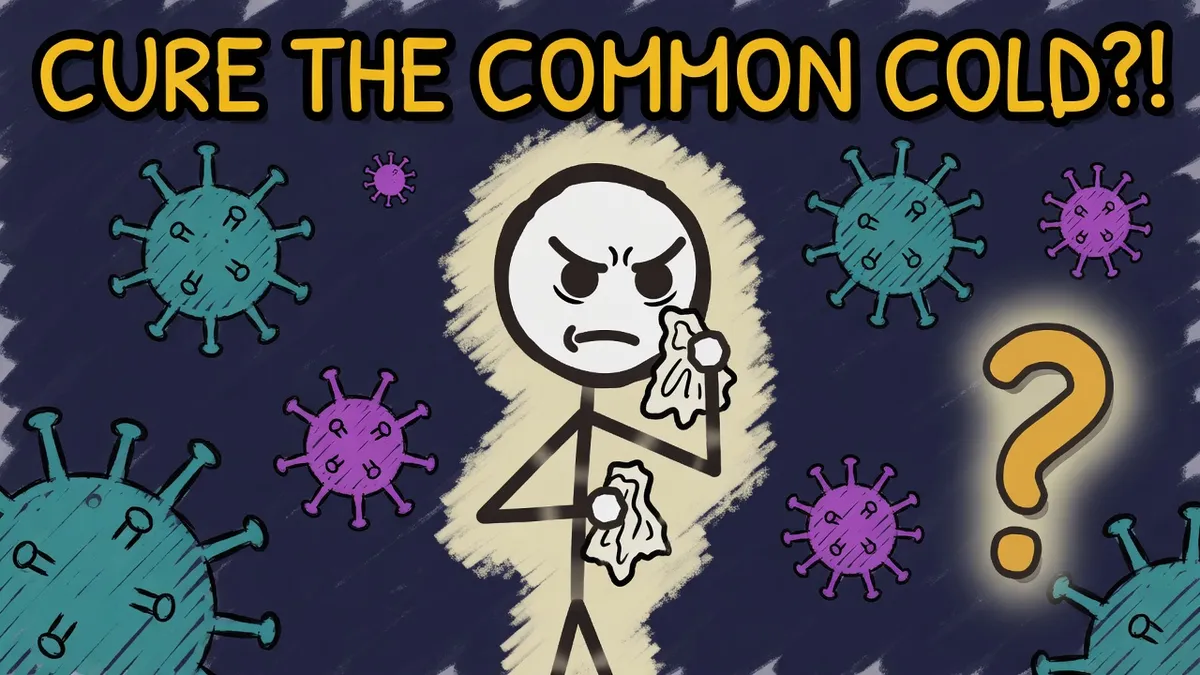
Here is a genuinely humbling fact about modern medicine. We took smallpox, a disease that killed hundreds of millions of people, and erased it from the face of the Earth. We pushed polio to the edge of extinction. We built vaccines against measles, hepatitis, and a global pandemic virus in under a year. And yet the runny nose you had last February, the one that ruined a weekend and then quietly went away on its own, remains completely, stubbornly incurable. The problem is not that the cold is too dangerous. The problem is that it was never really one thing to cure.
01 · The category errorThe cold is not a disease. It's a symptom.
Start with the thing almost everyone gets wrong. When you say you have “a cold,” you are not naming a virus. You are describing a set of symptoms: the stuffy nose, the sore throat, the sneezing, the low-grade misery. And an enormous number of completely different viruses can produce that exact set of symptoms. More than 200 distinct viruses are known to cause colds, drawn from several unrelated viral families: rhinoviruses, coronaviruses, adenoviruses, RSV, parainfluenza, and more. Asking to “cure the common cold” is a bit like asking to cure “a headache.” You are naming the ache, not the cause, and there are hundreds of causes.
02 · The ringleadersOne family, 160-plus disguises
The single biggest culprit is a family called the rhinoviruses, which cause up to about half of all colds. And here is where the numbers get properly absurd. Rhinoviruses are not one virus. They split into three species, and between them there are more than 160 recognised types, each wearing a slightly different set of surface proteins. To your immune system, those surface proteins are the virus’s face. Learn one face and you can spot that intruder instantly next time. The trouble is that all 160-plus rhinovirus types have different faces. Beating one teaches your body almost nothing about the others, which is why you can catch cold after cold after cold and never seem to build up a wall.
03 · The moving targetWhy it never sits still
Even if you somehow trained your immune system on all 160-plus faces at once, the viruses would not do you the courtesy of keeping them. Rhinoviruses copy their genetic code with a sloppy enzyme that has no proofreading step, so it makes errors on nearly every replication cycle, on the order of one to a few mutations each time. Over millions of copies, the population keeps quietly reshaping its face, a process called antigenic drift. This is the same trick that forces us to reformulate the flu vaccine every year, except the cold plays it across hundreds of viral types at once. A vaccine needs a stationary bullseye. The cold is a swarm, and every member of the swarm is slowly changing shape.
04 · The failed rescuesWhy "cures" keep collapsing
None of this has stopped people trying, and the failures are instructive. Antibiotics, still handed out for colds far too often, do literally nothing: colds are viral, and antibiotics kill bacteria, so all you get is unpleasant side effects and a nudge toward antibiotic resistance. Antivirals are the smarter idea, but they run straight into the diversity problem. The most promising candidate, pleconaril, cleverly plugged into a pocket on the virus’s outer shell, and it actually worked, a little. It shortened colds by roughly half a day to a day and a half. An FDA panel rejected it in 2002, citing modest benefit, side effects, and a worrying interaction with oral contraceptives. And the vitamin C and zinc you keep in the cupboard? At best they trim a cold’s edges. Nothing you can buy makes it vanish.
The very thing that let us destroy smallpox is the thing that saves the cold. Smallpox was one virus, one stable face, one vaccine. The cold's superpower is not that it's deadly. It's that it's a crowd.
05 · The cruel comparisonWe beat the monsters, not the pest
Think about what we have actually defeated. Smallpox had a single, genetically stable form: hit it with one good vaccine and there was nowhere for it to hide, which is exactly how it became the first disease ever eradicated. Polio, near the finish line, comes in only a handful of types. The pattern is clear: humanity wins against viruses that hold still and present one target. The cold is the precise opposite of that. It is not one deadly enemy but a shifting, endlessly varied mob of mostly harmless ones. We conquered the monsters because they stood in the open. The pest survives by being a hundred different pests, none of them worth standing still to fight.
06 · The economics of mercyNobody's paying for the war
There is one last, very human reason. The cold is mild. It clears on its own in about a week, and it almost never kills a healthy person. That gentleness is precisely why it is neglected: research money and pharmaceutical investment flow toward the diseases that maim and kill, not the ones that merely annoy. It is a genuinely reasonable set of priorities, and it leaves the cold sitting in a strange blind spot: a disease costing the U.S. economy an estimated tens of billions of dollars a year in sick days and doctor visits, yet never dangerous enough to command a serious, sustained hunt for a cure.
07 · The payoffSo why can't we cure it?
Because “it” was always the wrong word. The common cold is not a single disease with a hidden weak spot we simply haven’t found. It is a loose alliance of over 200 viruses, led by a family of 160-plus rhinoviruses that all look different, mutate constantly, and grant you no lasting immunity. Every property that makes a virus curable, one form, one stable target, one vaccine that finishes the job, is a property the cold specifically lacks. We didn’t fail to cure the common cold because it outsmarted us. We are simply, quietly, wildly outnumbered, by an enemy too mild for anyone to fund the fight.
Quick questions
How many viruses cause the common cold?
More than 200 distinct viruses can produce what we call a cold. Rhinoviruses are the biggest single family, causing up to about half of all colds, followed by coronaviruses, adenoviruses, RSV, parainfluenza and others. That is why 'the cold' behaves less like one disease and more like a category.
How many types of rhinovirus are there?
Over 160. Rhinoviruses split into three species (A, B and C) and, between them, more than 160 recognised types, each carrying different surface proteins. Your immune system treats nearly every one as a brand new enemy.
Why doesn't catching a cold make you immune to the next one?
Because the next cold is usually a different virus, or a different type of the same virus. Antibodies you build against one rhinovirus type barely recognise the others, so immunity to one gives you almost no cross-protection against the 160-plus that remain.
Why is there no cold vaccine?
A vaccine needs a stable target. To cover the cold you would need protection against 200-plus viruses, including 160-plus rhinovirus types that keep mutating. Making, and injecting, that many components at once is currently impractical, which is why no cold vaccine has ever been approved.
Do antibiotics help a cold?
No. Colds are caused by viruses, and antibiotics only kill bacteria. Taking them for a cold does nothing for you and helps breed antibiotic-resistant bacteria. Doctors still prescribe them for colds far too often, which is a genuine public-health problem, not a treatment.
Is there any antiviral for the common cold?
Not an approved one. The most promising candidate, pleconaril, blocked the virus's outer shell but was rejected by the FDA in 2002: it shortened colds by only about a day and carried side effects, including a worrying drug interaction. The cold's diversity makes a broad antiviral very hard to design.
Why can we cure some viral diseases but not the cold?
We tend to beat viruses that are single, stable targets. Smallpox had one form and one vaccine wiped it out. The cold is the opposite: a shifting crowd of hundreds of viruses, so there is no single bullseye to aim a cure or vaccine at.
How often does the average person get a cold?
Adults typically catch two to three colds a year, and young children often get six to twelve, partly because they are meeting these viruses for the first time. Over a lifetime that adds up to a couple of hundred colds, most of them different viruses.
Do rhinoviruses mutate a lot?
Yes. Their copying enzyme lacks proofreading, so it makes errors on almost every replication cycle. That constant drift means the virus population keeps changing its appearance, which is one reason lasting immunity, and a lasting vaccine, are so hard.
Why hasn't more money gone into curing the cold?
Because it is usually mild and self-limiting. A disease that clears on its own in a week attracts far less research funding and pharmaceutical investment than a killer would, even though the cold's sheer frequency costs economies tens of billions of dollars a year.
Does vitamin C or zinc cure a cold?
Neither cures it. For most people vitamin C does not prevent colds and shortens them only marginally at best. Some evidence suggests zinc, taken very early, may trim a cold's duration slightly, but results are mixed and it is far from a cure. Nothing you can buy makes a cold disappear.
Will we ever cure the common cold?
Maybe partially. Researchers are exploring approaches that target something the virus can't easily change, such as a human protein it needs to replicate, or shared features across many rhinovirus types. A single classic vaccine remains unlikely, but a broad-acting antiviral is not impossible.
Take the quiz on this
A quick 4-question check on what you just read. Get them right to earn XP: no points for just scrolling.
Our sources 10 checked
// every claim on this page was checked before it went up