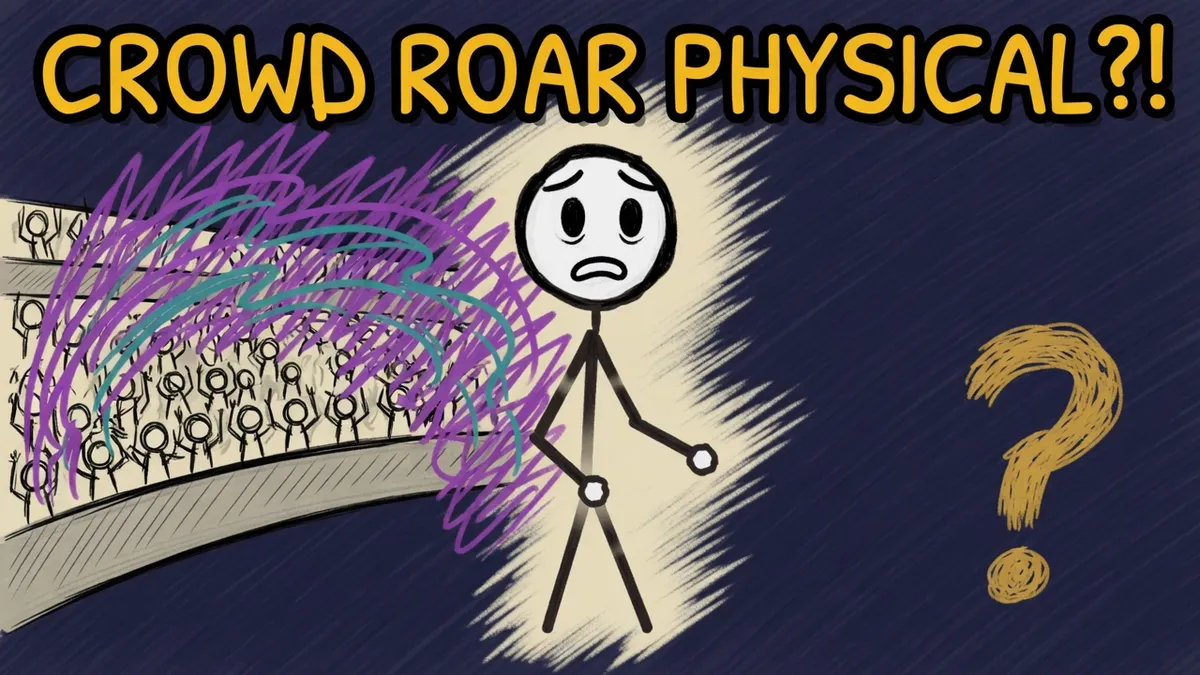
There is a strange threshold in a packed stadium, and if you have ever been inside one you know exactly the moment. A goal, a knockout, a final whistle, and the place erupts. For a second the roar stops being something you hear and becomes something that hits you. It presses on your chest. It moves the air in your lungs. That is not your imagination working overtime, and it is not just excitement. A roar that big is, in the most literal physical sense, pushing on your body.
01 · The waveSound was always a physical thing
Here is the fact everything else hangs on: sound is a pressure wave. When a source vibrates, it shoves the air next to it into a patch of slightly higher pressure, which shoves the next patch, and so on, a ripple of squeeze-and-release racing outward at the speed of sound. There is no “sound” floating through the air as some separate substance. There is only moving air pressure. When that ripple reaches you, it physically pushes and pulls on whatever it meets: your eardrum, your skin, your ribcage.
At the volumes of ordinary life, that push is minuscule, far too small to feel anywhere but the exquisitely sensitive eardrum, so it registers only as hearing. But the wave was never only a sensation in your ears. It was always a mechanical force. Turn the pressure up high enough, and your body starts to feel the very same wave your ears are straining to process. Hearing and feeling a sound are not two different things. They are the same push, at two different sizes.
02 · The decibelWhy the numbers hide how violent it gets
To understand why a stadium crosses that line, you have to understand the decibel, and the decibel is sneaky. It is a logarithmic scale, built to compress an enormous range of pressures, from a falling pin to a jet engine, spanning something like a trillion to one, into tidy two- and three-digit numbers. The trade-off is that the scale quietly lies about how big the steps are.
The rule to hold onto: every 10 decibels is ten times the sound energy. Not ten percent more. Ten times. So 90 dB carries ten times the energy of 80 dB, and 100 dB carries a hundred times the energy of 80 dB. A rock concert at 120 dB and a stadium roar at 140 dB look like near neighbours on paper. In actual energy delivered to your body, the roar is on the order of a hundred times more powerful. The scale is gentle. The reality it describes is not.
03 · The recordHow loud a crowd has genuinely been
So how loud does a crowd actually get? Loud enough to be measured and certified, and the numbers are startling. The verified record for the loudest crowd roar at a sports stadium, ratified by Guinness World Records, is 142.2 dBA, set by Kansas City Chiefs fans at Arrowhead Stadium on 29 September 2014. To put that in company: a jet engine heard up close and a gunshot both sit around 140 to 150 dB. Tens of thousands of ordinary people, cheering, reached the same neighbourhood.
It was the peak of an arms race. The year before, on 2 December 2013, Seattle Seahawks fans at what was then CenturyLink Field hit 137.6 dBA, and that reading came with a detail that sounds invented but isn’t: the Pacific Northwest Seismic Network picked up ground vibrations around the stadium equivalent to a small magnitude 1 to 2 tremor. Most of that came from the crowd jumping and stamping in rough unison rather than from the sound itself, but the point stands. A big, excited crowd pumps a genuinely seismic amount of mechanical energy into the world around it.
04 · The chestWhy bass is the part you feel
Not all of that sound reaches your body equally, though, and this is the elegant part. What you feel, as opposed to merely hear, is overwhelmingly the low end: the bass, and the deep collective rumble of thousands of voices. The reason is resonance. Your torso is full of air-filled spaces, the chest and the abdomen chief among them, and those cavities have their own natural resonant frequencies, which happen to sit low. When a strong low-frequency wave arrives, it matches those resonances and transfers its energy straight into your body, setting your chest wall genuinely vibrating.
High frequencies can’t do this. A cymbal or a whistle is too fast and too easily soaked up by skin and clothing to move your ribcage, so it stays purely in your ears. But bass couples into your body. That is the whole secret of why a huge sound feels physical: the low frequencies aren’t just heard, they mechanically shake the air inside you. Your chest becomes, briefly, part of the instrument.
The very bottom of a crowd's rumble shades into infrasound, sound too low for your ears to register as a tone, but not too low for your body to feel. It's the same eerie low-frequency channel that, in a quiet room, can conjure a vague sense of dread out of nowhere.
We go down that rabbit hole in its own piece: why a sound too low to hear can fill a room with dread. In a stadium the low end is doing the friendlier version of the same trick, reaching past your ears and pressing directly on you.
05 · The crowdA roar is loud and loaded
But if a roar were only air pressure, a subwoofer in an empty room would move you the same way, and it doesn’t. Because a crowd roar is never just loud. It is social, and that changes what your nervous system does with it. A sudden collective eruption, at a moment that clearly matters, is exactly the sort of intense, meaningful spike that flips your body into its fight-or-flight state and floods it with adrenaline. That’s the same reflex that raises the hair on your arms, and it overlaps directly with the machinery behind goosebumps and the reward-soaked shiver of musical chills.
There’s a second, stranger layer. Being physically inside a crowd appears to synchronise you with the people around you. Studies of live audiences have found that attendees’ autonomic nervous systems, heart rate and arousal, fall into greater alignment at the group level than those of people watching remotely, and that this shared arousal is tied to a stronger sense of bonding and even fused identity. So the roar hits you twice over. Once as raw pressure on your chest, and once as a wave of collective feeling your own body is quietly tuning into. That combination is why the same goal feels seismic in the stands and merely pleasant on a screen.
06 · The catchThe honest note about your ears
Now the part that has to be said plainly, because the physics that makes a roar thrilling is the same physics that makes it dangerous. The threshold of pain for sound sits at roughly 120 to 130 decibels, about a loud concert at close range. Pain is not squeamishness. It is your body’s blunt alarm that the pressure is now high enough to do harm. Push to around 140 dB, and even a single brief burst can permanently damage the tiny hair cells in your inner ear.
Look back at those records. 142.2 dB. 137.6 dB. Those crowds, however magnificent, were genuinely in hearing-damage territory. And the cruel thing about noise damage is that it is cumulative and permanent: the CDC notes that hearing loss can come from a single exposure at or above 120 dB, or from repeated exposure at or above 85 dB over time, and the hair cells you lose do not grow back. Every loud event you sit through spends a little of a balance you can never top up. The ringing or muffled feeling afterward is not a badge. It is the receipt.
07 · The payoffSo why does it feel physical?
Because it is physical, from start to finish. A roar is a wall of moving air pressure, so loud that it stops being a mere signal to your ears and becomes a genuine force on your chest, with its low frequencies resonating inside the cavities of your own body. Layered on top is the social electricity of a synchronised crowd, borrowing the ancient reflex that gives you goosebumps. There is even a hard ceiling to it all: no sound in our atmosphere can exceed about 194 decibels, the point where the wave’s own troughs hit a vacuum and it collapses into a shockwave. A stadium roar, for all its power, is a controlled brush with that limit. The next time a crowd erupts and you feel it land in your chest, know that you are not being poetic. You are standing in a pressure wave, feeling a sound that has grown too big for your ears to keep to themselves.
Quick questions
Is sound actually a physical force?
Yes, always, at every volume. Sound is a wave of alternating high and low air pressure travelling outward from its source. When it reaches you, that pressure literally pushes and pulls on anything in its path, including your eardrum, your skin, and your chest wall. At quiet levels the push is far too small to feel, so it only registers as hearing. At the levels of a stadium roar, the push gets big enough that your body starts to feel the wave directly, on top of hearing it.
Why can I feel bass in my chest but not high notes?
Low frequencies match the natural resonances of your air-filled body cavities, chiefly the chest and abdomen, so a strong low-frequency wave transfers its energy into your torso and sets it vibrating. High frequencies are too fast and too easily absorbed by skin and clothing to do this, so they stay as pure sound. That's why bass and deep rumble are the parts of loud music you feel in your body, while a cymbal or a whistle stays in your ears.
What is the loudest crowd ever recorded?
The Guinness World Record for the loudest crowd roar at a sports stadium is 142.2 dBA, set by Kansas City Chiefs fans at Arrowhead Stadium on 29 September 2014. Before that, Seattle Seahawks fans at CenturyLink Field (now Lumen Field) reached 137.6 dBA on 2 December 2013, a reading so intense that the local seismic network detected ground vibrations equivalent to a small earthquake.
How loud is 142 decibels really?
Extremely, dangerously loud. For scale, a jet engine at close range and a gunshot both sit around 140 to 150 dB. Because decibels are logarithmic, 142 dB is not 'a bit louder' than a rock concert at 120 dB: it carries on the order of a hundred times more sound energy. It is well past the threshold of pain and into the range where even brief exposure can cause immediate, permanent hearing damage.
What does a decibel actually measure?
It measures sound intensity on a logarithmic scale, which is a compact way to handle a range of pressures spanning about a trillion to one. The key rule: every increase of 10 dB means ten times the sound energy, and is heard as roughly twice as loud. So 90 dB is ten times the energy of 80 dB, and 100 dB is a hundred times the energy of 80 dB. The scale looks gentle and the reality is anything but.
Why does +10 dB mean ten times the sound, not just a bit more?
Because the decibel scale is deliberately logarithmic. Our ears register an enormous span of pressures, from a faint rustle to a jet engine, so a plain linear scale would need numbers with a dozen digits. Compressing that span with logarithms keeps the numbers small and human-sized, at the cost of hiding how brutal the top end is. Each 10-point step packs a tenfold jump in energy, which is exactly why the difference between 130 and 140 dB matters far more than it looks.
Is the low rumble of a big crowd infrasound?
Part of it edges that way. Thousands of voices and stamping feet produce a lot of low-frequency energy, and the very bottom of it shades toward infrasound, the range below about 20 Hz that your ears can't register as a tone but your body can feel as vibration. It's the same low-frequency channel that, in other settings, can produce a vague bodily unease. We cover that strange effect in why a sound too low to hear can fill a room with dread.
Why does a crowd roar give me goosebumps or chills?
Because it isn't only loud, it's socially charged, and that flips your fight-or-flight system on. A sudden collective roar, especially at a moment that matters, is exactly the kind of intense, meaningful spike that triggers the adrenaline reflex behind gooseflesh and the reward-linked shiver of musical chills. It's the same hardware, borrowed by a stadium. See why you get goosebumps and why music gives you chills.
Can a crowd's noise really cause an earthquake reading?
Not a real earthquake, but genuine ground vibration that seismometers can pick up. When Seattle's crowd hit its record in 2013, the Pacific Northwest Seismic Network registered tremors in the surrounding ground equivalent to a magnitude 1 to 2 event. The shaking came mostly from tens of thousands of people jumping and stamping in rough unison, with the sound pressure adding to it, not from the sound alone. It's a vivid illustration of how much mechanical energy a big excited crowd puts into its surroundings.
At what volume does sound start to hurt?
The threshold of pain sits at roughly 120 to 130 dB for most people, which is about the level of a loud rock concert at close range or a nearby ambulance siren. Pain is your body's blunt warning that the pressure is now high enough to risk damage. Above about 140 dB, even a single brief exposure can cause immediate, permanent harm to the delicate hair cells in your inner ear.
Can a loud concert or match permanently damage my hearing?
Yes. According to the CDC, noise-induced hearing loss can come from a one-time exposure to a very loud sound at or above 120 dB, or from repeated exposure to sounds at or above 85 dB over time. The damage is to the hair cells of the inner ear, which do not grow back, so it is permanent and it accumulates over a lifetime. A ringing or muffled feeling after a loud event is a real warning sign, not just a nuisance.
Is there a limit to how loud a sound in air can be?
Yes, and it's around 194 dB. A sound wave is alternating high and low pressure, and the low-pressure troughs can't fall below a total vacuum. At about 194 dB the troughs hit that floor, so the wave can't get any louder without breaking down into a shockwave or blast wave instead. So there is a hard ceiling on ordinary sound in Earth's atmosphere, and a stadium roar, loud as it feels, is comfortably below it.
Why does a roar feel more physical in person than on TV?
Two reasons. First, the raw sound pressure: a stadium PA and tens of thousands of voices deliver far more low-frequency energy to your body than any living-room speaker, so you actually feel the wave. Second, being physically inside a crowd syncs your arousal with everyone around you. Studies of live audiences find people's autonomic nervous systems fall into greater synchrony in person, which a screen can't reproduce. The roar hits your chest and your social wiring at once.
Does everyone feel a loud crowd the same way?
The physics is the same for everyone: the pressure wave pushes on every chest equally. The feeling, though, varies. How strongly a roar moves you emotionally, whether it raises the hair on your arms, tracks the same individual wiring that governs musical chills, which some people feel intensely and others barely at all. So two people in the same row can take identical pressure on the ribcage and have very different experiences of it.
Take the quiz on this
A quick 4-question check on what you just read. Get them right to earn XP: no points for just scrolling.
Our sources 10 checked
// every claim on this page was checked before it went up