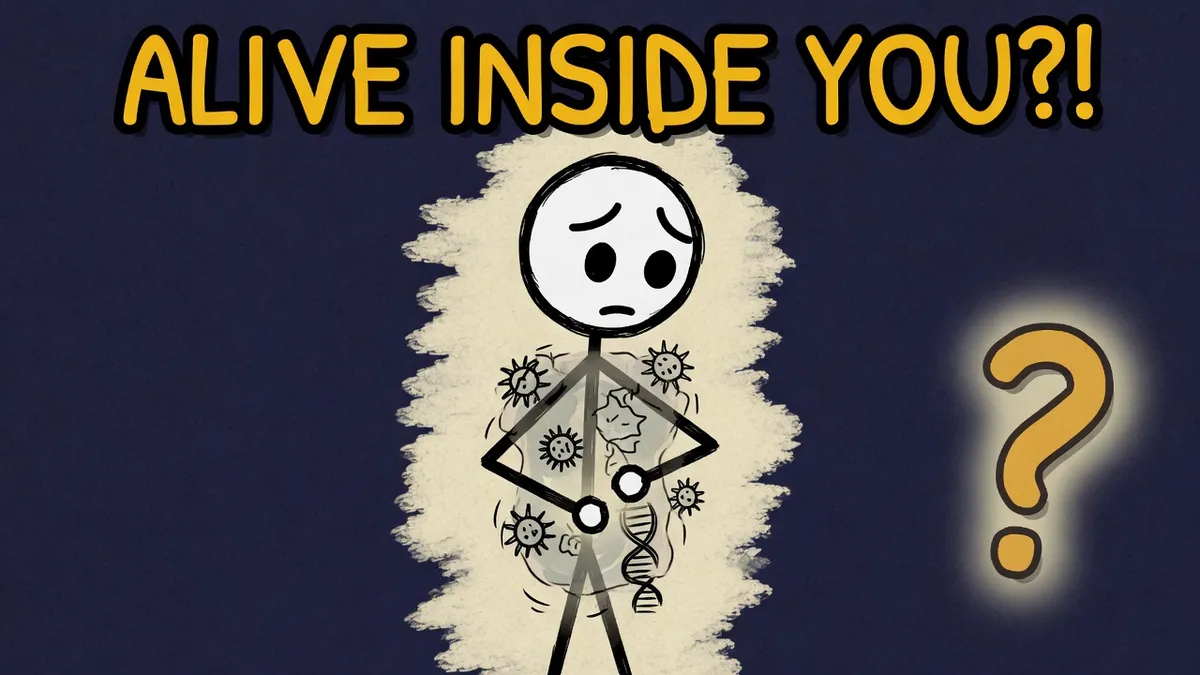
Here is a genuinely unsettling sentence to read about your own body: there's roughly a fifty-fifty chance that, right now, your mouth is full of something science only discovered in 2024, and nobody can quite agree whether it's alive. Not a bacterium. Not a virus. Not a single thing we already had a name for. Researchers called them obelisks, and the strangest part isn't that they exist. It's that they'd been inside us all along, and we simply didn't have the eyes to see them.
01 · The findSomething new, and it was already in your mouth
In early 2024, a team at Stanford led by a graduate researcher named Ivan Zheludev announced they’d found something entirely new living inside people. They named the things obelisks, and the numbers made everyone sit up: depending on the sample set, obelisks turned up in around 7% of gut samples and roughly half of the mouth samples they looked at. Not a curiosity in one unlucky patient, apparently a common resident of the human body that we’d walked past for the entire history of biology.
02 · The methodHiding in data we already had
The way they were found is almost the best part. Nobody spotted an obelisk down a microscope. Instead, the researchers went trawling through enormous public databases of genetic code, all the RNA that earlier studies had scooped out of human guts and mouths and dumped online, and built a custom tool to hunt for one specific oddity: little loops of code that matched nothing known. Not any bacterium, not any virus, not anything ever catalogued. The obelisks weren’t hidden in some remote cave. They were sitting in data we’d already collected, for years, waiting for somebody to think to look.
03 · The thing itselfWhat an obelisk actually is
At heart, an obelisk is almost absurdly simple. It’s a tiny circle of RNA, genetic material, the close chemical cousin of DNA, about a thousand letters long, that folds up on itself into a long, thin rod. That rod shape is exactly where the name comes from. A subset of them carry a scrap of self-cutting RNA machinery (a “hammerhead ribozyme”), and they all seem to code for a brand-new family of proteins the researchers had to invent a word for: Oblins. But strip that away and you’re left with something startling in its bareness, a naked little loop of code, and essentially nothing else.
04 · The classification problemNot a virus, not a bacterium
Here’s why obelisks caused such a stir: they fit nowhere on the tree of life. Far too small and simple to be a bacterium. But not quite a virus, either. A virus at least wraps its genes in a protein shell, a delivery capsule for getting into cells. An obelisk is more stripped-back than that, closer to a viroid, which is about the barest scrap of biology we know of. When the team compared them to every catalogued genome, they matched none of it. Obelisks form their own group, off on their own branch, related to nothing we’d met before.
They don't live in your cells. They live inside the microbes that live inside you, a hidden layer, tucked underneath a hidden layer. Some researchers have called them the microbiome's own microbiome.
05 · The locationThe microbiome's microbiome
Your mouth and gut are teeming with bacteria, your microbiome, and obelisks have set up home inside some of them. So far the clearest confirmed host is Streptococcus sanguinis, a bacterium so common it’s probably in your mouth as you read this. Inside it, a specific obelisk copies itself quite happily. And here’s a telling detail: as best anyone can tell, the bacterium doesn’t need the obelisk. Knock it out and the bug grows fine. So the obelisk isn’t a vital part; it’s more like a long-term lodger whose reason for being there is, so far, a mystery.
06 · The old questionIs it even alive?
Which drags up the oldest argument in all of biology. Left entirely on its own, an obelisk does absolutely nothing. It can’t move. It can’t feed. It can’t even copy itself. It has to hijack a living cell to do anything at all. So by that test, no, it isn’t alive. But by that exact same test, neither is a virus, and we’ve been arguing about viruses for a century. The honest position, and the one the researchers themselves take, is that obelisks sit right on the blurry line between chemistry and life, and it’s genuinely too early to plant a flag on either side.
07 · The humbling partNobody knows what they do, yet
And now the part scientists are most careful about. We have almost no idea what obelisks are for. Are they helping the bacteria they live in? Harming them? Doing anything at all to you? Nobody yet knows. Helpful, harmful, and completely neutral are all still on the table, and this is very fresh, still-being-worked-out science. There’s no evidence they cause any disease, and equally no evidence they’re doing you any good. They’ve apparently been riding around inside human beings, unnoticed, for who knows how long.
So the real answer to “why did scientists just find things inside you that aren’t quite alive?” is a little humbling. They didn’t find them because the things were rare or hiding. They found them because someone finally built the right tool and thought to look in the data we already had. You’re not really one single thing. You’re closer to a walking city: your own human cells, the trillions of microbes riding along with you, and now a freshly-spotted layer beneath even those. Bare little loops of code, that may not even count as alive, that we only really noticed the day before yesterday. Which does rather make you wonder what else is quietly in there.
The animated version
Same answer, told as a little animated story with the strange little stickman acting it out. Dry, quick, and, obviously, correct.
Quick questions
What are obelisks in biology?
Obelisks are a newly described class of viroid-like RNA elements, first reported by a Stanford team in 2024. Each is a small circular strand of RNA, around 1,000 letters long, that folds into a rod-like shape and lives inside the bacteria of the human microbiome. They don't match any bacterium or virus previously catalogued; they form their own group.
Are obelisks alive?
That's genuinely unresolved. Left alone, an obelisk can't move, feed, or copy itself, it needs a living cell to do anything. By that test it isn't alive. But by that exact same test, neither is a virus. Obelisks sit on the same blurry border between chemistry and life, and scientists are careful not to overclaim either way.
How were obelisks discovered?
Not down a microscope. Researchers data-mined huge public databases of genetic code, the RNA scooped out of human guts and mouths in earlier studies, using a custom tool to spot circular sequences that matched nothing known. The obelisks had been sitting in data we'd already collected, unnoticed, for years.
Do obelisks make you sick?
Nobody knows yet. Their effect, on the bacteria they live in, and on us, is one of the biggest open questions. They could be harmful, helpful, or simply along for the ride. As of now there's no evidence tying them to any disease; the honest answer is that it's too early to say.
How common are obelisks in people?
In the original study, obelisks turned up in roughly 7% of gut (stool) samples and about 50% of mouth samples analysed, so around half the oral microbiomes tested carried them. A later global survey catalogued nearly 30,000 distinct obelisks from many different environments, so they appear to be widespread, not rare.
When were obelisks discovered?
In 2024, which makes them astonishingly fresh as scientific discoveries go. The Stanford team posted their findings as a preprint in January 2024, and the peer-reviewed paper appeared in the journal Cell later that year. The ink is barely dry, which is exactly why so much about obelisks is still honestly marked 'unknown.'
What is a viroid?
A viroid is the smallest known infectious agent: a tiny loop of naked RNA, no protein shell, and no genes for making proteins, and that's essentially it. They run to just a few hundred letters of circular, single-stranded RNA. The first was pinned down in 1971 as the cause of a potato disease, and the viroids we know of infect plants. Obelisks are described as viroid-like because they share that bare-loop-of-RNA design, though they aren't classic viroids, notably, they appear to code for proteins, which true viroids don't.
What is the difference between a virus and a viroid?
A virus wraps its genetic material. DNA or RNA, inside a protein shell (a capsid) that works as a delivery capsule, and it usually carries genes for making proteins. A viroid is far more stripped-back: a bare circle of RNA with no protein coat at all, and it codes for no proteins. Both still need a living host to copy themselves. Obelisks sit oddly between the two, as bare as a viroid, but, unusually, they do seem to encode proteins of their own, which is part of why they were flagged as genuinely new.
What are Oblins?
Oblins are a brand-new family of proteins that obelisks appear to code for, so new the researchers had to coin the word. Most obelisks carry the genes for at least one. What the proteins actually do is unsettled: early structural predictions hint that one version might bind metal ions and another might grip onto host-cell enzymes, but those are model-based guesses, not confirmed jobs. That obelisks encode any protein at all is one of the things setting them apart from classic viroids, which encode none.
What do obelisks do in the gut?
Honestly, nobody knows yet, it's the single biggest open question about them. Early structural predictions hint that their Oblin proteins might bind metal ions or latch onto host enzymes, which could mean they influence the bacteria they live in, and in principle ripple out to affect us. But that is informed guesswork from computer models, not a demonstrated function. As of now, their actual role in the gut is unproven.
Are obelisks dangerous?
There's no evidence that they are, though it's a fair thing to ask, because their plant-infecting cousins the viroids genuinely do cause disease (one of them wrecks potato crops). For obelisks in people, no one has tied them to any illness, and it's far too early to say whether they're harmful, helpful, or simply passengers. Treat any confident claim in either direction with suspicion; the honest answer is that we don't yet know.
How common are obelisks in people?
Common in some niches, rare in others. They showed up in about 7% of analysed stool metatranscriptomes and about half of oral ones, and a later global survey found tens of thousands of distinct obelisks. They hitchhike with the microbiome rather than living as freestanding parasites of human cells.
Are obelisks viruses?
Not exactly. They are tiny RNA agents more like plant viroids than classic viruses: no protein coat, tiny genome, and they hitchhike with bacteria rather than infecting human cells the way a flu virus does. They sit in a fuzzy zone of 'almost alive' genetics.
Take the quiz on this
A quick 4-question check on what you just read. Get them right to earn XP: no points for just scrolling.
Our sources 14 checked
// every claim on this page was checked before it went up