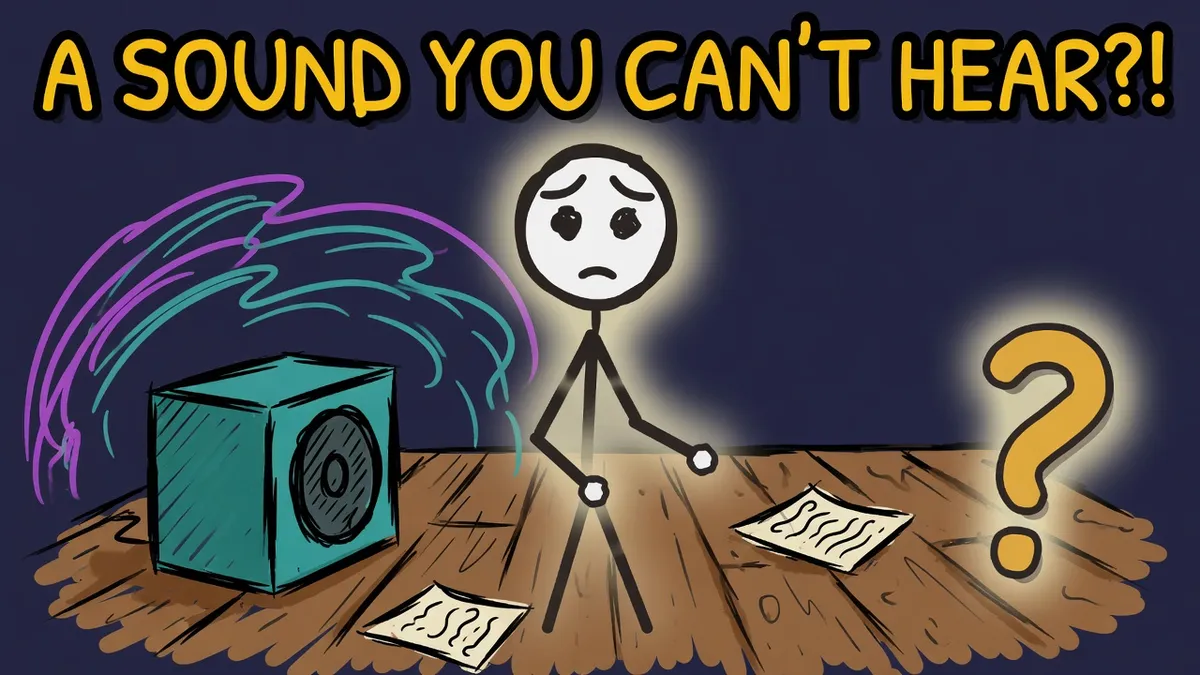
Here is a genuinely unsettling idea: there are sounds all around you, right now, that your ears are physically incapable of hearing, and at least one of them may be able to reach inside you anyway. Not by being loud. By being low. Too low to register as a note, but not too low to shake your eyes, press on your chest, and, on the right dark night in the right room, help write a ghost story with your name on it. The strangest part is that the man who first pieced this together wasn't a ghost hunter. He was an engineer, and he thought he was losing his mind.
01 · The hauntingThe engineer who met a sound
In 1998, an experimental officer at Coventry University named Vic Tandy was working late and alone in a medical-equipment lab that everyone quietly agreed was haunted. That night he felt it himself: a creeping dread, a cold sweat, and then, at the very edge of his vision, a grey, indistinct figure watching him. He turned to face it. There was nothing there.
He might have chalked it up to nerves, except the clue turned up the next day. Tandy clamped his fencing foil into a vice to work on it, and the blade began to vibrate wildly, all on its own, with nobody touching it. Being an engineer rather than a mystic, he followed the vibration back to its source: a large extractor fan, newly installed in the room.
02 · The frequencyA sound below the floor of your hearing
That fan was pumping out a standing wave at around 19 hertz, 18.98 Hz, to be exact. And here’s the crucial part: you can’t hear 19 Hz. Human hearing bottoms out at roughly 20 Hz, and anything below that has a name, infrasound. It’s sound that’s too low for your ears to register as a tone, but, at high enough intensity, not too low for your body to feel as vibration.
Tandy and psychologist Tony Lawrence wrote the case up that year, in a paper with the irresistible title “The Ghost in the Machine.” Turn the fan off, and the ghost went with it.
03 · The eyesWhere the grey figure came from
So why the figure at the edge of his sight? Here’s the leading idea, and it’s a lovely one. Your eyeball is essentially a small fluid-filled sphere, and like any such object it has a natural resonant frequency, measured, by NASA and US Air Force vibration research, at somewhere around 18 to 19 hertz. Hit it with a strong enough wave tuned to exactly that, the thinking goes, and your eyeballs begin to wobble in their sockets. Your vision smears, and out at the corner of your eye, that smear can read as a grey, shifting shape. On this account, Tandy’s ghost was his own trembling eyes.
I want to be honest with you here, because this is where the science gets slippery. It’s a genuinely compelling explanation, but it is not settled. Critics, notably the researchers Braithwaite and Townsend, point out that if your eyeballs were really resonating, they’d smear your whole visual field, not just the periphery, and that a wobble is a strange way to produce a complex, persistent “figure.” The peripheral-ghost effect hasn’t been reliably reproduced in a controlled setting. So take the eyeball story as the best current guess, not a proven fact.
04 · The dreadWhy the room felt wrong
And the feeling of dread? Parts of your body resonate at low frequencies too: the whole body around 4 to 8 Hz, the chest and abdominal cavity across a broad band from roughly 3 to 17 Hz. A strong low-frequency wave can transfer energy into your torso, producing a faint sense of internal pressure or the odd impression that your own breathing has changed. And your brain has an old, blunt rule for “my breathing feels wrong”: danger. Put that vague bodily unease together with a shadow flickering at the edge of a dark room, and your own alarm system happily writes the rest of the ghost story for you.
Notice, though, that this is a softer claim than the neat “19 Hz shakes everything” version you’ll see online. Your chest doesn’t resonate at 19 Hz specifically. It’s tuned lower and broader. What infrasound seems to do is nudge, not command.
05 · EverywhereYou're quietly bathed in it
Infrasound is not exotic. It’s everywhere, all the time. Storms generate it; so do ocean waves, earthquakes, and wind pouring over the edge of a building. Traffic makes it, heavy machinery makes it, ventilation fans make it, and the deepest pipes of a church organ make it. Some organ pipes dip to around 16 Hz, right into infrasonic territory. You are often quietly awash in low-frequency sound without the faintest idea. Some animals go further and use it on purpose: elephants, whales and tigers all send infrasonic signals to communicate across remarkable distances.
And here’s the reassuring counterweight to all this: being bathed in infrasound is not, by itself, dangerous, and the lurid claims about it are mostly myth. The “brown note”, a frequency supposed to make you lose control of your bowels, doesn’t exist; MythBusters blasted volunteers with 5 Hz at 120 decibels in 2005 and got nothing but a rattling chest. “Wind turbine syndrome,” the nausea and headaches blamed on turbine infrasound, largely evaporated in a 2023 double-blind study where 72 hours of realistic simulated turbine infrasound produced no dizziness, nausea or sleep loss. The symptoms are real, but the culprit looks like expectation, not the sound. At everyday levels the worst infrasound tends to do is annoy. Only sustained, industrial-strength exposure, the kind you’d never meet by accident, is known to do genuine physical harm.
06 · The testThe concert that laced its own audience
This has actually been put to the test, deliberately. On 31 May 2003, in London’s Purcell Room, a team including Sarah Angliss and psychologist Richard Wiseman staged a concert for around 700 people, and secretly laced two of the four pieces with soft 17 Hz tones, far too low for the audience to consciously hear. The listeners didn’t know which pieces carried the hidden frequency.
During the laced passages, roughly 22 percent more people reported chills, anxiety, sadness or a vague unease, with no idea why. That’s a real result. But look at the number honestly: it’s about one in five, not everyone in the room. Infrasound tilted the odds toward unease; it did not reliably manufacture terror.
When researchers actually built a "haunted room" and pumped in infrasound on demand, the single best predictor of who felt spooked wasn't the sound at all, it was how suggestible the person was. Sometimes the ghost really is in the machine. And sometimes it's in you.
07 · The payoffSo what was in that room?
In 2008, psychologist Chris French and colleagues did the clean experiment: a purpose-built chamber, 79 volunteers, and a design that switched infrasound and electromagnetic fields on and off. Almost everyone reported feeling odd or dizzy at some point, but the infrasound itself barely mattered. What predicted who saw or felt “something” was their suggestibility. Tell a person a room might be haunted, and a good number will oblige, fan or no fan.
So here is the honest, and I think more interesting, answer. A sound you cannot possibly hear probably can reach into you, vibrating your eyes, pressing faintly on your chest, tilting your mood a few degrees toward dread. The effect is real, but it’s a whisper, not a shout, and exactly how it works is still being argued over. The full ghost, the figure, the certainty that you are not alone, is mostly built by the most powerful haunting machine in the room, which is the one behind your eyes. So the next time a room just feels wrong, and something flickers at the edge of your sight, don’t panic. It might not be a ghost. It might just be the fan. Probably.

The animated version
Same answer, told as a little animated story with the strange little stickman acting it out. Dry, quick, and, obviously, correct.
Quick questions
What is infrasound?
Infrasound is sound with a frequency below the lower limit of human hearing, generally taken as under 20 Hz. Your ears can't register it as a tone, but at high enough intensity you can feel it as vibration in your body. Storms, wind over buildings, heavy machinery and the deepest organ pipes all produce it.
Can infrasound really make you feel afraid?
The evidence suggests it can nudge some people toward unease, chills or anxiety, but the effect is modest and doesn't hit everyone. A 2003 concert laced with 17 Hz saw about 22% of the audience report unusual feelings during those passages. It's a real but small effect, not a reliable 'fear button.'
What is the 19 Hz 'fear frequency'?
It comes from engineer Vic Tandy's 1998 case, where a fan producing a roughly 19 Hz standing wave coincided with a 'haunted' feeling in his lab. The idea is that ~19 Hz is close to the resonant frequency of the human eyeball, so a strong wave there could disturb vision. It's a compelling story, but the mechanism is contested and hasn't been reliably reproduced.
Why would infrasound make you 'see' a ghost?
The leading explanation is eyeball resonance: your eye is a fluid-filled sphere with a resonant frequency near 18 to 19 Hz, so a strong wave at that frequency could make it wobble and smear your vision, especially at the edge of sight. Critics counter that this should blur your whole field, not just the periphery, so treat this as a leading idea, not settled fact.
Where does infrasound come from in everyday life?
All over the place. Natural sources include storms, ocean waves, wind pouring over buildings and earthquakes; man-made ones include traffic, ventilation fans, heavy machinery and large pipe organs. Some animals, elephants, whales, tigers, even use infrasound deliberately to communicate over long distances.
Is the infrasound-haunting theory proven?
No. It's a genuinely interesting, plausible idea with some supporting evidence, but it remains contested. A 2008 study that built a 'haunted room' with infrasound and electromagnetic fields found that a person's suggestibility predicted their experiences far better than the infrasound itself.
Can infrasound make you feel sick or nauseous?
Possibly, but the evidence is thin. Some researchers argue very low-frequency sound can weakly stimulate the vestibular (balance) system and produce a motion-sickness-like queasiness with no actual movement. But sonic-weapons expert Jürgen Altmann has noted there's no reliable evidence that infrasound dependably causes nausea or vomiting, and a 2023 double-blind study found simulated wind-turbine infrasound didn't make people dizzy or nauseous at all. Treat 'infrasound makes you sick' as unproven rather than established.
Is infrasound dangerous to humans?
It depends entirely on the dose. At the levels you meet in ordinary life, traffic, weather, ventilation, the main documented effect is annoyance or disturbed sleep for some people, not harm. Very high-intensity infrasound in industrial or laboratory settings is a different matter: prolonged exposure can cause fatigue, ear pressure and dizziness, and at extreme sound pressures, measurable changes in heart rhythm (most pronounced around 10 Hz). Everyday infrasound is a nuisance at worst; only sustained, industrial-strength exposure is known to do real physical harm.
Do haunted places actually have infrasound?
Sometimes, but it's far from a rule. Vic Tandy's fan is the famous case, and a few investigators since have measured low-frequency sound in reputedly haunted spots. But no one has shown that haunted-feeling places reliably contain infrasound, or that infrasound is what makes them feel haunted, and the cleanest controlled test (Chris French's 2008 study) found a person's suggestibility mattered far more than the sound. Infrasound is at most one occasional ingredient, not the explanation for hauntings.
Can wind turbines cause health problems from their infrasound?
The best evidence says no. Turbines do emit low-frequency sound, and 'wind turbine syndrome' blames headaches, nausea and poor sleep on it, but a 2023 double-blind study that exposed people to 72 hours of realistic simulated turbine infrasound found no effect on dizziness, nausea, heart health, mental health or sleep. Researchers largely attribute the reported symptoms to the nocebo effect: negative expectation making people genuinely feel unwell. The symptoms are real; the infrasound doesn't appear to be the cause.
What is the brown note?
A myth. The 'brown note' is a supposed infrasonic frequency, usually said to be somewhere in the 5 to 9 Hz range, that would make you lose control of your bowels. It doesn't exist. MythBusters tested it in 2005 with a wall of subwoofers hitting 120 decibels as low as 5 Hz and got only chest vibration and mild discomfort, no accidents. Air is simply too inefficient at transmitting low-frequency vibration into the body to trigger anything like that. Consider it busted.
Which animals can hear infrasound?
Plenty, and some use it to talk. Elephants rumble to each other with calls whose fundamentals dip below the 20 Hz human floor, carrying for miles across the savannah; whales, giraffes, rhinos, hippos and even tigers produce infrasonic calls, and pigeons and some other birds can detect infrasound generated by weather and terrain, possibly as a navigation aid. What sits below your hearing floor is, for them, an open communication channel.
Can a haunted house really be explained by infrasound?
Sometimes as one ingredient, never as a full explanation. Vic Tandy's lab fan is the classic case where a ~19 Hz wave lined up with dread and a peripheral 'figure,' and low-frequency sound has been measured in a few reputedly haunted spots. But Chris French's 2008 haunted-room study found a person's suggestibility predicted odd experiences far better than the sound itself. So infrasound can tilt a room toward unease; it does not manufacture a haunting on its own.
Take the quiz on this
A quick 4-question check on what you just read. Get them right to earn XP: no points for just scrolling.
Our sources 13 checked
// every claim on this page was checked before it went up