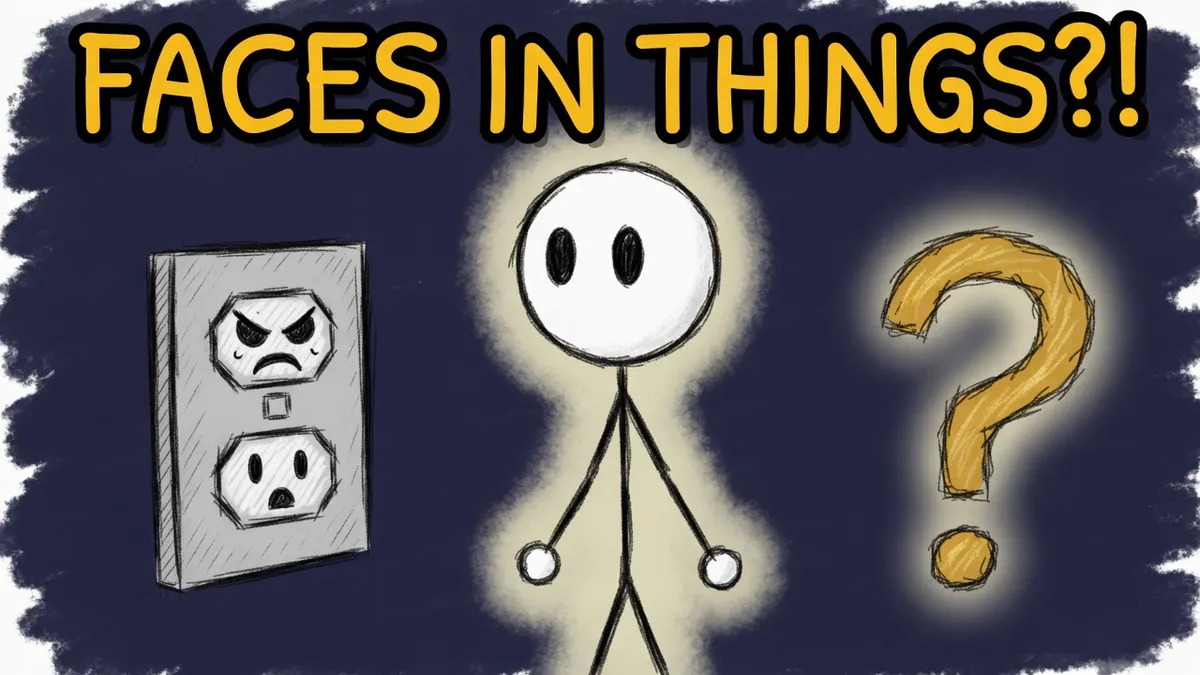
Look around the room and you will start to notice them: the plug socket that looks permanently startled, the tap that seems glum, the front of a car wearing an expression somewhere between friendly and smug. None of these things has a face. Not one of them has eyes, or a mouth, or anything that could hold an expression. And yet your brain keeps handing you people where there are only objects, reliably, instantly, and whether you asked it to or not. The strange part isn't that it happens. It's how eager, and how fast, your brain is to do it.
01 · The nameIt's called pareidolia, and it's completely normal
The technical term is face pareidolia: the perception of a face in something that has no face at all. It’s the man in the moon, the shocked expression on a bell pepper, the sad little face on the underside of a car. And it is not a malfunction. Seeing these faces is a sign that your face-detection system is working exactly as designed, arguably too well. Nearly everyone does it, constantly, and the people who do it most vividly are not damaged in any way. Their detector is simply turned up loud.
02 · The hardwareYour brain has a patch dedicated to faces
Faces are so important to a social animal that your brain devotes special machinery to them. On the underside of the temporal lobe sits a region called the fusiform face area, or FFA, which specialises in processing faces the way other regions specialise in words or places. The telling thing is what it responds to. In a 2014 study memorably titled “Seeing Jesus in toast,” researchers showed people nothing but visual static, pure noise, while telling them half the images secretly contained faces. People duly “saw” faces about a third of the time. And when they did, the right FFA lit up, as though a real face had appeared. The brain’s face module doesn’t wait for a face to be there. It responds to the idea of one.
03 · The speedThe face fires before you decide
Here is what makes pareidolia feel so involuntary: it’s already over before your conscious mind gets a vote. Using magnetic brain recording, scientists have measured the moment the face-specific response fires, and for face-like objects it arrives at around 165 milliseconds, roughly a sixth of a second, at almost exactly the same time and place as the response to a genuine human face. That early signal, known as the N170 or M170, is bigger for objects that look face-like than for ones that don’t. In other words, your brain flags “face” in a fraction of a second, long before the slow, sensible part of you can point out that it’s only a socket.
04 · The biasWhy the detector is built to over-react
So why is the system so quick to cry “face”? Because of a lopsided bet your ancestors couldn’t afford to lose. Imagine two kinds of error. You could mistake a shadow in the bushes for a lurking face, a false alarm, mildly embarrassing, otherwise harmless. Or you could mistake a real, lurking face for a shadow, and get ambushed. Those two mistakes are not remotely equal in cost. When missing a genuine face or predator can kill you and a false positive costs you nothing, evolution tunes the detector to err toward too many faces. Carl Sagan made the same point decades ago: a baby that reliably locks onto its parent’s face, and smiles back, wins the bond that keeps it alive. A brain that finds faces everywhere is the safe, cheap setting, and we all inherited it.
It isn't a uniquely human quirk. In 2017, researchers found that rhesus monkeys stare longer at objects with illusory faces too, meaning this habit of seeing people in things is older than our species.
05 · The companyMonkeys do it, and so does AI
If pareidolia were just a human foible, you’d expect it to stop at us. It doesn’t. In 2017, a team showed rhesus monkeys photographs of ordinary objects that happen to look face-like, and the monkeys, like us, lingered longer on the ones with illusory faces, examining the phantom eyes and mouth. It was the first hard evidence of face pareidolia in another species, which pushes the phenomenon back into our shared primate past. And it goes further still. A 2025 study found that artificial neural networks, trained only to recognise real faces and objects, spontaneously started seeing faces in the same face-like junk we do, fixating on “eye”-like features to make the call. The lesson is quietly profound: pareidolia may not be a bug you could design out. It may be the unavoidable price of getting very, very good at spotting real faces.
06 · The quirksThe illusory faces have a gender, and a mood
Once you accept that the brain conjures these faces, the details get strange. These aren’t blank faces: they come pre-loaded with character. A 2022 study gathered hundreds of pareidolia images and asked people to rate them, and found the illusory faces were judged to be male about 80% of the time, despite the objects having no gender whatsoever. The bias wasn’t in the objects; it was in us, a hint that the brain’s default, bare-minimum face is somehow “male” until proven otherwise. The faces also carry expressions: startled sockets, angry houses, cheerful cars. And what you see is shaped by your culture. Where Western eyes find a man in the moon, many East Asian traditions see a rabbit in the very same shadows, proof that a good chunk of the “face” was never on the object at all. You supplied it.
07 · The payoffSo why do you see faces everywhere?
Because you are running a face-detector built for a world where a face could mean a friend, a mate, or a threat about to close in, and in that world, the only unforgivable error was missing one. So the system fires early, fires often, and fires on the flimsiest evidence: two dark patches over a line is enough. It fires in a sixth of a second, before you can talk it down. It fired in your ancestors, it fires in a monkey looking at a pepper, and it fires in a machine that was only ever taught to recognise real people. Seeing a startled little face in a plug socket isn’t your mind slipping. It’s a brilliant, ancient survival system doing precisely its job, finding people in the noise, just in case one of them is real.
Quick questions
Why do I see faces in random objects?
It's a phenomenon called face pareidolia. Your brain runs a fast, always-on face-detector that's tuned to react to the basic layout of a face, two dots above a line, even when it appears on a plug socket, a car or a slice of toast. The detector is deliberately trigger-happy, because historically the cost of missing a real face was far higher than the cost of a false alarm.
What is face pareidolia?
Pareidolia is the tendency to perceive a familiar, meaningful pattern, most often a face, in random or ambiguous things. Face pareidolia is the specific case of seeing faces: the man in the moon, a shocked-looking electrical outlet, a face in the froth of a coffee. It's a normal quirk of how the visual system is built.
What part of the brain sees faces?
A region on the underside of the temporal lobe called the fusiform face area (FFA) is specialised for processing faces. Brain-imaging studies show it responds not just to real faces but to illusory ones in objects, one 2014 study found the right FFA activated specifically when people 'saw' a face in pure visual noise.
Is seeing faces in things a sign of a mental illness?
No. Everyday face pareidolia is normal and universal, a sign your face-detection system is working, not failing. That said, unusually frequent or vivid pareidolia is being studied as a possible early marker in some conditions: people with Parkinson's disease and dementia with Lewy bodies produce markedly more illusory faces on standardised 'pareidolia tests,' which track with their tendency toward visual hallucinations.
Why do illusory faces usually look male?
They genuinely do. A 2022 study of hundreds of pareidolia images found people rated the illusory faces as male about 80% of the time, even though the objects themselves had no gender. The leading interpretation is that a minimal, bare-bones face is treated by the brain as male by default, revealing a bias baked into how we read faces rather than anything about the objects.
Do animals see faces in things too?
At least one other species does. A 2017 study found that rhesus monkeys look longer at objects with illusory faces, like a face-like pepper or coffee, just as humans do, the first evidence of face pareidolia outside humans. It suggests the tendency is an old, shared feature of the primate visual system, not a human peculiarity.
Why do we see a face in the moon?
The 'man in the moon' is pareidolia on a lunar scale: the dark volcanic plains and bright highlands happen to fall into a rough eyes-and-mouth arrangement, and the brain does the rest. Tellingly, not everyone sees a man, many East Asian cultures see a rabbit in the very same markings, which shows how much of the 'face' is supplied by the viewer, not the moon.
Why do cars and houses look like they have faces?
Because they have the ingredients: headlights and a grille read as eyes and a mouth; windows and a door read as a face on a house. Designers know this and lean into it: a car's 'expression' (aggressive, friendly, smug) is a real thing car makers tune deliberately, exploiting the same detector that finds faces in sockets.
Do babies see faces before anything else?
Newborns show a preference for face-like patterns within hours of birth: they'll track a simple face-shaped arrangement of dots further than a scrambled one. Full-blown pareidolia, seeing faces in genuinely non-face objects, seems to develop over the first year as the visual brain matures, but the raw pull toward faces is there almost immediately.
Is 'seeing Jesus in toast' the same thing?
Yes, famous religious sightings on toast, tortillas or clouds are textbook face pareidolia. The 2014 study that scanned this phenomenon was literally titled 'Seeing Jesus in toast,' and its authors concluded the experience is completely normal and driven by ordinary brain activity, not anything supernatural. It later won an Ig Nobel Prize.
Can AI see faces in things too?
It turns out it can. A 2025 study found that deep neural networks trained to recognise faces and objects spontaneously develop human-like face pareidolia, latching onto 'eye'-like features to flag objects as faces, much as we do. That's a clue that pareidolia may be an almost inevitable side-effect of getting very good at spotting real faces.
Does everyone see the same faces in things?
The basic pull is universal, but the details vary. Some people are much more prone to pareidolia than others, and what you 'see' is shaped by expectation and culture, hence a man in the moon for some, a rabbit for others. There's also a documented bias for the illusory faces to read as male and to carry an apparent emotion, like surprise or anger.
Why do I see scary or angry faces in the dark?
Two things stack up. First, in the dark your visual system has less information, so it fills gaps more aggressively and false-triggers more easily. Second, the whole point of an over-eager face-detector is threat: it evolved partly to catch a hostile face or a predator early, so ambiguous shapes at night are biased toward looking watchful, angry or frightening rather than friendly.
Can you switch off seeing faces in objects?
Not really. Pareidolia is automatic and pre-conscious: the face-response fires in roughly 165 milliseconds, well before you can decide whether there's really a face there. You can know perfectly well that a socket is just a socket and still be unable to stop it looking startled. The detector runs whether you want it to or not.
Take the quiz on this
A quick 4-question check on what you just read. Get them right to earn XP: no points for just scrolling.
Our sources 15 checked
// every claim on this page was checked before it went up