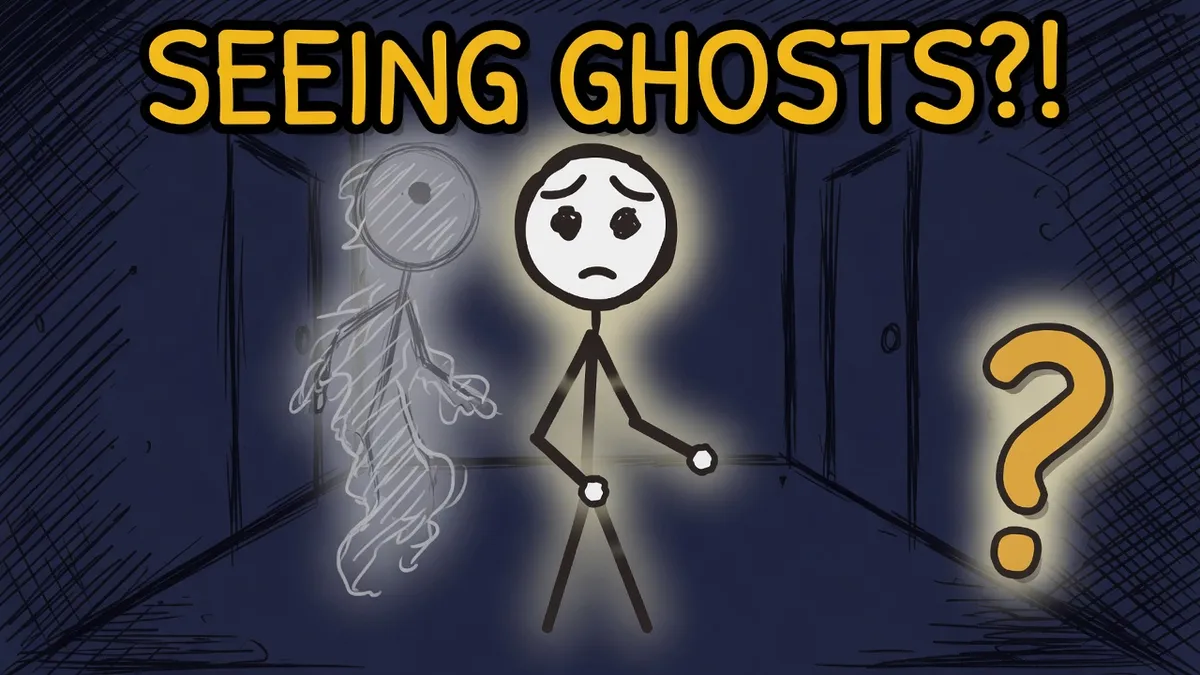
Start with the part almost everyone gets wrong, on both sides of the argument. When someone tells you they saw a figure at the foot of the bed, felt a hand on their shoulder in an empty room, or knew, with total certainty, that a presence was standing behind them, they are not lying and they are not broken. The experience is real. Something genuinely happened inside their skull. The interesting question, the only honest one, isn't whether they perceived a ghost. It's what their brain was doing when it built one.
01 · The framingThe perception is real. The ghost is a guess.
Here’s the frame that makes all of this make sense. Your brain never touches the world directly. It sits in the dark of your skull receiving noisy, incomplete signals, and it builds its best guess of what’s out there. Most of the time that guess is so good it feels like simply seeing. But when the inputs get scrambled, at the edge of sleep, under stress, in the dark, in grief, the guessing machine keeps running, and it can assemble a whole person out of very little. A hallucination is not a fake perception. It’s a real perception of something that isn’t there. Everything that follows is just the different ways that happens.
02 · The doorway of sleepFigures at the edge of dreaming
The single richest source of ghosts is the border between sleeping and waking. As you drift off, or surface, your brain can slip into a state where dreaming and waking overlap, and it throws vivid images, sounds and sensations into waking awareness: a face, footsteps, your name called out, a shape in the corner. These are hypnagogic hallucinations at sleep onset and hypnopompic ones on waking, and a large share of ordinary people have had them.
Then there’s the intense version. In sleep paralysis, the muscle shutdown that keeps you from acting out your dreams lingers for a few seconds after your mind wakes up. You’re conscious, you can’t move, and very often a figure appears: an intruder in the room, a weight on your chest, a certainty of menace. It’s terrifying, it’s harmless, and it has been reported across every culture on Earth, dressed up as demons, witches, and old hags. If you want the full mechanism, we’ve written it up in why you get sleep paralysis.
03 · The felt presenceA ghost built in a lab
Long before anyone sees a figure, they often just feel one: the unmistakable sense that a person is nearby, usually just behind you. It’s one of the most consistent features of ghost reports. And in 2014, a team led by Olaf Blanke’s lab did something remarkable with it. They built a robotic rig that let a healthy volunteer make a poking motion while a second robot reproduced that exact motion on their back, either in perfect sync or with a slight delay.
When the feedback was delayed by a fraction of a second, about a third of these healthy people suddenly felt an unseen presence standing behind them. A couple were unsettled enough to ask to stop. No ghost. Just the brain's model of its own body, knocked out of step with itself.
That’s the finding, published in Current Biology: a felt presence is what happens when the brain briefly fails to recognise its own actions as its own, and attributes them to someone else in the room. The “someone” is you, misfiled.
04 · The sound you can't hearInfrasound, and an honest caveat
Some hauntings may be, quite literally, a bad vibe. Infrasound is sound below about 20 Hz: too low to consciously hear, but you can still feel it in your body. It has been linked in some work to unease, chills, and a sense of presence. The most famous case belongs to engineer Vic Tandy, who kept sensing a grey figure and a wave of dread in his lab, and eventually traced it to an extractor fan producing a standing wave at around 18.98 Hz. Fix the fan, and the ghost left.
It’s a wonderful story, and it might be a real effect. But honesty matters here more than a tidy answer. When researchers have tried to build a deliberately “haunted” room using infrasound and magnetic fields under controlled conditions, the results have been inconsistent, and at least one careful attempt concluded that plain suggestibility explained the reports better than the physics did. So: suggestive, genuinely intriguing, and not settled. Infrasound may nudge some experiences. It is not a proven master key. Our piece on why infrasound can make you feel dread digs into what’s actually known.
05 · The furnace in the cellarWhen the haunting is poison
Here is a case where the “ghost” turned out to be deadly, and it’s worth taking seriously for practical reasons. In 1921, an ophthalmologist named William Wilmer published a report in the American Journal of Ophthalmology describing a family tormented in their home by footsteps, moving furniture, sapping fatigue, and dark figures. The children grew pale and listless. One of them described a strange woman approaching in the dark. The cause wasn’t a spirit: it was carbon monoxide pouring from a faulty furnace. Repair the furnace, and the haunting stopped.
Carbon monoxide starves the brain of oxygen, and it can produce hallucinations, dread and confusion, which is exactly why doctors still cite this case. But keep the claim the right size: this explains specific poisoning incidents, not hauntings as a category. It is a single striking case, not a general theory. The genuinely useful takeaway is unromantic and important: if a whole household feels ill and “haunted” at once, check the carbon monoxide alarm before you check for spirits.
06 · The face in the noiseA brain built to find people
Even wide awake, in a normal room, the brain is primed to conjure people. Two old habits do the heavy lifting. The first is pareidolia: your face-detector is so eager it fires on a coat on a door, folds in a curtain, a smudge of shadow on the wall. Faces are so important to catch that the brain would rather see one that isn’t there than miss one that is. Our article on why you see faces in things unpacks how automatic this is.
The second is agency detection. For an animal whose ancestors were sometimes hunted, the cheap mistake is to assume a rustle in the grass is a someone, not a nothing. Guess “predator” and be wrong, you lose nothing. Guess “wind” and be wrong, you’re lunch. So the brain leans, hard, toward reading intention and presence into ambiguity. Put those two together in a dark corridor and an unexplained shape doesn’t stay a shape. It becomes a watcher.
07 · The power of being toldExpectation writes the script
None of this happens in a vacuum. What you expect changes what you perceive, and with ghosts the effect is huge. In a 1997 study, Lange and Houran walked people through a theatre. Some were told it had a history of ghostly activity; others were told the building was simply being renovated. The group primed for a haunting reported dramatically more unusual experiences, across nearly every category measured, in the very same rooms.
That’s the quiet engine behind a lot of hauntings. A place gets a reputation, visitors arrive already braced, and the priming does the rest: an ordinary draught, a creak, a cold patch becomes evidence. The label “haunted” is not just a description of the reports. It’s partly the cause of them, which is why ghost stories are so good at renewing themselves.
08 · The ones we loveGrief, and the presence that stays
The most common ghost of all is barely discussed, because it’s so gentle. After someone dies, a great many bereaved people sense them: hear their voice, feel their presence in a room, catch them for an instant in a chair. A landmark 1971 study of widowed people in Wales found nearly half reported experiences of their late spouse, most often simply the feeling that they were near, and most people found it a comfort rather than a fright. Far from a symptom, it’s now widely regarded as a normal, even healthy, part of grieving.
And that’s the note to end on, because it dissolves the smugness this topic usually invites. Explaining the mechanism doesn’t make the experience false. The figure in the doorway, the hand on the shoulder, the beloved voice in an empty kitchen: every one of those genuinely occurred, in the only place any experience ever occurs, in a human brain doing its best with what it was given. People see ghosts because the brain, faced with the dark, the strange, and the missing, builds the thing that matters most to us in the whole world: another person. The ghost is real. It’s just made of us.
The animated version
Same answer, told as a little animated story with the strange little stickman acting it out. Dry, quick, and, obviously, correct.
Quick questions
Are people who see ghosts imagining it or lying?
Neither, in the vast majority of cases. A hallucination is a real perceptual event: the brain genuinely produces the sight, sound or sensation, and the person genuinely experiences it. Perfectly healthy people have these experiences. The honest scientific position isn't 'you made it up', it's 'your brain built something real from ambiguous inputs, and a ghost was its best explanation'.
Why do I wake up unable to move with someone in the room?
That's sleep paralysis, and it's common. As you wake out of REM sleep, the body's dream-time muscle paralysis can briefly linger while your mind is already conscious. In that state many people also experience a vivid intruder or presence hallucination: a figure, a weight on the chest, a sense of menace. It's frightening but harmless, and it has a name and a mechanism.
What are hypnagogic and hypnopompic hallucinations?
They're the vivid images, sounds and sensations that appear right as you're falling asleep (hypnagogic) or right as you're waking (hypnopompic). Faces, figures, footsteps, a voice calling your name. They happen at the blurry border where dreaming and waking overlap, and they're experienced by a large share of ordinary people, not a sign that anything is wrong.
Can science actually make someone feel a ghostly presence?
Yes. In a 2014 study led by Olaf Blanke's lab, published in Current Biology, a robot setup fed healthy participants slightly delayed feedback of their own movements. Around a third of them spontaneously reported feeling that someone was standing behind them, and a couple were unsettled enough to stop. The 'presence' was manufactured purely by desynchronising the brain's own sense of its body.
Can sound you can't hear make a place feel haunted?
It's a real hypothesis, though the evidence is mixed. Infrasound (sound below about 20 Hz, too low to consciously hear) has been linked to unease, chills and a sense of presence. The engineer Vic Tandy traced his own 'haunted' lab to a fan producing a standing wave around 19 Hz. But controlled attempts to reproduce the effect have had inconsistent results, so treat it as suggestive rather than proven.
Can carbon monoxide make you see ghosts?
In some documented poisoning cases, yes. Carbon monoxide starves the brain of oxygen and can cause hallucinations, dread and confusion, and there's a classic 1921 medical case where a family's 'haunting' turned out to be a leaking furnace. It's a genuinely important safety point (see a doctor and check your CO alarm), but it explains specific cases, not hauntings in general.
Why do people see faces in the dark that aren't there?
That's pareidolia: the brain's face-detector is so eager it fires on shadows, folds in a curtain, or patterns on a wall. Faces are so important to spot that the brain is tuned to over-report them rather than miss a real one. In the dark, with a bit of fear priming you, an ambiguous shape gets read as a watching face.
Why does the brain jump to 'a ghost' rather than a random shape?
Partly because of what researchers call an agency-detection bias. It's cheaper, in survival terms, to assume an ambiguous rustle is a someone than to assume it's nothing and be wrong. The brain is biased toward reading intention and presence into noise, so when it can't explain a feeling, 'a person is here' is a natural default guess.
Does being told a place is haunted make you more likely to experience something?
Strongly, yes. In a 1997 study, Lange and Houran took people through a theatre; those told it was haunted reported far more unusual experiences than those told it was just being renovated. Expectation primes perception. This is also why 'haunted' reputations can be self-sustaining: the label itself generates the reports.
Is sensing a dead loved one normal?
Very. Sensing the presence, voice or touch of someone who has died is a common, well-documented part of grief. A landmark 1971 study of widowed people in Wales found nearly half reported experiences of their late spouse, most often simply feeling their presence, and most found it comforting. It is generally considered a normal feature of bereavement, not a symptom of illness.
Does seeing a ghost mean I have a mental illness?
Usually not. Isolated hallucinations, especially around sleep, grief or fatigue, are common in mentally healthy people. Hallucinations only point toward a medical or psychiatric issue when they're frequent, distressing, and paired with other symptoms. A one-off figure in the night is far more likely to be an ordinary brain event than a diagnosis.
Why are ghost sightings so often at night or when tired?
Because that's when the conditions stack up. Darkness starves the visual system of clear information, so it fills the gaps. Fatigue and disrupted sleep push you toward the hypnagogic and sleep-paralysis states where figures appear. Fear primes the threat detector. Night doesn't summon ghosts; it just supplies everything the brain needs to build one.
If it's all in the brain, why do different people report the same ghost?
Shared expectation and shared conditions. If a place has a known 'haunting' story, people arrive primed for the same kind of experience, and the same physical quirks (a cold draught, an odd sound, a dim corridor) act on everyone. Culture supplies the script; the building supplies the cues. Similar inputs plus a shared story produce similar ghosts.
Does explaining ghosts this way mean they're fake?
No, and that's the key point. Explaining the mechanism doesn't make the experience fake, any more than explaining a rainbow makes it less real. The sight, the dread, the presence: all genuinely happened in the person's brain. What the science offers isn't 'you're wrong', it's a respectful account of a real and often profound human experience.
Take the quiz on this
A quick 4-question check on what you just read. Get them right to earn XP: no points for just scrolling.
Our sources 11 checked
// every claim on this page was checked before it went up