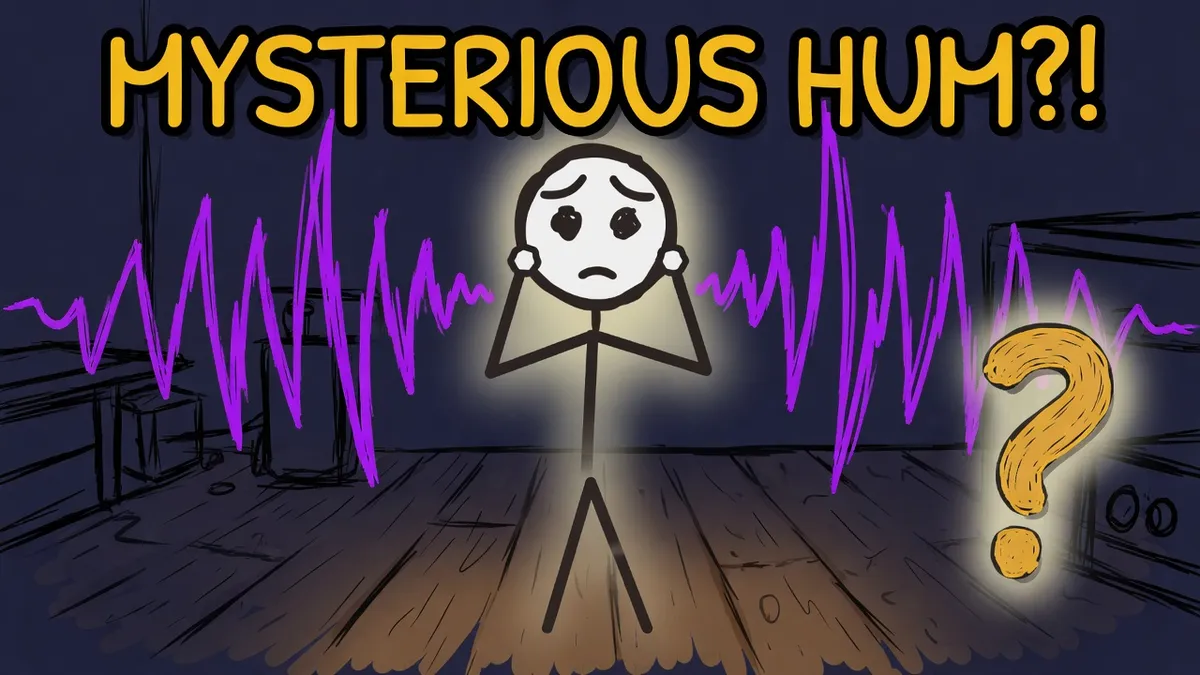
Imagine lying awake at 3am next to a sound you cannot escape. A low, steady drone, like a lorry idling three streets away, or a distant generator that never switches off. You get up, you check the house, you press your ear to the walls. Nothing. You wake your partner, who listens hard and, honestly, hears silence. The sound is real to you, night after night, and completely absent to the person beside you. This is the Hum, and for fifty years it has quietly tormented a small slice of humanity while everyone else wonders what on earth they are talking about.
01 · The complaintA drone only some can hear
The Hum is not a scream or a whine. People describe it as low: a rumble, a throb, an idling engine, always at the bottom of hearing. It is worst where it should be quietest, indoors and late at night, in peaceful rural towns rather than noisy cities. And its defining, maddening feature is that it is selective. Only about 2% of people in an affected area ever hear it. To them it is loud enough to ruin sleep and fray nerves. To the majority around them, there is simply nothing there. That split, real to a few and silent to the rest, is the whole puzzle in one sentence.
02 · The famous townsBristol, Taos, and a global pattern
This is not one person’s private ordeal. It shows up in clusters, town by town. It gathered attention in Bristol, England in the 1970s, when residents flooded the local paper with letters about an inescapable low sound. In the 1990s it became famous in Taos, New Mexico, and in Kokomo, Indiana, and it has since been reported across Canada, Scotland, Australia, New Zealand and Europe. The remarkable thing is how similar the descriptions are across places that have never compared notes. Different continents, the same idling drone, the same small fraction of people driven to distraction by it.
03 · Sometimes it is a machineThe cases that got solved
Before reaching for anything strange, it is worth saying: sometimes the Hum is exactly what it sounds like. In a number of towns, dogged investigation eventually found a real, external, measurable source, usually something dull and industrial: a set of cooling fans, a factory running through the night, heavy machinery pushing a low tone through the ground and air. Track it down, switch it off, and the Hum stops. Those cases are genuinely solved. The trouble is that solving one town’s machine tells you nothing about the next town, where every search comes up empty.
04 · When there is nothing to findThe sound from inside
Because in the classic cases, like Taos, investigators have looked hard and found no external sound at all. No machine, no mast, nothing on the instruments, and yet real people are still hearing a real drone. That points somewhere uncomfortable: inward. Your ear is not a passive microphone. It actively amplifies sound, and it can even generate faint sounds of its own. In tinnitus, the auditory system produces a phantom noise with no source in the outside world, usually a ringing. The leading explanation for the unsolved Hums is that many are a rare, low-frequency version of exactly that: a droning tinnitus manufactured inside the listener’s own hearing system. That would explain the one detail nothing else can, why the person next to you hears silence. The sound was never in the room. It was in the ear.
For the towns where no machine is ever found, the most likely source of the Hum is not out in the night at all. It is being generated, faint and relentless, inside the head of each person who hears it.
05 · Why the night makes it worseThe trap of a quiet room
Whether the sound starts outside or inside, the same cruel logic amplifies it. A faint low tone is drowned out all day by traffic, voices and the general roar of life. Strip that away at night, in a still house, and the drone rises out of the silence and becomes impossible to ignore. Worse, attention feeds it: the moment you start listening for it, your brain locks on, and a sound you might have tuned out becomes the only thing in the world. It is a genuine phenomenon caught in a feedback loop of quiet and focus, which is why sufferers so often describe the small hours as the worst.
06 · The payoffSo why do only some people hear it?
Because the Hum is really two stories wearing one name. A handful of cases are ordinary machines hiding in the dark, heard by the people whose ears happen to catch that low band. The rest, the true unsolved Hums, appear to be a rare form of tinnitus, a drone the auditory system produces on its own, which is why it haunts one person and passes right through the next. Either way, the torment is real, and the mystery is not that the sound is imaginary. It is that a completely genuine noise can have no place in the outside world at all, playing on a loop for an audience of one.

The animated version
Same answer, told as a little animated story with the strange little stickman acting it out. Dry, quick, and, obviously, correct.
Quick questions
What is the Hum?
The Hum is a name for a persistent, low-frequency droning or rumbling sound that a minority of people report hearing, often compared to a distant idling engine or truck. It is usually worse indoors, at night, and in quiet rural areas, and it can be intensely distressing to those affected.
How many people can hear the Hum?
Estimates put it at roughly 2% of the population. That small fraction is a big part of the mystery: in the same house, on the same night, one person may be tormented by the noise while everyone else hears complete silence.
Where has the Hum been reported?
All over the world. Early reports gathered in Bristol, England in the 1970s. Later famous cases appeared in Taos, New Mexico and Kokomo, Indiana in the 1990s, and it has since been described in Canada, Scotland, Australia, New Zealand and across Europe.
Is the Hum a real sound or imaginary?
The experience is completely real to those who hear it, and it causes real harm: lost sleep, anxiety, headaches. What is disputed is the source. In some cases the sound is external and measurable. In many others, no external sound can be detected at all, which points to a cause inside the listener.
What causes the Hum?
There is no single cause. A number of individual cases have been traced to genuine industrial machinery. For the classic unsolved cases, the leading idea is that the hum is generated inside the person's own auditory system, a rare low-frequency form of tinnitus.
How can a sound come from inside your own ear?
The ear is not just a passive microphone. It actively amplifies sound, and can produce faint sounds of its own (otoacoustic emissions). In tinnitus, the auditory system generates a phantom sound with no external source. A low-frequency version of that could explain a hum only one person hears.
Why is the Hum worse at night and indoors?
Because it is quiet. At night, with background noise gone, a faint low sound (whether external or internally generated) becomes far easier to notice, and once you are listening for it, it can be almost impossible to tune out. That focus makes it feel louder and more relentless.
Have any Hums actually been solved?
Yes. Some local cases were traced to real sources: industrial cooling fans, factory equipment and similar machinery. Solving one town's hum, though, does not explain the others, because the classic cases like Taos have resisted every search for an external source.
Is the Hum dangerous?
The sound itself is not thought to cause physical harm, but its effects can be serious. Chronic sleep loss, stress and anxiety from an inescapable noise genuinely damage wellbeing, which is why sufferers describe it as maddening rather than trivial.
Is the Hum the same as tinnitus?
For many unsolved cases, the leading explanation is essentially that it is a specific, low-frequency form of subjective tinnitus. It differs from classic ringing tinnitus in pitch and character, but the underlying idea, a phantom sound generated by the auditory system, is the same.
Could the Hum be caused by phone masts or power lines?
Those are popular suspicions, but investigations have generally not confirmed them as the cause of the classic Hums. Where a real external source has been found, it has usually been ordinary machinery, not exotic technology.
How common is the Hum?
Estimates put it at roughly 2% of people, and characteristically only some residents of a place hear it while neighbours hear nothing. Bristol, Taos and Kokomo are famous case sites; some individual Hums trace to machinery, while classic ones remain unsolved.
Is the Hum dangerous?
The sound itself is not known to damage hearing the way industrial noise can, but chronic sleep disruption, stress and anxiety are real secondary harms for people who hear it for months or years. Treat the distress seriously even when no external source is found.
Take the quiz on this
A quick 4-question check on what you just read. Get them right to earn XP: no points for just scrolling.
Our sources 6 checked
// every claim on this page was checked before it went up