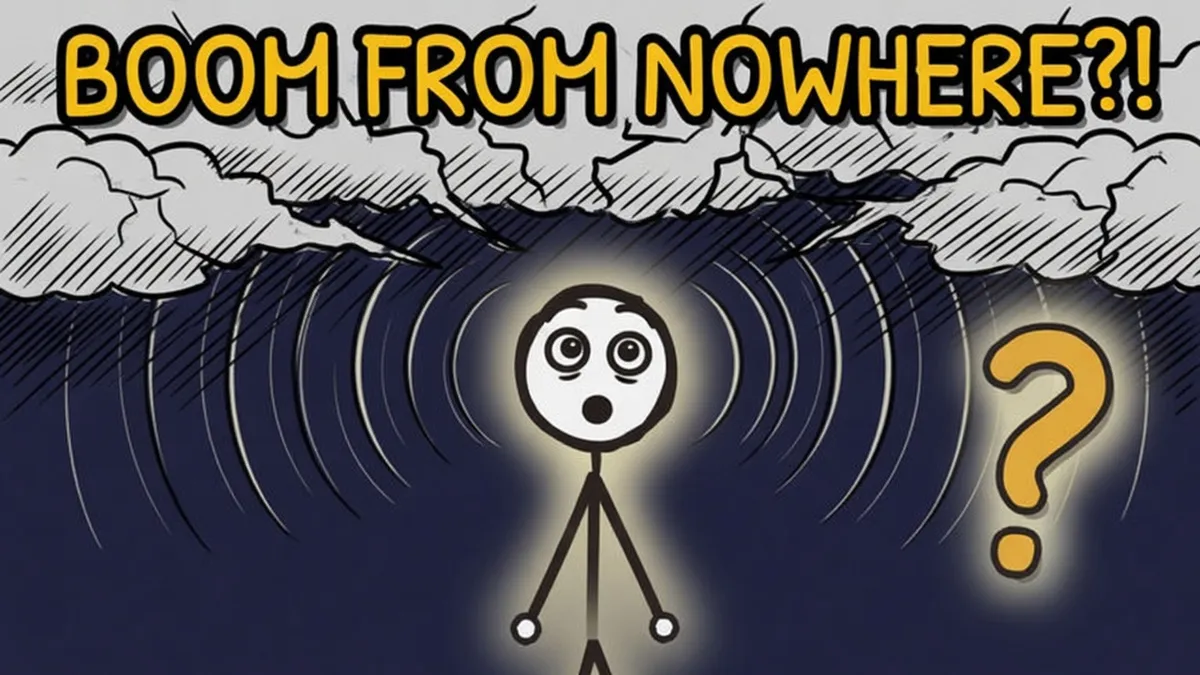
You are outside on a calm, cloudless day. Somewhere above or beyond the horizon, a deep boom rolls across the sky, like far-off cannon fire or a heavy door slamming shut in an empty house. You look up. Nothing. No storm, no plane, no flash. Just a fading rumble and the odd sense that the sky itself just fired a shot. People have heard exactly this for centuries, on several continents, and given it a dozen names. They are called skyquakes, and the mystery is stranger than a single hidden cause.
01 · The phenomenonA boom with a hundred names
Wherever skyquakes are heard, people have named them. On the Ganges Delta they are the Barisal guns. Around New York’s Finger Lakes and the Carolinas coast they are the Seneca guns. The Dutch call them mistpouffers, roughly “fog belches”; in Japan they are uminari, “cries from the sea”; in Italy, brontidi. The names span continents and centuries, and they share a curious detail: reports cluster near water. Lakes, coastlines, and river deltas turn up again and again, which has fed theories for as long as the booms have been logged.
02 · The usual suspectsThe booms we can explain
Many skyquakes do have answers. The US Geological Survey points out that most booms people report are simply human activity: quarry blasting, construction, or a sonic boom from a fast aircraft. Nature supplies more. A shallow earthquake can crack out an audible boom. So can a frost quake, when groundwater freezes, expands, and splits frozen ground in a hard cold snap, often without registering on a seismograph. Each of these can deliver a startling bang from what feels like nowhere, and each one gets mistaken for something stranger.
03 · The sky's own artilleryMeteors and bent thunder
Two causes are especially eerie because they leave no trace on the ground. The first is a bolide: a large meteor that detonates miles up in the atmosphere. The airburst reaches you as a deep rumble, and if it happens above cloud or in bright daylight, you may hear the boom and never see the flash. The second is atmospheric ducting. Under the right layering of warm and cold air, the sky can channel thunder from a storm far over the horizon, carrying it for many miles so it arrives loud and clear beneath a sky that looks completely empty. The storm is real; it is just somewhere you cannot see.
Here is the twist that reframes the whole mystery. Skyquakes are not one phenomenon with one hidden cause. They are a single dramatic sound that at least half a dozen unrelated forces can each produce. A meteor exploding 30 miles up, ice cracking underground, and a thunderstorm hiding beyond the horizon can all deliver the exact same boom to your window. So when scientists "solve" a skyquake, they usually solve that one boom, and the label survives because the next boom might have a totally different origin.
04 · The ones that resistStill unsolved after 150 years
Not everything fits a neat box. The classic Seneca guns have been reported for generations with no agreed cause, and the US Geological Survey says so plainly. The Barisal guns of the Ganges Delta, logged in colonial records back in the 1870s, remain unexplained after more than a century of investigation. When researchers put sensors on the problem in North Carolina in 2020, they caught the booms but found no matching earthquakes, concluding the sounds were travelling through the air. That narrowed the field without naming the culprit, which is often how it goes.
05 · The water connectionWhy lakes and coasts?
The persistent link to water keeps the theories coming. Calm water reflects sound cleanly, so a distant boom can arrive sharpened rather than muffled. Coastal shapes can focus the roar of surf. And some researchers have long suspected gas release: methane building up in swamp, lake, or delta sediments, then venting in a burst. None of these is proven for a specific event, which is exactly the frustration of skyquakes. The circumstances rhyme from place to place, but the smoking gun never quite appears.
06 · The payoffSo what makes the sky boom?
Usually, something ordinary wearing a mask. A jet, a meteor, cracking ice, a storm you cannot see. But “usually” is not “always”, and that gap is where the wonder lives. The honest answer is that skyquakes are not one riddle but many, sharing a single unforgettable sound. The sky really can fire a cannon at you in broad daylight, from a bolide you never glimpse, leaving no mark on the earth at all. Most of the time we can name the trigger. Every so often, we simply cannot, and the boom rolls away over the water exactly as it did for the people who first gave it a name.
The animated version
Same answer, told as a little animated story with the strange little stickman acting it out. Dry, quick, and, obviously, correct.
Quick questions
What are skyquakes?
Skyquakes are loud, thunder-like booms that appear to come from the sky or open air, often on clear days with no storm present. They have been reported around the world for centuries and go by many local names. Some have clear causes, while others remain genuinely unexplained.
What causes loud booms in the sky?
Several things can: sonic booms from aircraft, distant thunder carried far by the atmosphere, meteors exploding high overhead, shallow earthquakes, and frost quakes. The US Geological Survey notes that most booms people actually hear turn out to be ordinary human activity like blasting or aircraft.
Are skyquakes dangerous?
No. A skyquake is essentially a loud sound event. It may rattle windows or startle people, but there is no evidence the booms themselves cause harm. The unsettling part is usually not knowing the source, not the noise itself.
Are skyquakes earthquakes?
Sometimes, but usually not. Shallow earthquakes can produce audible booms, but a 2020 study of booms in North Carolina found no matching earthquakes and concluded the sounds travelled through the atmosphere rather than the ground. So most true skyquakes are an air phenomenon.
What are the Seneca guns?
'Seneca guns' is the local name for mystery booms first associated with Seneca Lake in New York's Finger Lakes, and later with the Carolinas coast. The name is old enough to have inspired a James Fenimore Cooper story, and the US Geological Survey lists these booms among those with no agreed cause.
Can meteors cause booms?
Yes. A large meteor, called a bolide, can explode high in the atmosphere and send a sonic boom down to the ground as a deep rumble. If it happens above clouds or in daylight, people may hear the boom without ever seeing a fireball.
What are mistpouffers?
'Mistpouffers', roughly meaning 'fog belches', is the Dutch and Belgian name for skyquakes. It refers to the same clear-sky booms heard near coasts and water, and it is one of the oldest recorded terms for the phenomenon.
What are the Barisal guns?
The Barisal guns are booms heard near Barisal in the Ganges Delta of present-day Bangladesh, documented in British colonial records from the 1870s. They are a classic example of skyquakes and have never been satisfactorily explained after more than a century.
Why do skyquakes happen near water?
Most reports come from lakes, coasts, and river deltas, which is why many theories involve water: sound reflecting off calm surfaces, waves shaped by coastal topography, or gas venting from lake and delta sediments. The link to water is real but not fully explained.
What is a frost quake?
A frost quake, or cryoseism, happens when shallow groundwater freezes and expands, cracking frozen soil and rock with a loud boom. They occur during hard cold snaps and often do not register on seismographs, which can make them feel mysterious.
Can thunder cause a boom on a clear day?
Yes, indirectly. Under the right temperature layering and winds, the atmosphere can channel thunder from a storm far beyond the horizon, so the boom arrives loud in a place where the sky overhead looks perfectly clear. This atmospheric ducting is a leading skyquake explanation.
Are skyquakes real or a myth?
They are real, documented sound events, not folklore. Sensors have recorded some of them, and agencies like the US Geological Survey have investigated them. What is uncertain is the cause of certain cases, not whether the booms happen.
Do skyquakes happen all over the world?
Yes. They have been reported on multiple continents, including the United States, Bangladesh, Japan, Italy, Ireland, Canada, Finland, and Australia, each with its own local name. That global spread is part of why a single explanation is unlikely.
Is there really no explanation for skyquakes?
Many individual booms are explained by aircraft, meteors, or shallow quakes. But the US Geological Survey notes there is no single agreed cause for the classic Seneca-guns type, and some cases genuinely remain unsolved. It is likely that different booms simply have different causes.
Our sources 5 checked
// every claim on this page was checked before it went up