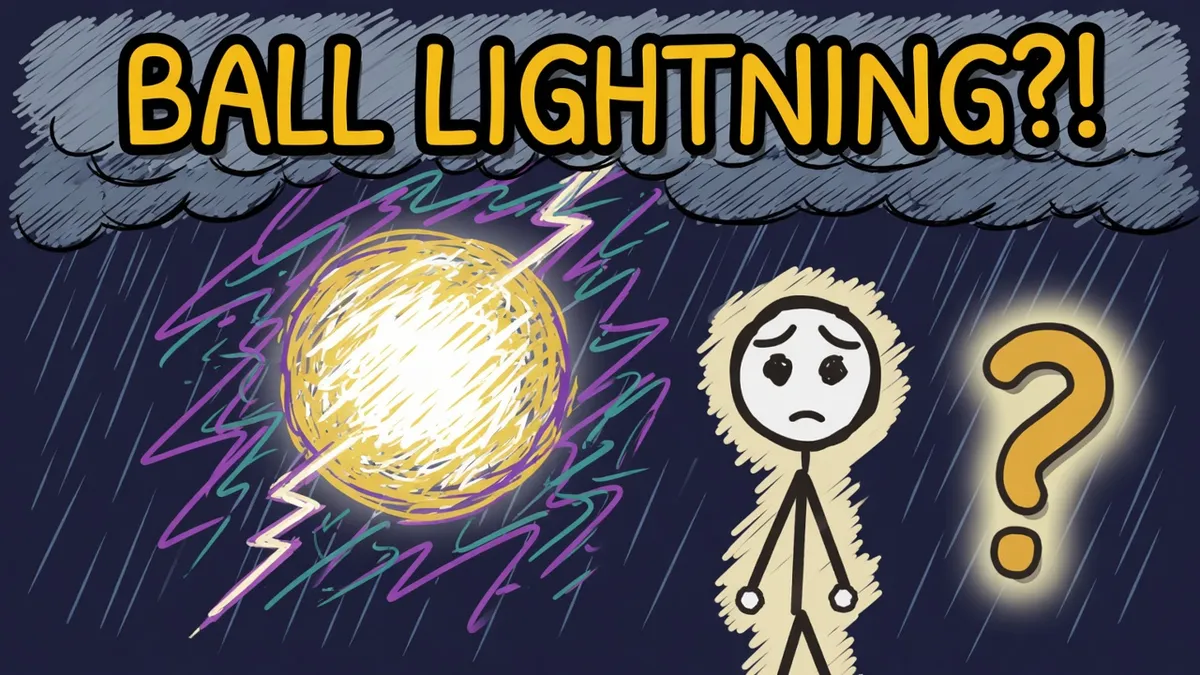
The stories are almost too consistent to ignore. A thunderstorm is raging, and a glowing ball, sometimes the size of a grapefruit, sometimes bigger, appears out of nowhere. It drifts through the air, slow and eerie, with none of the violence of a lightning bolt. It floats across a field, down an aircraft aisle, or straight through a closed window into a kitchen. Then, after a few seconds, it either fades away or bursts with a bang. People have described this for centuries, in every corner of the world. And science still cannot fully tell you what it is.
01 · The sightingA calm ball in a violent sky
Ordinary lightning is the opposite of subtle: a blinding fork, a crack of thunder, all over in a fraction of a second. Ball lightning is its strange, quiet cousin. Witnesses describe a rounded, glowing sphere that lingers, hovering and drifting for whole seconds as if it had all the time in the world. Sailors reported it. Pilots reported it. So did farmers, soldiers and startled people in their own living rooms. The accounts differ on colour and size, but the core is spookily stable: a slow ball of light where a fast bolt should be.
02 · The doubtWhy science shrugged for so long
For most of its history, ball lightning had a serious credibility problem, and the reason is instructive. Science runs on things you can summon, measure and repeat. Ball lightning does none of that. It appears without warning, lasts seconds, never shows up when a scientist is ready, and leaves behind almost nothing to examine. For a long time the only evidence was eyewitness testimony, which is precisely the kind of evidence physics is trained to be suspicious of. Plenty of researchers quietly assumed it was a trick of the eye, an afterimage of a normal flash. The problem was that too many careful, sober people kept describing the same impossible thing.
03 · The leading ideaLightning that sets the ground alight
The theory most scientists now favour is beautifully down to earth, literally. When a bolt of lightning slams into soil, it superheats it, and among the minerals in dirt is a lot of silicon. The strike vaporises it, blasting a puff of pure silicon atoms into the air. As they cool, they clump into a fine cloud of tiny particles that slowly react with oxygen, burning gently and glowing as they go. In this picture, ball lightning is not really electricity at all. It is a floating ember of vaporised ground, a puff of dirt set alight, drifting until the last of it burns out.
04 · The lucky breakThe night the camera was pointing the right way
For decades that theory had a frustrating gap: nobody had ever managed to record the light of real ball lightning to test it. Then, in 2012, on a high plateau in China, a team of researchers was recording completely ordinary lightning with cameras and spectrographs, instruments that split light into its component colours to reveal which elements are glowing. By sheer luck, a ball of light appeared in their frame, and they caught its spectrum. When they analysed it in a 2014 paper, the result was a quiet triumph: the ball’s glow contained the fingerprints of silicon, iron and calcium, exactly the elements you would find in the soil beneath the strike.
The glowing ball was, chemically, made of dirt. Its light carried the signature of the very ground the lightning had hit, which is precisely what the vaporised-soil theory predicted.
05 · The stubborn puzzlesThe parts the theory can't reach
So, mystery solved? Not quite, and this is why ball lightning keeps its crown. The soil theory explains a glowing sphere near the ground beautifully. It struggles with some of the most-reported details. Witnesses again and again describe ball lightning drifting through closed windows, sometimes leaving a neat hole and sometimes leaving the glass untouched. They describe it appearing inside aircraft, far from any soil. A burning puff of dirt should not be able to do those things. Either many careful witnesses are wrong in the same specific way, or there is physics here we have not pinned down. Rival ideas, like energy trapped inside a bubble of plasma, try to fill the gaps, but none yet explains everything.
06 · The payoffSo why is ball lightning still a mystery?
Because it sits in the hardest possible spot for science: clearly real, yet almost impossible to catch. We finally have a strong lead and a genuine piece of hard evidence, a spectrum that says “this is burning ground,” and that is a real triumph after centuries of doubt. But the phenomenon still does things our best theory cannot fully explain, and it refuses to appear on schedule so we can settle the argument. Ball lightning is a rare and beautiful reminder that the natural world has not run out of secrets. Sometimes the storm throws a glowing ball across the room, lets you see it for a second and a half, and then takes the answer with it.
The animated version
Same answer, told as a little animated story with the strange little stickman acting it out. Dry, quick, and, obviously, correct.
Quick questions
What is ball lightning?
It is a rare atmospheric phenomenon: a glowing, floating sphere of light that appears during thunderstorms. Reports describe it as anything from pea-sized to several metres across, usually lasting only a few seconds before fading or exploding.
Is ball lightning actually real?
The evidence now strongly says yes. It was doubted for a long time because it is so rare and fleeting, but there are thousands of consistent eyewitness accounts across centuries and cultures, and in 2014 its light was finally recorded and analysed by scientists.
Why did scientists doubt it for so long?
Because it breaks the normal rules of studying nature. You cannot summon it, predict it, or reliably reproduce it. For most of history the only evidence was eyewitness testimony, which is exactly the kind of evidence physics is trained to distrust.
What is the leading explanation?
The most popular theory is that when lightning strikes soil, it vaporises silicon and other minerals. Those atoms form a cloud of tiny particles that slowly burn in the air, glowing as a floating ball until the fuel runs out.
What happened in the 2014 study?
Chinese researchers on a plateau were recording ordinary lightning with cameras and spectrographs when a ball of light appeared by chance. They captured its spectrum, the first ever for natural ball lightning, and found emission lines from silicon, iron and calcium: all elements abundant in soil.
Why is the soil evidence so important?
Because it directly supports the vaporised-mineral theory. If ball lightning were purely electrical or plasma from the air, you would not expect its glow to be made of the exact elements found in dirt. Seeing soil elements light up is a strong clue about where it comes from.
Can ball lightning really pass through glass?
Many reports describe it drifting through closed windows or walls, sometimes leaving a hole and sometimes not. This is one of the strangest and least explained features, and any complete theory of ball lightning has to account for it. It remains genuinely puzzling.
How long does ball lightning last?
Usually just a few seconds, though some accounts describe longer. The 2014 recording captured a ball that lasted under two seconds. That brevity is a big reason it is so hard to study: by the time you notice it, it is often already gone.
Is ball lightning dangerous?
It can be. Some reports describe it fading harmlessly, others describe it exploding loudly, scorching objects, or causing injury. Because it is so rare, the true level of risk is hard to pin down, but treating a floating ball of storm energy with caution is wise.
Are there other theories besides vaporised soil?
Yes. Ideas include trapped microwave energy inside a plasma bubble, slow-burning chemical reactions, and even more exotic proposals. The soil-vaporisation model is currently the front-runner, but no single theory yet explains every reported feature.
Has anyone made ball lightning in a lab?
Researchers have produced glowing, floating balls of plasma in laboratories that share some features with the real thing, and silicon experiments have created glowing beads. But recreating something that behaves exactly like wild ball lightning, especially the window-passing reports, has not been fully achieved.
How is ball lightning different from regular lightning?
Ordinary lightning is a brief, blindingly fast electrical discharge lasting a fraction of a second. Ball lightning is slow, rounded, and lingers for seconds, drifting almost lazily. They appear in the same storms but behave like completely different phenomena.
Take the quiz on this
A quick 4-question check on what you just read. Get them right to earn XP: no points for just scrolling.
Our sources 6 checked
// every claim on this page was checked before it went up