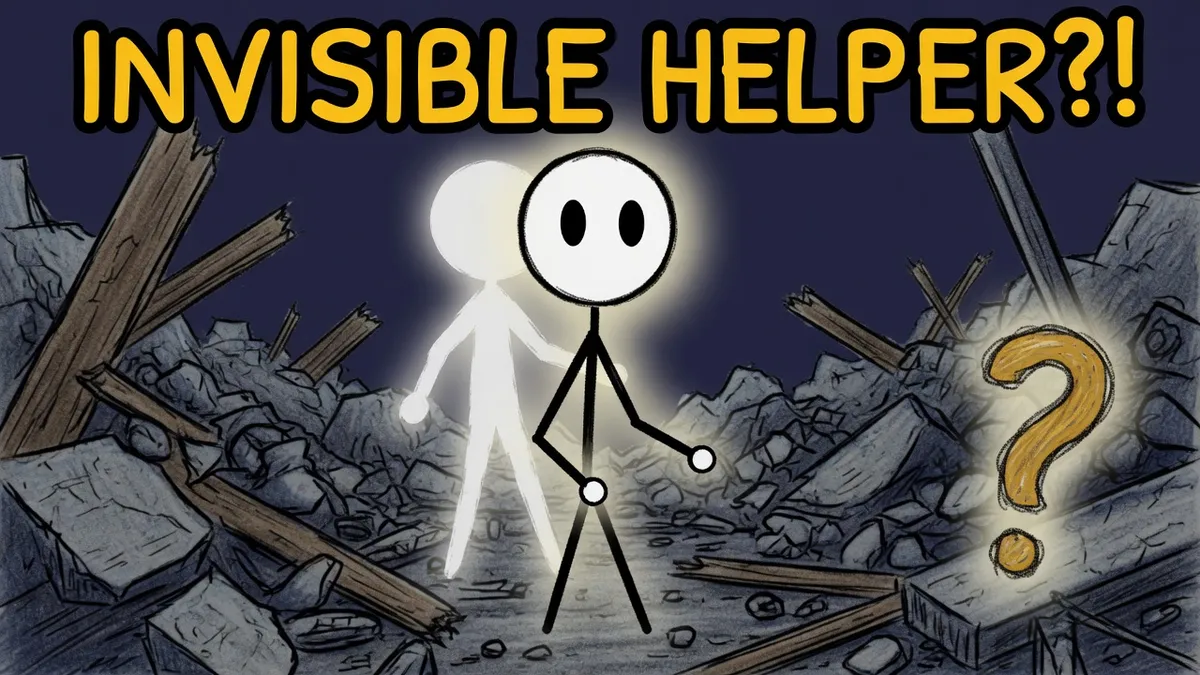
Imagine the worst conditions our species has ever thrown itself into: thin air, endless ice, a broken boat, a burning tower. Now add the detail that a surprising number of survivors swear by. They were not alone up there. Someone was with them, calm and close, telling them to keep going. Someone who left no tracks in the snow and, when the danger passed, was simply gone. It has been reported for over a hundred years, it has a name, and the explanations are stranger than a ghost.
01 · The reportA companion with no body
The experience goes by a slightly cinematic name: the Third Man factor. In life-threatening extremes, people suddenly sense an extra presence. It is not always seen. Usually it is just known, with total certainty. The presence might give calm instructions, offer silent company, or plant the simple conviction that giving up would be unthinkable with someone else there. And then, the moment safety returns, the companion dissolves. No goodbye, no explanation. It was there when it was needed, and not a second longer.
02 · The classic caseFour men on a mountain built for three
The story that named the phenomenon belongs to Ernest Shackleton. In 1916, after his Antarctic expedition collapsed and his ship was crushed by ice, Shackleton and two companions, Frank Worsley and Tom Crean, made a desperate final march across the mountains of South Georgia to reach a whaling station. Later, Shackleton wrote that during that long, racking crossing, it “seemed to me often that we were four, not three.” He was oddly shy about it in print. When his companions compared notes, each of the three men, it turned out, had felt the same unspoken fourth presence on the ice. T. S. Eliot read the account, and folded it into The Waste Land: “Who is the third who walks always beside you?”
03 · The patternClimbers, sailors, and the worst of days
Once you know to listen for it, the template repeats with eerie consistency. A mountaineer descending alone feels a partner on the rope who is not there. A solo sailor senses a second watch-stander in the cabin of a tiny boat. Survivors of shipwrecks, avalanches and mining disasters describe a guide leading them through smoke, snow or rubble. Some people who escaped the World Trade Center on 9/11 later described a calming presence steering them down the stairs. The surface details change. The deep structure rhymes every time: extremity, isolation, overload, then a companion-shaped presence that helps the person carry on.
The Third Man may be less a visitor from outside reality and more a feature of the self under load: your own mind conjuring the teammate it refuses to face the end without.
04 · The scienceA coping tool, not a campfire ghost
Researchers have taken the phenomenon seriously without reaching for the supernatural. The psychologist Peter Suedfeld, working with the writer John Geiger, framed the sensed presence as a possible coping resource in extreme environments. It is a careful phrase, and a clever one. It says the experience can be genuinely useful to survival without deciding what it is. If a mind pushed to its absolute limit generates a calm companion that keeps a freezing, exhausted body walking toward rescue, then the brain has done something quietly brilliant with catastrophic inputs. The likely triggers stack rather than compete: crushing stress and sleep loss warping perception, cold and pain and hunger narrowing the mind until it outsources its own encouragement, and thin mountain air starving the brain of oxygen.
05 · The shadow in the labFinding the switch
The most startling clue came not from a mountain but from an operating theatre. In 2006, Swiss neuroscientists were stimulating the brain of a patient, and when they applied a current to a region called the temporoparietal junction, she suddenly felt a person behind her. A young man, she said, silent, uncomfortably close, copying her exact posture as she sat. There was nobody there. That patch of brain helps build your sense of where your body is and where you end and the world begins. Disturb it, and the brain can apparently spin a bit of your own body-sense off into a felt “other.” It does not explain every Third Man story, but it shows something profound: a presence that feels one hundred percent real and external can be generated entirely from inside a single skull.
06 · Why it mattersA mind that refuses to be alone
If the Third Man is a companion the brain builds, that says something oddly tender about us. We are so wired for company that when the world strips every other person away and death moves in close, the mind would rather mint a person than face the void by itself. That is strange, and it is also, as survival strategies go, weirdly loving. It is also a warning against easy supernatural marketing: a completely real neurological event can feel like an outside visitor, and the fierce certainty that comes with it is not evidence of anything beyond the brain producing it.
07 · The payoffSo who is the helper?
In the accounts that built the legend, the helper is a presence assembled right at the edge of what a body can survive: a crisis companion, a portable witness, one last teammate summoned when the real ones are gone. Whether you read that as brain chemistry, as grace, or as both at once is a fork the evidence does not force closed. What the evidence does support is simpler, and plenty wonderful on its own. When a human being is almost out of human, the mind still finds a way to say, without a mouth and without a body: keep going. I am here.
The animated version
Same answer, told as a little animated story with the strange little stickman acting it out. Dry, quick, and, obviously, correct.
Quick questions
What is the Third Man factor?
It is the experience of sensing an unseen companion during extreme danger or endurance, usually felt as calm, reassuring or guiding. The name comes from the odd detail that people in pairs sometimes sense a third, and people in threes sometimes sense a fourth.
Where does the name come from?
From Ernest Shackleton's account of crossing South Georgia in 1916 with two companions, when it repeatedly seemed there were four of them. T. S. Eliot picked up the image in The Waste Land ('Who is the third who walks always beside you?'), and the label stuck.
Is the Third Man a ghost or a guardian angel?
Survivors sometimes describe it that way, and some experience it as divine. But the scientific literature does not need a supernatural agent. It studies the experience as something the human brain generates under extraordinary conditions.
What conditions bring it on?
Almost always some mix of extreme stress: isolation, exhaustion, sleep loss, cold, hunger, injury, high altitude and life-threatening fear. The brain is pushed to a metabolic and emotional edge.
Do you have to be religious to experience it?
No. Reports come from devout believers and firm non-believers alike. Some name the presence as God or an angel, others as a dead companion, others simply as 'someone who was with me.' The experience does not seem to care what you believe.
Is there a real brain explanation?
There are several candidates, and they probably stack: stress and sleep loss distorting perception, altitude starving the brain of oxygen, and a disruption of the systems that track your own body and separate self from other. In 2006, scientists stimulating one brain region actually made a patient feel a shadowy presence copying her movements.
Which brain region is involved?
One strong lead is the temporoparietal junction, which helps build your sense of where your body is and where 'you' end. When Swiss researchers stimulated it in a patient, she felt an unseen person right behind her, mimicking her posture. It suggests the sensed presence can be a misfire of the brain's own body map.
Does the invisible helper actually keep people alive?
Many survivors are certain it did, saying the calm and encouragement kept them moving when they wanted to stop. That is a real claim about motivation and morale, and a coping tool can genuinely save a life whether or not anyone else is really there.
Why is it called the 'third' man if three people were already there?
Because Shackleton's famous case involved three men who each sensed a fourth. 'Third Man' became the cultural name for the whole family of invisible-companion reports, even though the numbers vary from story to story.
Is this the same as feeling like you are being watched?
Only loosely. Feeling watched is usually a mild, everyday social-detection glitch. The Third Man is far stronger and more specific: a companion-like presence during genuine crisis, often felt as helpful rather than threatening.
Is it related to sleep paralysis or grief?
They are cousins. Sleep paralysis often brings a frightening intruder, and grief can fill a room with someone recently lost. The Third Man is its own category: crisis conditions, usually a benevolent or practical tone, and a strong link to endurance and survival.
Should I be worried if I once felt a presence on a hard climb?
A single strange presence during real exhaustion or danger is not, by itself, a medical alarm. Recurrent sensed presences in ordinary life, or ones that come with other neurological symptoms, are worth mentioning to a doctor.
Take the quiz on this
A quick 4-question check on what you just read. Get them right to earn XP: no points for just scrolling.
Our sources 7 checked
// every claim on this page was checked before it went up