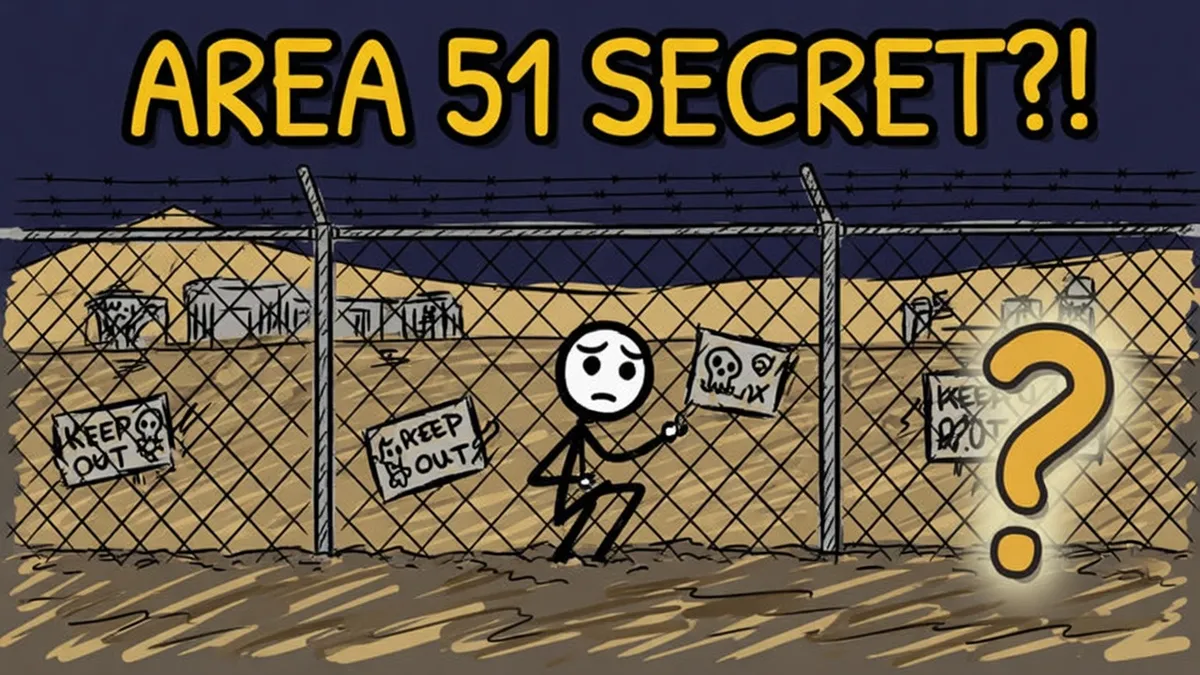
For a place that officially did not exist until 2013, Area 51 casts a very long shadow. It sits in the Nevada desert behind restricted airspace and warning signs, a base the US government spent nearly six decades refusing to even confirm was there. Nature abhors a vacuum, and so does the human imagination: hand people a patch of desert full of strange lights and zero official answers, and they will fill it with flying saucers. The real secret is quieter, and in its own way just as remarkable. Area 51 is where America goes to test the future of flight.
01 · The real jobA garage for impossible planes
Strip away the mythology and Area 51 is a flight-test facility. It was set up in 1955 in a remote stretch of Nevada, beside a dry lakebed called Groom Lake, for one purpose: to build and fly aircraft so advanced and so secret that no rival could be allowed to know they existed. The first resident was the U-2 spy plane, designed to cruise at the edge of the atmosphere and photograph the Soviet Union. You cannot test a top-secret plane at a normal airfield with the public watching. You need somewhere nobody can see. That is what Area 51 was, and largely still is.
02 · The secrecyWhy silence was the whole point
The secrecy isn’t decoration; it’s the entire function. The planes tested there, the U-2, then the Mach-3 A-12 and SR-71 Blackbird, then early stealth aircraft, were revolutionary, and their value depended completely on the enemy not knowing what they could do. Every detail was classified at the Top Secret level. During the Cold War, the goal was to spy on adversaries who had no idea such aircraft were even possible, so the base that produced them had to be more than guarded. It had to be invisible. A base that officially isn’t there can’t be asked about.
03 · The twistThe spy planes were the UFOs
Here is the detail that quietly dissolves most of the mystery. As secret flights ramped up in the 1950s and 60s, ordinary people on the ground began seeing things they couldn’t explain: objects gleaming and moving at altitudes and speeds no known aircraft could reach. Naturally, they reported UFOs. But the CIA has since acknowledged that a large share of those Cold War UFO sightings were its own U-2 and A-12 planes, flying far higher than any airliner and catching the sun in strange ways. The public simply had no framework for a plane that could do that, so their minds reached for the only thing that fit: something not of this world.
The famous "flying saucers" of the early Cold War were, in a large number of cases, American spy planes. The government couldn't debunk the alien rumours without revealing the very aircraft it was desperate to keep secret. The UFO myth was, in a sense, the perfect cover story.
04 · The long denialNot real until 2013
If it’s just a plane base, why the decades of stonewalling? Because admitting the base existed meant admitting the programs did. For most of its life the US government would not confirm Area 51 was even there, treating a place millions had seen on maps and satellite images as a non-entity. It took until 2013 for the CIA to officially acknowledge its existence, in documents prised loose by a Freedom of Information request. Nearly sixty years of official silence is a very long time, and every year of it poured fuel on the alien fire. Deny something long enough and people assume you’re hiding something extraordinary.
05 · So what's there now?Still classified, still not aliens
Acknowledging the base didn’t mean opening the doors. Area 51 is believed to remain an active site for testing current and future classified aircraft, drones and technologies, which is why the secrecy continues. But “we won’t tell you” is not the same as “aliens”. National-security historians who’ve studied the site are blunt: what’s protected there is advanced but earthly military work, the kind any nation would guard fiercely. The restricted airspace, the sensors, the warning signs, all of it is standard for a classified base, and all of it, frustratingly, looks exactly like what a base full of secrets would do.
06 · The payoffSo why is Area 51 so secret?
Because it’s the workshop for America’s most classified flying machines, and the entire value of those machines rests on nobody knowing what they can do. The secrecy is real, the technology is real, and the strange things in the sky were real too, they were just spy planes, not spaceships. The alien legend grew in the gap left by a government that would rather let people believe in flying saucers than admit what it was actually building. The final irony is perfect: the truth about Area 51 was hidden not because it was too strange to believe, but because it was too valuable to reveal.
The animated version
Same answer, told as a little animated story with the strange little stickman acting it out. Dry, quick, and, obviously, correct.
Quick questions
What is Area 51, really?
It's a highly classified United States Air Force facility in the Nevada desert, part of the Nevada Test and Training Range, officially associated with Groom Lake (also called Homey Airport). Since 1955 it has been used to secretly develop, test and fly experimental military aircraft. It's a flight-test base for cutting-edge planes, not a museum of aliens.
Why is it kept so secret then?
Because the aircraft tested there are among the most sensitive technology the US owns, and knowing their capabilities would hand rivals a huge advantage. Everything at the site is classified at the Top Secret level. During the Cold War especially, the whole point was to build planes that could spy on adversaries who had no idea such aircraft even existed, so the base that built them had to be invisible too.
What was actually built and tested at Area 51?
Some of the most famous aircraft in history. The base was set up in 1955 to test the U-2 spy plane, which flew at extreme altitude. It then tested the A-12 and SR-71 Blackbird, which flew at around three times the speed of sound, and later played a role in developing stealth aircraft like the F-117. These were revolutionary, secret machines, which is exactly why the site had to stay hidden.
So why do people think there are aliens there?
Because secrecy and strange things in the sky are a perfect breeding ground for rumour. As U-2 and A-12 flights ramped up in the 1950s and 60s, people on the ground saw objects flying higher and faster than any known plane, and reported them as UFOs. Combine unexplained craft with a base the government flatly refused to acknowledge, and the imagination fills the gap with the most exciting answer: aliens.
Did spy planes really cause UFO sightings?
Yes, to a striking degree. The CIA itself has acknowledged that a large share of UFO reports in the 1950s and 60s were actually sightings of secret U-2 and A-12 flights. These planes cruised at altitudes far above normal aircraft, and their metallic surfaces could catch sunlight in ways that looked bizarre to observers below who had no concept that anything could fly that high. The 'flying saucers' were often American spy planes.
When did the government admit Area 51 exists?
Remarkably recently. Although the base had operated since 1955 and was an open secret for decades, the CIA only officially acknowledged its existence in 2013, in documents released through a Freedom of Information Act request originally filed in 2005. For most of its life, the US government simply would not confirm the place was there at all, which only deepened the mystique.
Why not just declassify it if there are no aliens?
Because 'no aliens' does not mean 'nothing to hide'. The site is still an active facility believed to test current and future classified aircraft, drones and technologies. Revealing what goes on there in detail would expose real military capabilities. So the secrecy persists not to conceal a cosmic truth, but to protect ordinary (if very advanced) national-security work that any country would guard.
Can you visit or see Area 51?
Not up close. The base itself is off-limits, surrounded by restricted airspace and desert, with the boundary heavily monitored and trespassing prohibited. You can drive nearby public roads and visit the famous black mailbox and the town of Rachel, Nevada, but the facility is not open to the public. The heavy security is standard for a classified military site, and unsurprisingly it feeds the intrigue further.
Where did the name 'Area 51' come from?
It's essentially a map label. The name is widely believed to come from its designation on old Atomic Energy Commission grid maps of the Nevada Test Site, where numbered 'areas' divided the land. So the eerie-sounding name that has launched a thousand conspiracy theories is, in origin, a piece of dry government cartography, not a code for anything otherworldly.
What does Roswell have to do with Area 51?
In the popular imagination the two are linked, but they are separate. The 1947 Roswell incident, a crash in New Mexico that the US military later attributed to a secret high-altitude balloon from Project Mogul, happened hundreds of miles from Nevada and years before Area 51 opened in 1955. The idea that recovered 'alien' wreckage was spirited off to Area 51 is folklore, stitching two famous stories into one.
Who is Bob Lazar and did he prove aliens are at Area 51?
Bob Lazar is a man who claimed in 1989 to have worked at a site near Area 51 reverse-engineering alien spacecraft, and his story helped ignite the modern Area 51 alien legend. His claims have never been substantiated, and parts of the background he asserted could not be independently verified. Extraordinary claims need hard evidence, and his amount to testimony alone, which is why scientists and historians do not treat them as proof.
What was the 'Storm Area 51' event?
It began as a joke: a 2019 social media post invited people to rush the base to, in its words, 'see them aliens', and it went viral with millions signing up online. In the end only a few thousand people gathered near the gates and in nearby towns, and nobody actually stormed the heavily guarded facility. It turned into more of a festival than a raid, but it showed how firmly Area 51 sits in pop culture.
Is Area 51 the only secret base of its kind?
No, it's just the most famous. The United States operates other classified test and training sites, and the wider Nevada Test and Training Range surrounding Area 51 is itself vast and restricted. Groom Lake draws the fame largely because of the UFO mythology attached to it, but from a military standpoint it is one especially secretive node in a much larger network of guarded facilities.
Our sources 6 checked
// every claim on this page was checked before it went up