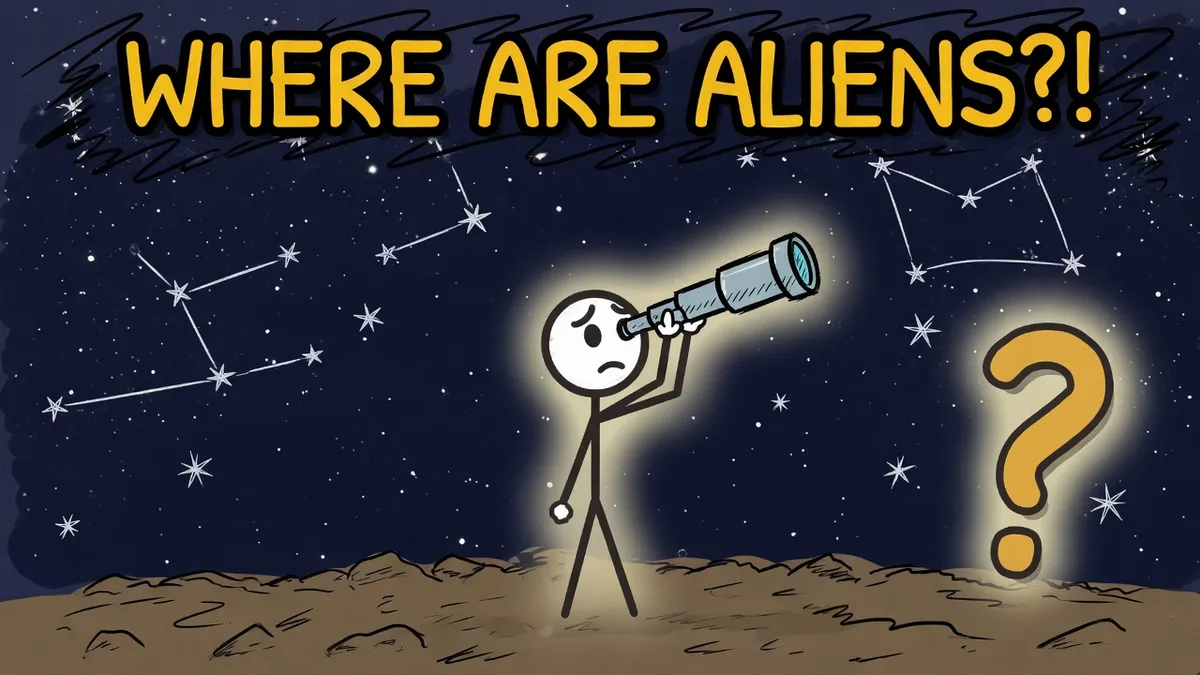
Step outside on a clear night and look up. Above you are hundreds of billions of stars in our galaxy alone, most of them circled by planets, many of those planets warm and wet and old enough for life. Run the numbers and the galaxy should be humming with civilisations, some of them millions of years ahead of us. And yet, when we point our instruments at all that promise, we hear nothing. No signals, no cities, no fleets, no messages. Just silence. In 1950 the physicist Enrico Fermi put the whole problem into three words over lunch: "Where is everybody?"
01 · The setupThe galaxy should be crowded
The paradox only bites once you feel the scale. The Milky Way is about 10 billion years old and 100,000 light-years across, stuffed with billions of potentially habitable worlds. Life had a colossal head start on countless planets that formed long before Earth. And spreading through a galaxy, even slowly, doesn’t take forever: a civilisation crawling along at just one percent of light speed could blanket the entire Milky Way many times over in a fraction of its age. By every reasonable estimate, someone should have got here, or at least left a trace we could see. That’s the “should.”
02 · The problemAnd yet, nothing
Here’s the “is.” Despite decades of scanning the skies, sifting radio waves, and hunting for any technological fingerprint, we have found no clear evidence of a single other civilisation. Not one confirmed signal. Not one probe. Not one unambiguous sign. The cosmos, which by the maths should be noisy with neighbours, is eerily quiet. That mismatch, the crowd we expect versus the silence we get, is the Fermi paradox. It isn’t a question about whether aliens are polite. It’s a question about whether our basic picture of life in the universe is missing something big.
03 · The Great FilterSomething stops almost everything
The most sobering answer is called the Great Filter. It proposes that somewhere along the road from dead rock to galaxy-spanning civilisation, there’s a barrier that almost nothing gets past. The unsettling question is where that filter sits. If it’s behind us, in the sheer fluke of life starting at all, or the leap from simple cells to complex ones, then we are rare survivors and the silence is simply because so few make it this far. But if the filter lies ahead of us, it means civilisations reliably wipe themselves out before they spread. And we have not yet passed it.
This flips how you should feel about finding alien life. If we ever discover the ruins of a dead civilisation, or even microbes on Mars, it's arguably terrible news: it means the Great Filter probably isn't behind us, which means it's still ahead. In the search for aliens, silence might be the most reassuring thing we could hear.
04 · The hidden onesMaybe they're staying quiet
Or perhaps they’re out there and simply not talking. Two ideas explore this. The gentle one is the Zoo hypothesis: advanced civilisations know we exist but leave us alone, the way you’d leave a nature reserve undisturbed, watching without interfering until we’re ready. The dark one is the Dark Forest hypothesis, named from a novel: the universe is a forest full of hidden hunters, and any civilisation foolish enough to announce its location risks being destroyed by a frightened neighbour. In that grim picture, everyone who’s still alive is silent on purpose, and our own cheerful broadcasts into space are a dangerous mistake.
05 · The dull, hopeful answersEarly, blind, or looking wrong
Not every answer is frightening. Maybe we’re simply early: the universe has trillions of years ahead of it, stars are still forming, and the great age of life may be mostly in the future, with us among the first to arrive. Maybe others are there but we can’t detect them, because we’ve only listened for a few decades, across a sliver of the sky, for signals we know how to recognise. A civilisation using methods we can’t intercept would be invisible to us no matter how loud it was. For all our confidence, we’ve barely dipped a toe in the ocean and declared it empty.
06 · The payoffSo why haven't we found aliens?
Because one of several strange things must be true, and we don’t yet know which. Either life is far rarer than the odds suggest, or it routinely destroys itself, or it’s hiding, or it’s simply out of reach of our young, half-blind search, or the party hasn’t really started yet. Every one of these answers reshapes our place in the cosmos, and most of them carry a chill. The Fermi paradox isn’t really about aliens at all. It’s a mirror: the silence overhead is quietly asking what, exactly, becomes of a civilisation like ours.
The animated version
Same answer, told as a little animated story with the strange little stickman acting it out. Dry, quick, and, obviously, correct.
Quick questions
What is the Fermi paradox?
It's the clash between two things that should not both be true. On one hand, the universe is vast and ancient, with billions of stars and potentially habitable planets, so intelligent life should be common. On the other hand, despite decades of searching, we have found no clear evidence of any alien civilisation. The physicist Enrico Fermi captured it in 1950 with a simple question: if aliens should be everywhere, 'Where is everybody?'
Why should the galaxy be full of aliens?
Because of scale and time. The Milky Way is roughly 10 billion years old and about 100,000 light-years across, and contains billions of potentially habitable worlds. Even a civilisation spreading slowly, at just 1% of the speed of light, could in principle have colonised the entire galaxy many times over in the time available. So on paper, evidence of others should be all around us. The silence is the surprise.
What is the Great Filter?
It's the idea that somewhere between 'lifeless planet' and 'galaxy-spanning civilisation' there is a barrier that almost nothing gets past. The unsettling part is where that filter sits. If it's behind us, in the origin of life itself, or the leap from simple to complex cells, then we are rare survivors and the silence makes sense. If the filter is ahead of us, it means civilisations tend to destroy themselves before spreading, and our hardest test is still to come.
What is the Dark Forest hypothesis?
It's a chilling answer named after a novel by Cixin Liu. It imagines the universe as a dark forest full of hidden hunters, where any civilisation that reveals its location risks being destroyed by another that sees it as a potential threat. In this view, everyone stays silent out of self-preservation, and the reason we hear nothing is that broadcasting your existence is dangerous. The sky is quiet because being loud is fatal.
What is the Zoo hypothesis?
A gentler idea: that advanced civilisations do exist and know we're here, but deliberately avoid contact, the way a nature reserve is left undisturbed. On this view we are being allowed to develop on our own, watched but not interfered with, until perhaps we reach some threshold of maturity. It's impossible to prove, but it neatly explains why a galaxy that might contain others would still look empty from where we stand.
Could we just be alone?
It's possible, though many scientists think it unlikely. Perhaps the chain of lucky steps that led to us, life starting at all, becoming complex, becoming intelligent, is so improbable that it has happened only once. That would make us genuinely alone. But surveys of scientists in relevant fields find most believe at least basic alien life exists somewhere, so 'we're the only ones' remains a serious but minority position.
Maybe the aliens are out there but we just can't detect them?
Very plausibly. We have only been listening for a few decades, with limited instruments, across a tiny slice of the sky and the radio spectrum. A civilisation could be using communication methods we can't intercept or don't understand, or simply be too far away for any signal to have reached us yet. Absence of evidence, here, is not strong evidence of absence: we've barely begun to look.
Could we simply be early?
Yes, and it's an underrated answer. The universe still has an enormous future ahead of it, with new stars forming for trillions of years. It may be that the conditions for intelligent life are only now becoming common, and that most civilisations are yet to arise. In that case we aren't late to a crowded party; we're among the first guests to show up, in a galaxy whose life is mostly still to come.
Do UFO sightings count as finding aliens?
Not in the scientific sense. Reported sightings and unexplained aerial phenomena remain unexplained, which is not the same as confirmed alien contact. To 'find aliens' scientifically would mean reproducible, verifiable evidence, a clear signal, a biosignature, physical proof, that holds up to scrutiny. So far nothing has cleared that bar. The Fermi paradox is precisely about the absence of that kind of solid, undeniable evidence.
What is the Drake equation?
It's a famous formula written by astronomer Frank Drake in 1961 to estimate how many communicating civilisations might exist in our galaxy. It multiplies together factors like the rate of star formation, the fraction of stars with planets, how many of those could host life, and how long a civilisation might keep broadcasting. The catch is that several of those numbers are almost pure guesswork, so the equation works less as a calculator than as a way of organising our ignorance.
Has SETI ever detected an alien signal?
No confirmed one. The Search for Extraterrestrial Intelligence has scanned the skies for decades without finding a verified message. The closest tease was the 'Wow! signal' of 1977, a strong, brief radio burst that was never explained or repeated, but a single unrepeatable blip is not proof of anything. Every promising candidate so far has turned out to be interference or a natural source.
Are scientists looking for intelligent aliens or just any life at all?
Both, and they're very different searches. Finding simple life, microbes on Mars or in the ocean of an icy moon, would be momentous, but it is a separate quest from detecting a technological civilisation. Many scientists suspect basic life may be relatively common while intelligent, communicating life is rare. The Fermi paradox is specifically about the second kind: not slime, but neighbours who could signal back.
Should we be sending messages to aliens ourselves?
It's genuinely debated. Deliberately broadcasting our location, sometimes called METI, has been done in a handful of cases, but some scientists warn it could be reckless if the Dark Forest idea holds any truth. Others point out that our ordinary radio and television leakage has been spilling into space for about a century anyway, so in a sense the horse has bolted. There is no global agreement on whether announcing ourselves is wise.
Our sources 6 checked
// every claim on this page was checked before it went up