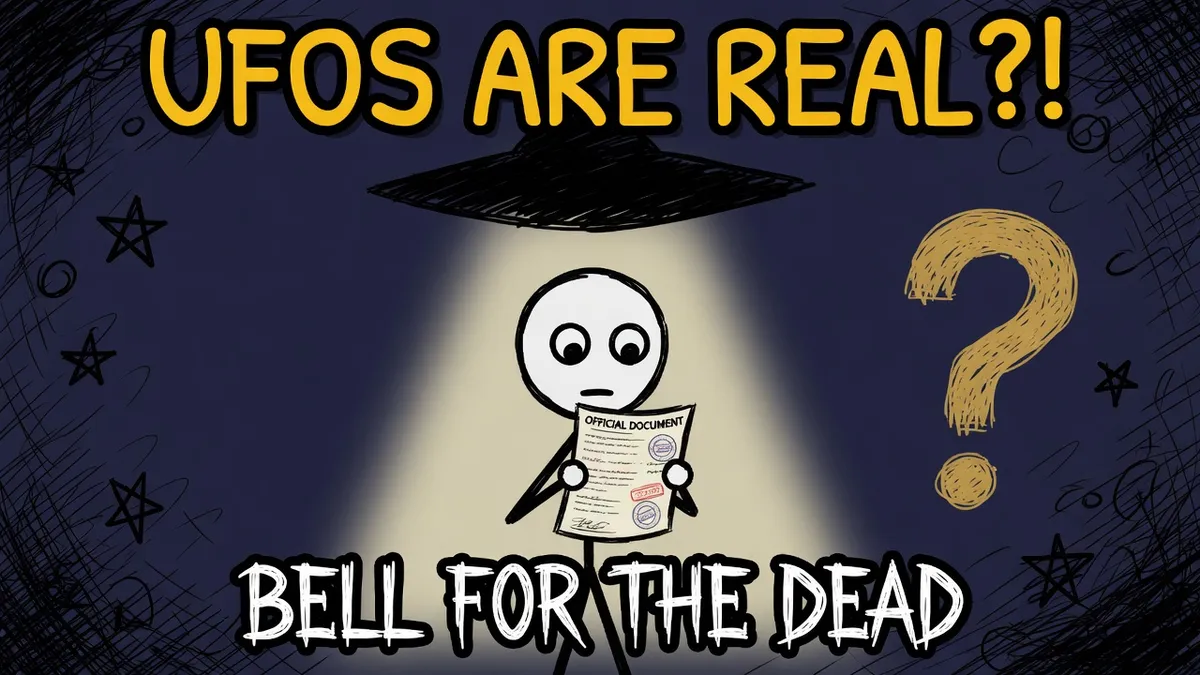
A few years ago something genuinely strange happened: the US government stopped laughing off UFOs. The Pentagon released official reports. Navy pilots testified. Congress held hearings. Headlines declared that the authorities had finally admitted UFOs are real. And they had, sort of. But between the headline and the truth is a gap you could fly a weather balloon through. What changed wasn't that the government found aliens. What changed was that a law made it stop staying silent, and 'real' turned out to mean something much more careful than anyone hoped.
01 · What "admitted" meansReal, but carefully
Let’s be precise about the admission, because the wording is everything. The government now officially acknowledges that trained military personnel encounter things in the sky they cannot identify, and it publishes reports about them. That is real. What it has not said is that any of these things are alien craft. “Real” here means the sightings genuinely happen and are genuinely hard to explain, not that the mystery has been solved in favour of extraterrestrials. It’s an official admission of uncertainty. That’s rarer than it sounds, and much less than the headlines imply.
02 · The actual triggerCongress made them
So why did decades of official silence break in 2021? Not because of a crash or a discovery, but because of a law. A provision attached to the Intelligence Authorization Act required the Director of National Intelligence and the Department of Defense to hand Congress a report on what the government knew about these phenomena, within 180 days. That deadline is why the first big assessment landed in June 2021, and why the reports keep coming: lawmakers wrote the obligation into legislation. The “disclosure” everyone talks about was, at its root, a bureaucratic requirement being met on schedule.
03 · The rebrandFrom UFO to UAP
You’ll notice officials rarely say “UFO” anymore. They say UAP, unidentified anomalous phenomena. This isn’t just jargon. The term “UFO” drags along so much alien and pop-culture baggage that it makes sober analysis almost impossible; the moment you say it, half the room pictures flying saucers. “UAP” is deliberately flat and neutral: it names something that was seen and not yet identified, and pointedly refuses to hint at what it is. The rename is a signal of intent, a decision to treat the subject as a straight intelligence and safety problem rather than a punchline.
04 · Why they careDrones, not Martians
If it isn’t about aliens, why does the military bother? Three very earthly reasons. National security: an unidentified object loitering near a base could be a foreign surveillance drone, which is a serious problem. Flight safety: anything a pilot can’t identify in crowded airspace is a hazard, whatever it is. And intelligence: the military simply wants to know what’s operating in its own skies. Every one of these concerns is pressing, and not one of them needs a spaceship. Taking unexplained sightings seriously is, for the Pentagon, just competent defence.
The most consequential change wasn't a report at all. It was removing the stigma. For decades, a pilot who reported something strange risked ridicule and a stalled career, so most said nothing. Once reporting was encouraged and made safe, the number of reports jumped into the hundreds, not because more is in the sky, but because people finally started writing down what they'd been quietly seeing all along.
05 · What they foundMostly, not enough data
So after all the reports and a dedicated office, the All-domain Anomaly Resolution Office, what’s the verdict? Underwhelming, if you were hoping for aliens. Officials have repeatedly said they’ve found no verified evidence that any UAP is extraterrestrial technology. Most cases either get explained once better data arrives, drones, balloons, aircraft, sensor quirks, atmospheric effects, or stay unresolved simply because the original data, a blurry glimpse, a brief sensor blip, is too poor to conclude anything. “Unidentified” almost always means “under-documented,” not “otherworldly.” The honest position is a shrug over a small pile of genuinely puzzling cases.
06 · The payoffSo why did the government admit UFOs are real?
Because Congress legally required it to, and because “real” is doing a lot of quiet work in that sentence. What’s real is that military witnesses see things they can’t explain, and that the government has, at last, agreed to study rather than mock them. What’s not established is that any of it comes from beyond Earth. The genuine story here isn’t a cosmic disclosure; it’s a bureaucratic and cultural shift, from stigma and silence to law, offices and reports. That’s a real change, and a meaningful one. It’s just not the change the headlines promised.
The animated version
Same answer, told as a little animated story with the strange little stickman acting it out. Dry, quick, and, obviously, correct.
Quick questions
Did the US government really admit UFOs are real?
In a specific, careful sense, yes. Since 2021 the government has officially acknowledged that military personnel encounter objects and phenomena in the sky they cannot identify, and it now publishes reports about them using the term UAP (unidentified anomalous phenomena). But 'real' means the sightings and the difficulty explaining them are real, not that any object has been confirmed as an alien spacecraft. It's an admission of genuine uncertainty, not of extraterrestrial contact.
Why did they start releasing reports now?
Mainly because Congress forced them to. A provision attached to the Intelligence Authorization Act for fiscal year 2021 legally required the Director of National Intelligence and the Department of Defense to produce a report on what the government knew about UAP within 180 days. That's why the first big assessment appeared in June 2021, and why follow-up reports have continued: lawmakers wrote the requirement into legislation, so the reporting is now a legal obligation, not a choice.
What does UAP mean, and why the name change from UFO?
UAP stands for unidentified anomalous phenomena (earlier, unidentified aerial phenomena). The government shifted away from 'UFO' partly because that term is so loaded with alien and pop-culture associations that it makes serious analysis difficult. 'UAP' is deliberately neutral: it describes something observed and not yet identified, without implying anything about what it is. The rename is an attempt to treat the subject as a straight intelligence and safety problem.
Does 'unidentified' mean it's aliens?
No. 'Unidentified' usually means the data isn't good enough to say what something was, not that it must be extraordinary. Many sightings come from brief glimpses, imperfect sensors, or unusual angles that make ordinary objects, drones, balloons, aircraft, birds, atmospheric effects, hard to pin down. Officials have been explicit that a lack of identification reflects limited information far more often than evidence of anything exotic, let alone alien.
Why does the government actually care about this?
For down-to-earth reasons. First, national security: unidentified objects near military bases or aircraft could be foreign surveillance drones or technology, which is a genuine concern. Second, flight safety: things pilots can't identify in busy airspace are a hazard regardless of origin. Third, intelligence gaps: the military wants to understand anything operating in its airspace. None of these motivations require aliens; all of them require taking unexplained sightings seriously.
What is AARO?
AARO is the All-domain Anomaly Resolution Office, a dedicated US Department of Defense body set up to collect, analyse and try to resolve reports of UAP across air, sea and space. Its creation is a big part of the story: rather than sightings being scattered, stigmatised and ignored, there is now an official channel to gather data systematically. That structure is itself an admission that the phenomenon is worth studying seriously, whatever it turns out to be.
Did reducing stigma change how many sightings there are?
It appears to have increased reporting, which is partly the point. For decades, pilots and personnel who saw something odd risked ridicule or career damage if they reported it, so many stayed quiet. By officially encouraging reports and creating formal channels, the government has seen the number of submitted reports rise, into the hundreds in some periods. That doesn't mean more things are in the sky; it means more of what's seen is now being written down instead of buried.
Has the government found any evidence of alien technology?
As of the official reporting, no. Government assessments and the dedicated office have repeatedly stated they have found no verified evidence that any UAP represents extraterrestrial technology. Most cases either get explained with better data or remain unresolved because the data is too poor to conclude anything. The honest official position is uncertainty about a residue of hard-to-explain cases, not confirmation of alien visitation.
So is this a letdown or a big deal?
Both, depending on what you hoped for. If you wanted proof of aliens, it's a letdown: nothing of the sort has been confirmed. But as a shift in how a government handles an awkward subject, it's genuinely significant: unexplained sightings have gone from a stigmatised joke to a formally studied national-security and safety issue, backed by law and a dedicated office. The change is real and important; it's just a change in transparency and process, not a cosmic revelation.
What were the Navy 'Tic Tac' and other UFO videos?
They are short pieces of military sensor footage, captured by US Navy aircraft, showing objects that behaved in ways the crews could not readily explain. The most famous, nicknamed the Tic Tac for its shape, comes from a 2004 encounter off the coast of California. The Pentagon has confirmed the videos are genuine footage taken by Navy personnel, while stressing that genuine means real recordings of unidentified objects, not proof that the objects are alien.
What did the government UFO whistleblower claims involve?
In 2023 a former intelligence official testified to Congress that the US had secretly recovered non-human craft and materials, claims that drew enormous attention. Crucially, he said he was relaying information from others rather than presenting direct evidence, and he offered no physical proof publicly. The Pentagon's dedicated office has said it found no verifiable evidence supporting claims of recovered alien technology. The episode fuelled speculation but did not, on the public record, confirm anything extraordinary.
How many UAP cases actually get explained?
When there is enough good data, many sightings turn out to have ordinary explanations: drones, balloons, aircraft, birds, satellites, or sensor and camera artefacts. A share of cases remain unresolved, but officials stress this is usually because the original information is too limited to reach a conclusion, not because the objects are exotic. In other words, unidentified most often reflects poor data rather than genuinely unexplainable technology.
Can ordinary people report a UFO sighting to the government?
The formal reporting system is aimed mainly at military and government personnel and certain aviation sources, rather than the general public. The dedicated office, AARO, has focused on gathering data from people operating in or near controlled airspace, where sightings matter most for security and flight safety. Members of the public have typically reported sightings to private organisations instead, while the official channels have stayed focused on government, military and aviation sources.
Our sources 6 checked
// every claim on this page was checked before it went up