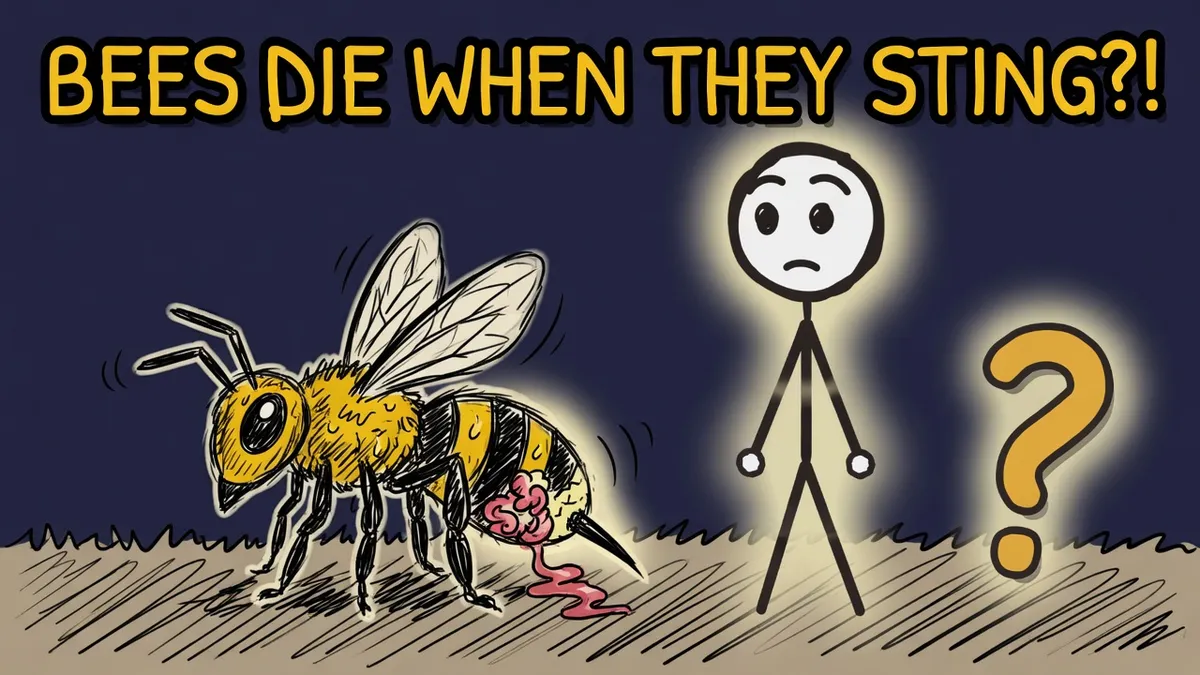
It is one of nature's strangest bargains. A honeybee stings you, and in doing so, she signs her own death warrant. Within minutes she is gone, killed by the very act of defending her home. On the face of it, this looks like the worst piece of engineering in the animal kingdom: a weapon that destroys the soldier every time it fires. But nature is rarely that careless. Look closely and the honeybee's suicide is not a flaw at all. It is a feature, and a chillingly effective one.
01 · The weaponNot a needle, a harpoon
Start with the sting itself, because it is not what you picture. It is not a smooth spike like a wasp’s. Under a microscope, a worker honeybee’s sting is a barbed harpoon: two blade-like lancets, each lined with around ten backward-facing barbs, that slide alternately to saw themselves deeper into flesh. Those barbs are brilliant on the way in and catastrophic on the way out. Researchers measured it: pulling the sting free takes roughly twenty times more force than pushing it in. The bee has built a weapon that is easy to plant and almost impossible to retrieve.
02 · The deathFlying off leaves half of her behind
Now the fatal moment. The barbs bury themselves in your skin and hold fast. When the bee tries to fly away, the sting simply will not come loose, so instead the entire sting apparatus rips out of her body, a process biologists call sting autotomy. It does not tear away cleanly, either. It takes the venom sac, the muscles, the nerves and part of her digestive tract with it, leaving a wound she cannot survive. One apiarist described it bluntly as bleeding to death, except that bees don’t have blood. She is dead within minutes of a single sting.
03 · The exceptionOnly her, and only against you
Here is the detail that unravels the whole “bees die when they sting” myth. It is not bees, plural, and it is not always. Only worker honeybees die this way, and only when they sting a mammal. The trick is the skin: thick, springy mammal skin grips the barbs, but the thin, hard exoskeleton of another insect does not. So the same worker can sting a rival bee or a wasp over and over inside the hive and survive every time, because the sting slides straight back out. Queens have smoother stings and live to sting again. Wasps, hornets and bumblebees keep their smooth stingers and never face this problem at all. The honeybee only dies against the one enemy her barbs were built to punish.
04 · The afterlifeThe sting keeps fighting without her
Perhaps the eeriest part is what happens after the bee is gone. That torn-out sting is not a lifeless splinter. It carries its own tiny bundle of nerves, a little pacemaker, that keeps the lancets sawing inward and the pump working, driving venom into you for up to a full minute after the bee has flown off and died. And riding alongside the venom is an alarm pheromone that smells, unmistakably, of bananas. Left in your skin, it acts as a chemical flare, marking you as the enemy and calling every other worker in the hive to come and sting the exact same spot.
The bee's death is not the cost of the weapon. The death IS the weapon. A living bee could deliver one quick jab and buzz off. A dead bee leaves behind a self-driving venom pump that keeps injecting for a minute and a scent beacon that summons the swarm. A honeybee is genuinely more dangerous to a large raider dead than alive. The suicide isn't a bug in the system. It is the most effective thing the sting does.
05 · The mathsWhy evolution allows a suicidal soldier
But how can natural selection favour a trait that kills the animal using it? The answer is to stop counting bodies and start counting genes. A honeybee colony is one queen and tens of thousands of sterile female workers, her daughters, who will never breed. A worker has no offspring of her own, so her personal survival is, in genetic terms, almost worthless. What carries her genes into the future is the colony: the queen and the sisters who share her DNA. So if one worker dies to drive off a bear, a badger or a human and save the hive, the genes for that self-sacrificing, barbed-sting defence are passed on through all the relatives she rescued. The individual is expendable. The genome is not.
06 · The payoffSo why do bees die when they sting you?
Because you are a mammal, and the honeybee’s harpoon was built specifically to make a large, warm-blooded raider regret it. The barbs lock into your skin, the sting rips from her body and keeps pumping venom on its own while its banana scent calls in reinforcements. She dies, yes, but a sterile worker’s death costs the colony almost nothing and buys it a far nastier defence than a survivable jab ever could. It only looks like a design failure until you realise who the weapon is really for. It was never meant for other insects, who feel nothing of this. It was meant for something big, and soft, and reaching into the hive. Something like you.
Quick questions
Do all bees die when they sting?
No. Only worker honeybees die, and only when they sting a mammal. Their barbed sting lodges in thick skin and tears out of the abdomen. Most of the world's roughly 20,000 bee species, including bumblebees and carpenter bees, have smooth stings and survive.
Do wasps die when they sting?
No. Wasps and hornets have smooth stings that slide straight back out, so they can sting repeatedly without harm. This is the single biggest thing people get wrong: the barbed, suicidal sting is a honeybee speciality, not a general insect trait.
Why don't bumblebees die when they sting?
Bumblebees have smooth or only faintly barbed stings, so nothing catches in your skin. The sting withdraws cleanly and the bumblebee flies off unharmed, ready to sting again if it still feels threatened.
Can a bee sting other insects without dying?
Yes. A worker honeybee can sting rival insects again and again without harm. An insect's thin exoskeleton does not grip the barbs, so the sting pulls out cleanly. The sting only gets fatally trapped in thick, elastic skin like a mammal's, which is exactly what it evolved to punish.
How long does a bee live after stinging?
Not long, usually only a few minutes. Tearing out the sting takes the venom sac, muscles, nerves and part of the gut with it, an injury the worker cannot survive. It is effectively fatal from the moment she pulls away.
Should you pull a bee sting out?
Yes, and fast. Older advice said always scrape, never pinch, but a study found the amount of venom delivered does not differ between the two methods. What actually matters is removing the sting as quickly as possible, because it keeps pumping venom while it stays in.
Does a bee sting keep pumping venom after the bee is gone?
Yes. The detached sting has its own tiny nervous system that keeps the lancets sawing and the valves pumping venom for up to about a minute. That is precisely why the speed of removal matters more than the technique you use.
Why do honeybees have barbed stings if it kills them?
Because the death is the deterrent. A barbed sting that stays embedded, keeps injecting venom and releases alarm scent punishes a large raider far more than a sting that simply pulls out. Evolution favoured it because a single worker's life is cheap next to the survival of the whole colony.
Do queen bees die when they sting?
No. The queen has a smoother sting with smaller barbs and can sting more than once. She rarely uses it on people; her sting is mainly a weapon for killing rival queens inside the hive.
Do male bees sting?
No. Drones, the male bees, have no sting at all. Only females possess one, so every bee that has ever stung you was female.
Why does a bee sting smell like bananas?
The sting releases an alarm pheromone, isopentyl acetate, which smells strongly of bananas. It marks you as a target and calls in more workers to sting the same place, which is why disturbing a hive can quickly trigger a swarm of stings.
Why do bees sting at all if it means dying?
A worker honeybee is sterile and cannot pass on genes by breeding, so from evolution's point of view her individual survival barely counts. By dying to defend the hive she protects the queen and thousands of sisters who share her genes, so the self-sacrificing behaviour is passed on through them.
Our sources 8 checked
// every claim on this page was checked before it went up