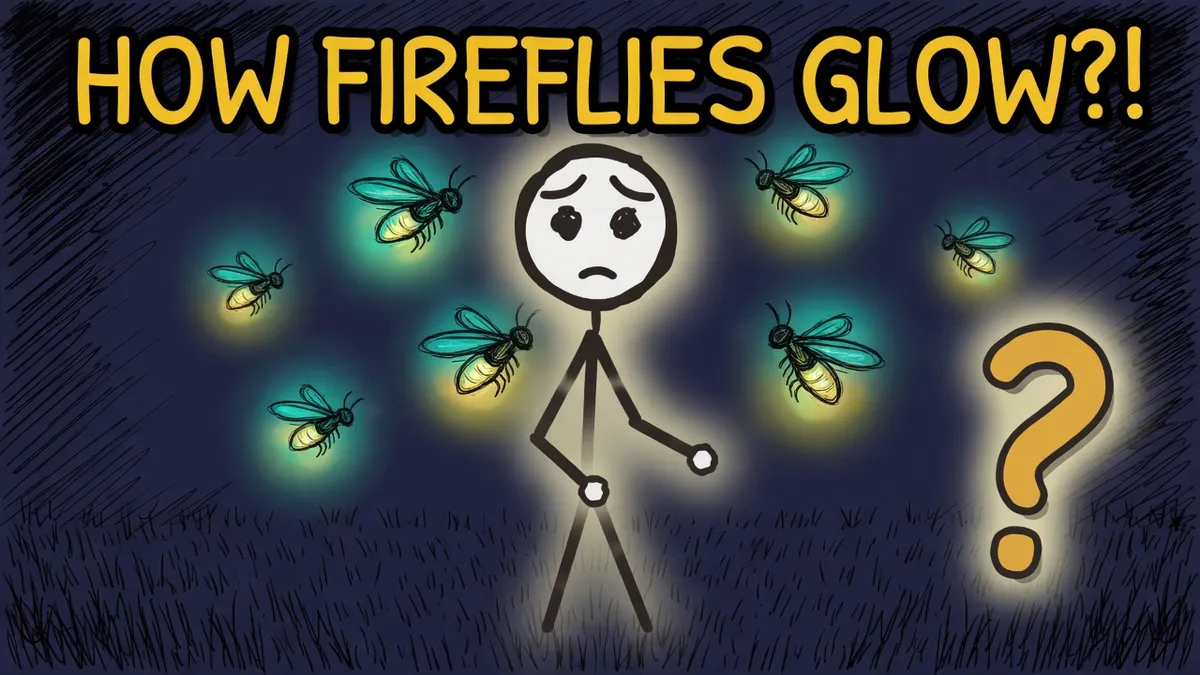
On a warm summer night, a meadow can turn into a slow-motion galaxy, thousands of tiny green lights blinking on and off across the dark. It looks like magic, but it is chemistry, and remarkably good chemistry at that. A firefly makes light so cleanly that it barely wastes a scrap of energy as heat, outperforming every lightbulb humans made for a century. And once you know what the flashing is actually for, that gentle summer glow starts to look a lot less innocent.
01 · The lanternA chemistry set in the abdomen
First, fireflies are not flies at all, they are beetles. The light comes from a dedicated organ, the “lantern,” on the underside of the abdomen, packed with special light-producing cells. This is not reflected light or a stored glow. It is a live chemical reaction, happening in real time, that the beetle runs whenever it wants to shine. Everything interesting about a firefly starts in that little glowing patch of belly.
02 · The reactionLuciferin, luciferase and a spark of oxygen
The recipe has a few key ingredients. A light-emitting molecule called luciferin. An enzyme called luciferase that runs the reaction. ATP, the same energy currency your own cells use. And oxygen. The enzyme first joins luciferin to ATP, then lets oxygen attack it, briefly forming a high-energy molecule that is desperate to calm down. When it relaxes into its stable form, called oxyluciferin, it dumps its surplus energy as a single particle of light, a photon. Multiply that by billions of molecules and you get a flash you can see from across a field.
Almost none of that energy escapes as heat. A firefly's light is close to 100% efficient, which makes it one of the most efficient light sources known. Compare that to an old-fashioned incandescent bulb, which is only about 10% efficient and blows the other 90% as wasted heat. The insect glowing on your windowsill is quietly a better piece of lighting engineering than anything Edison built. That is why it is called "cold light": you could hold the reaction and never feel it warm.
03 · The switchHow they blink on and off
If luciferin, luciferase and ATP are all sitting in the lantern all the time, why isn’t a firefly glowing constantly? Because the reaction is missing one thing until the beetle allows it in: oxygen. The firefly controls its flash by controlling the oxygen supply to those cells. The likely switch is a gas called nitric oxide. When the beetle wants to flash, a nerve signal releases nitric oxide, which briefly tells the cell’s oxygen-hungry mitochondria to stop hogging the gas. Oxygen suddenly floods through to the light-making machinery, and the lantern fires. The nitric oxide fades in an instant, the mitochondria go back to work, and the light snaps off. That is how you get crisp, controlled blinking rather than a steady smear.
04 · The messageFlashing in code to find a mate
So why go to all this trouble? For most adult fireflies, the answer is romance. Each species flashes in its own distinct pattern, a particular rhythm, number and length of pulses, even a particular colour, that works like a signature. A flying male broadcasts his species’ code into the dark, and a waiting female of the same species answers with the correct reply after a precise delay. Match the pattern, match the timing, and the two find each other in a meadow full of strangers. The light show that looks so peaceful is really thousands of insects calling out, and answering, in flickering Morse.
05 · The femme fataleWhen the love code becomes a trap
And here is where the fairy lights turn sinister. Females of the genus Photuris have learned to crack the code of other species. When a male of a different kind flashes his signal, a Photuris female flashes back his species’ correct answer, imitating a willing mate. He flies in, expecting love, and she seizes and eats him. She isn’t only after a meal, either. Her prey carry defensive toxins called lucibufagins that she cannot manufacture herself, so by devouring these deceived suitors she steals their chemical armour and becomes poisonous to her own predators. She hijacks another species’ language of light, and turns it into a hunting call.
06 · The payoffSo how do fireflies glow?
With a burst of near-perfect chemistry: luciferin oxidised by oxygen, run by an enzyme and fuelled by ATP, releasing its energy almost entirely as cold light and switched on and off by carefully rationing the oxygen. It is more efficient than any bulb, and every flash carries a meaning, usually a call for a mate, sometimes a warning that a larva is not worth eating, and occasionally a lie whispered by a predator wearing another insect’s words. The next time a meadow lights up on a summer night, remember what you are really watching. It is not decoration. It is a whole silent conversation, written in the most efficient light on Earth, and not all of it is friendly.
Quick questions
Why do fireflies light up?
Adult fireflies light up mainly to find a mate. Males and females flash species-specific patterns so they can recognise and locate each other in the dark. In larvae, the glow instead works as a warning that they are toxic or foul-tasting to predators.
How do fireflies make light without heat?
They use a chemical reaction (bioluminescence), not a hot filament. An enzyme called luciferase helps luciferin react with oxygen and ATP, and the released energy comes out almost entirely as light rather than heat. This 'cold light' is why a glowing firefly never feels warm.
What is luciferin?
Luciferin is the light-emitting molecule inside a firefly's lantern. When luciferase, ATP and oxygen act on it, it becomes an excited form called oxyluciferin, which sheds its extra energy as a photon of visible light. The name comes from the Latin for light-bearer.
What is luciferase?
Luciferase is the enzyme that drives the light reaction. It first joins luciferin to ATP, then helps oxygen oxidise it, producing the excited molecule that glows. Because it is so reliable, scientists use firefly luciferase as a marker in medical and biological research.
Do fireflies glow to attract mates?
Yes. For adult fireflies, flashing is chiefly a courtship signal. Each species has its own rhythm of flashes, and a female typically answers a male's signal after a set delay so the two can find each other in the dark.
Are fireflies disappearing?
Scientists report a broad decline in many firefly species, though some generalist species are holding on. The main threats are light pollution, habitat loss, pesticide use and climate change. Artificial light is especially damaging because it drowns out the flashes fireflies rely on to find mates.
Do firefly larvae glow?
Yes. The larvae of all firefly species are bioluminescent, and even some eggs glow faintly. In larvae the light is a warning signal telling predators they are chemically defended, rather than a mating call.
What is a glowworm?
A glowworm is usually a wingless adult female firefly, or a larva-like firefly, that produces a steady, long-lasting glow instead of quick flashes. Because she cannot fly, she glows to draw flying males to her.
What colour is firefly light?
Most fireflies flash yellow-green, but colours range across green, yellow and even orange depending on the species. The light sits in the visible range, roughly 480 to 600 nanometres, and the exact shade depends on the luciferin chemistry and conditions.
How do fireflies turn their flash on and off?
The glow depends on oxygen reaching the reaction site. Research suggests the gas nitric oxide briefly stops the lantern's mitochondria from using up oxygen, letting oxygen flood the light-producing cells so they flash. When the nitric oxide clears, the mitochondria resume and the light switches off.
Do fireflies eat other fireflies?
Some do. Females of the Photuris genus mimic the answering flash of other species to lure in unsuspecting males, then catch and eat them. They gain both a meal and defensive toxins, called lucibufagins, that they cannot make themselves.
How efficient is a firefly's light compared with a lightbulb?
Astonishingly efficient. A firefly converts nearly all its reaction energy into light, whereas a traditional incandescent bulb is only about 10% efficient and loses roughly 90% of its energy as heat. That near-total efficiency is why firefly light is called cold light.
Our sources 8 checked
// every claim on this page was checked before it went up