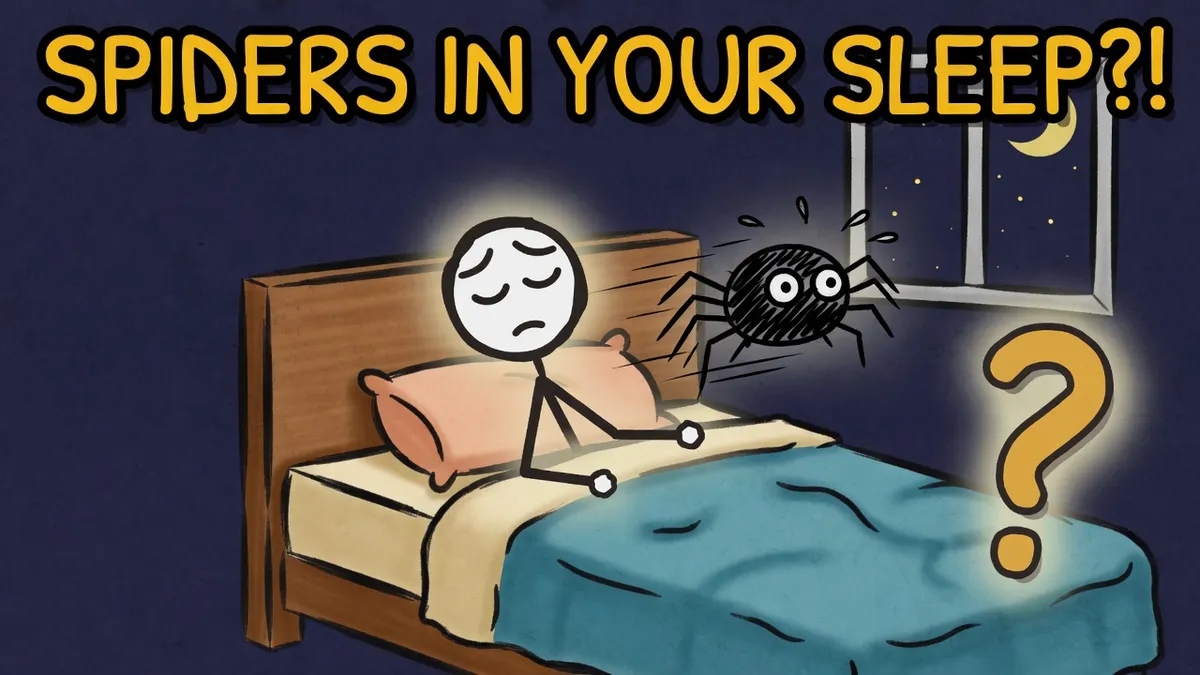
You have almost certainly heard it, probably as a horrifying "fun fact" at a sleepover: the average person swallows around eight spiders a year in their sleep. It's the kind of thing that lodges in your brain forever and makes you slightly wary of your own pillow. Well, sleep easy, because it is total nonsense. Not exaggerated, not "well, technically", but invented from nothing, and there's a genuinely delicious twist: even the popular story about who invented it appears to be made up too. It's a fake fact wrapped in a fake backstory, and peeling it apart is more fun than the myth ever was.
01 · The number is inventedZero cases, zero evidence
Let’s start with the claim itself. Four spiders a year, eight spiders a year, dozens in a lifetime, whatever version you heard, they all share one feature: there is no source. No study ever measured it. No scientist ever counted it. And crucially, in all of medical and scientific literature, there is not one single documented case of a person swallowing a spider in their sleep. The arachnologist Rod Crawford of the Burke Museum makes a devastatingly simple point: millions upon millions of people have watched a partner or child sleep. If this happened even occasionally, where is the one eyewitness who saw a spider crawl into someone’s mouth? There isn’t one. Anywhere. Ever.
02 · The spider's-eye viewYou are a monster
The number is fake, but the biology is what really kills it, because a spider has every reason in the world to avoid you. Spiders experience their environment largely through vibration, they feel the world trembling around them. Now consider what a sleeping human is, from that point of view: an enormous, warm mass that constantly thumps with a heartbeat, heaves with breathing, and, quite possibly, roars with snoring. To a creature that reads vibration as its primary danger signal, you are not a cosy place to explore. You are a terrifying, throbbing giant. As one expert put it, a spider regards a person about the way it would regard a big rock, except this rock is alive and shaking. Spiders don’t climb into your mouth. They flee the whole terrifying area.
03 · The chain of the impossibleEverything that would have to go right
Even setting fear aside, think about the sheer sequence of unlikely events required for a single sleep-swallowing. A spider would have to be in your bed in the first place. It would have to choose to walk across your face, of all the places to go. Your mouth would have to be open. The spider would have to march into that open mouth against a steady outward gust of warm, moist exhaled breath. And then, instead of you jolting awake at the sensation of legs on your lips, your swallow reflex would have to quietly fire. Each of those is improbable; all of them lining up, repeatedly, eight times a year, is fantasy. A spider offers your bed nothing it wants, no prey, no mate, so it has no reason to be there, and every reason to be somewhere, anywhere, else.
Here's the layer that makes this myth perfect. The popular explanation is that the "eight spiders" stat was deliberately invented in 1993 by a columnist named Lisa Holst, who supposedly put it in a magazine to prove how gullibly people spread things they read. It's a lovely, ironic story, a fake fact created to expose fake facts. Except that origin story is itself almost certainly fabricated. Searches turn up no real trace of "Lisa Holst" or the magazine, and the name "Lisa Birgit Holst" is reportedly an anagram of "This is a big troll." So we have a made-up statistic, and then a made-up story about how the statistic was made up to teach people not to believe made-up things. It's myths all the way down.
04 · Why it spread anywayThe perfect little lie
If it’s so baseless, why did it conquer the world? Because it’s beautifully engineered to be repeated. It’s short, it’s specific (a precise number feels authoritative), it’s disgusting, and it’s about something everyone does, sleep, so it feels personal and inescapable. That combination, gross plus specific plus universal, is catnip for the human urge to share. It didn’t spread because it was true. It spread because it was tellable, the kind of fact that’s almost too good to fact-check, which is exactly the instinct the myth’s own (probably invented) backstory was supposedly designed to mock.
05 · The related legendsNo, they don't drink from your mouth either
While we’re here, the spider-swallowing myth has a few cousins worth dismissing in the same breath. No, spiders do not drink water from your mouth while you sleep, another debunked legend on arachnologists’ lists. No, you’re not routinely being bitten in bed; spider bites overwhelmingly happen when a spider is accidentally trapped against skin, not because it hunted you down. The common thread through all of them is the same misunderstanding: they cast the spider as drawn toward humans, when the entire truth of spider behaviour points the other way. They want less to do with us than we could possibly want with them.
06 · The payoffSo do you swallow spiders in your sleep?
No. Not eight a year, not one a year, not really ever. The statistic was invented, no case has ever been recorded, and the biology runs firmly in the opposite direction: to a spider, a breathing, beating, snoring human is a fearsome thing to escape, not a diner to visit. The whole legend is a fake number dressed up in a probably-fake origin story, kept alive purely because it’s such a satisfyingly horrible thing to say. So tonight, when you turn out the light, you can let go of the pillow-dread entirely. The spiders in your house, if there are any, are doing their absolute best to stay as far from your face as they possibly can. You were never the predator’s target. You were the thing it runs from.
Quick questions
Do you swallow spiders in your sleep?
No. There is no evidence anyone regularly swallows spiders while asleep, and no such case appears in the scientific or medical literature. Spiders avoid sleeping people because we breathe, move and create vibrations they read as danger. The idea is an urban legend, not a documented fact.
How many spiders do you eat in your sleep?
On average, effectively zero. The famous 'four to eight a year' figure is invented and has no scientific source behind it. Experts who study spiders have never documented a single verified case, so the honest number is as close to none as makes no difference.
Do spiders crawl into your mouth at night?
Almost never, and not on purpose. A spider has no reason to enter a warm, breathing mouth, and the exhaled air alone would push it away. Most people would also wake up at the feeling of something crawling across their face, which is exactly why there are no eyewitness accounts.
Where did the spider-swallowing myth come from?
The stat spread as a classic piece of internet misinformation. A popular story credits a 1993 magazine column by 'Lisa Holst', supposedly written to prove how easily people believe things online. However, that origin tale is itself poorly documented and probably invented, so the myth's true source is unclear.
Do spiders avoid humans?
Yes. Spiders generally treat a human as part of the landscape, like a large rock, and steer clear of the vibrations we produce. They wander in search of prey or a mate, neither of which a person or a bed provides. Bites usually only happen when a spider is trapped against skin, not because it sought you out.
Is it true you eat 8 spiders a year?
No. The 'eight spiders a year' line is one of the most widely shared false facts on the internet and has no basis in research. There is no study, count or record supporting it. It is repeated precisely because it sounds surprising, not because it is true.
Has anyone ever actually swallowed a spider while sleeping?
There is no verified, documented case on record. As arachnologists note, millions of people have watched others sleep, yet not one eyewitness account of spider-swallowing exists. People sometimes claim it happened, but they never keep any evidence.
Why do spiders stay away from sleeping people?
Spiders rely heavily on vibration to sense their surroundings, and a sleeper's heartbeat, breathing and snoring all signal a large, living, potentially dangerous thing. To a spider that reads as a threat to avoid, not a place to explore. There is also no food for them in your bed.
Can a spider survive being swallowed?
This almost never comes up because swallowing one is so unlikely in the first place. In the rare, essentially random event that something crawled in, it would be an accident, not spider behaviour. The premise of routine spider-swallowing simply is not real.
Do spiders drink water from your mouth while you sleep?
This is a separate myth and also false. Arachnologists list it among debunked spider legends, and there is no evidence spiders seek moisture from sleeping people. Like the swallowing story, it survives on repetition rather than facts.
Is the 'Lisa Holst' story about the spider myth true?
Probably not. The tale that a columnist named Lisa Holst invented the stat in a 1993 magazine is widely repeated but very poorly documented. Reporting suggests the name may be a deliberate hoax (an anagram of 'This is a big troll'), so the origin story appears to be a myth about a myth.
Should I be worried about spiders in my bed?
Not really. Spiders have no interest in your bed and actively avoid the vibrations a person makes. The chance of one ending up near your face while you sleep is tiny, and the swallowing legend overstates the risk enormously. Spiders would much rather be anywhere you are not.
Our sources 7 checked
// every claim on this page was checked before it went up