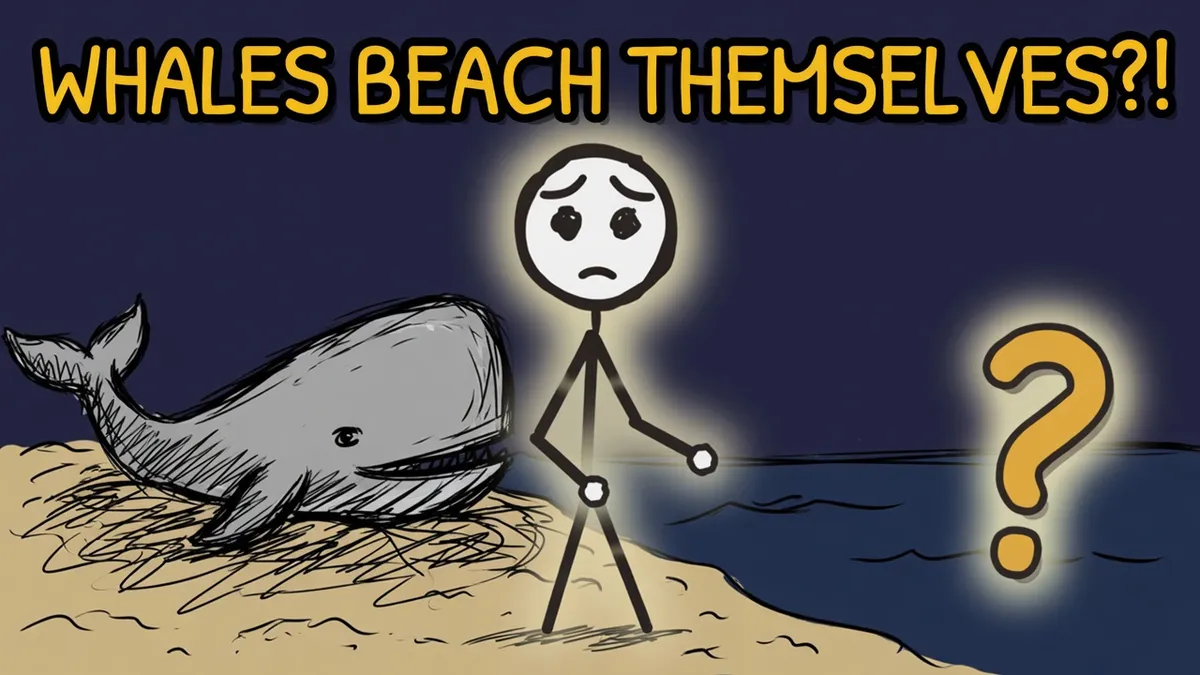
It is one of the ocean's most haunting sights. A whale, or a dozen, or a hundred, driven up onto a beach, stranded and helpless in the shallows, their bodies too heavy for the land they never should have touched. Rescuers rush in, crowds gather, and everyone asks the same question: why on earth would a creature so perfectly built for the sea end up dying on the sand? The honest answer is that there is no single answer. But the reasons range from the coldly biological to something that will genuinely break your heart.
01 · The lone whaleUsually, something was already wrong
Start with the most common case: a single whale on a beach. More often than not, this is not a healthy animal that made a mistake. It is a whale that was already dying, of disease, injury, starvation, or simple old age, and the tide carried it in. One recurring biological villain is a parasite called Nasitrema, a tiny worm that infests the sinuses, inner ear and even the balance nerves of toothed whales. Wreck a whale’s inner ear and you wreck its sense of direction and its echolocation at once. A disoriented, sick animal drifts shoreward and grounds. Sad, but usually not a mystery.
02 · The blind coastWhen sonar meets a sandy slope
Toothed whales don’t see their world so much as hear it. They fire out clicks and read the echoes, building a sound-picture of everything around them. It is a superb system, with one weakness: it depends on things bouncing sound back. A gently sloping, soft sandy shore is terrible at this. Instead of returning a clean echo, it scatters the clicks and swallows them, so a whale can be swimming toward a beach and effectively not hear it coming. It is no coincidence that many of the world’s notorious mass-stranding hotspots share exactly this shallow, shelving, sound-absorbing geography. The sea gives them a blind spot, and they swim into it.
03 · The sonar problemGiving whales the bends
Then there is a cause with our fingerprints on it. Since the 1980s, mass strandings of beaked whales, deep divers who are especially sensitive, have repeatedly coincided with naval mid-frequency sonar exercises. The clearest case came in the Canary Islands in September 2002: fourteen beaked whales stranded starting about four hours after a naval exercise began blasting sonar. When scientists examined the bodies, they found something chilling, gas bubbles and fat embolisms in the blood and organs, the signature of decompression sickness, the same “bends” that can kill a human diver who surfaces too fast. The leading idea is that the sonar frightens the whales into bolting for the surface, and the sudden ascent turns their own blood against them.
Here is the reason a hundred whales end up on one beach, and it isn't a wrong turn or a bad echo. The most social whales, above all pilot whales, live in pods bound together for life. If one animal, often a sick or disoriented leader, heads into deadly shallow water, the others follow out of pure loyalty. And if one becomes stranded, the rest hear its distress calls and beach themselves alongside it rather than abandon it. Rescuers know the anguish of refloating a single pilot whale only to watch it turn straight back toward its stranded family and strand itself again. The very bond that keeps them alive at sea is what kills them together on the sand.
04 · The trap of landWhy the beach itself is fatal
Whatever brings a whale ashore, the land finishes the job with terrible speed, and not for the reason most people assume. A stranded whale rarely drowns; it is crushed and cooked. In the water, a whale’s enormous body is cradled and supported. On land, that same weight has nowhere to go, and it presses down on the animal’s own lungs and organs until it can no longer breathe or circulate blood. At the same time, all that blubber, so brilliant at keeping heat in at sea, becomes a death trap on a warm beach, and the whale overheats. This is why time matters so desperately, and why a large whale ashore usually has only hours.
05 · What to doWhy you must never push it back
Every instinct screams to shove the animal back into the waves. Don’t. A panicked or unsupported whale can injure you badly, it may be carrying disease, and moving it wrong can kill it faster. Worse, with social species you may simply be sending a sick animal back to lure its pod ashore again. The right move is the hard one: keep your distance, keep dogs and crowds away, keep it cool and wet if advised, and get trained responders there fast. In the United States that means NOAA’s marine mammal stranding network. The people who do this know how to give the animal its only real chance, and how to read what actually went wrong.
06 · The payoffSo why do whales beach themselves?
Because “whales beaching” isn’t one event with one cause, it’s several different tragedies that happen to end on the same sand. Sometimes it’s a lone sick animal, its inner ear eaten by parasites, drifting in on the tide. Sometimes it’s a whole species’ sonar failing them against a silent sloping shore. Sometimes it’s our own navies, frightening deep divers into a fatal ascent. And sometimes, most movingly of all, it’s an entire pod choosing to die together rather than leave one of their own behind. That last one isn’t a malfunction or a mystery. It’s loyalty, taken to the water’s edge and beyond, by creatures who turned out to love their families a little too much to save themselves.
Quick questions
Why do whales beach themselves?
There is rarely one answer. Individual whales usually strand because they are already sick, injured, weak from old age, or carrying parasites that disrupt their balance and navigation. Others may make a navigation error, chase prey into shallows, be driven in by storms, or, in the case of beaked whales, be disturbed by naval sonar. Very often the exact cause of a single stranding cannot be determined.
Why do whole pods of whales strand together?
Mass strandings almost always involve intensely social toothed whales, especially pilot whales. Their pods are bound by lifelong social ties, so if one sick or disoriented individual heads for shore, the others tend to follow. If one becomes stuck, the rest may hear its distress calls and strand alongside it rather than leave it behind.
Does navy sonar cause whale strandings?
For some beaked whale mass strandings, yes, there is a strong documented link. Since the 1980s, beaked whale strandings have repeatedly coincided in time and place with naval mid-frequency sonar exercises, and affected whales have shown decompression-like tissue damage. However, sonar does not explain most strandings of other species, and the precise biological mechanism is still being researched.
Can a beached whale be saved?
Sometimes, but it is difficult and often unsuccessful. Small dolphins and whales are occasionally refloated by trained teams, and there are documented successes. Large whales are frequently impossible to move safely, and highly social species like pilot whales may simply re-strand trying to rejoin their pod.
Why can't a beached whale survive on land?
Their bodies are built to be supported by water. On land a whale's own weight compresses its lungs and internal organs, making breathing and blood flow fail. They also overheat quickly, because their bulk and thick blubber trap heat with no water to carry it away. Most survive only a few hours ashore.
Do whales strand themselves to die on purpose?
There is no good evidence that whales beach themselves deliberately to die. Stranding is better understood as the result of sickness, disorientation, navigation failure, disturbance, or social pods following a distressed member. The idea of whales committing suicide is a myth not supported by marine biologists.
Why do pilot whales strand so often?
Pilot whales are among the most socially bonded of all cetaceans and travel in large, close-knit pods. That loyalty is exactly what makes them prone to mass strandings: when one animal falters and heads inshore, the whole group is inclined to follow. Their strong response to a pod-mate's distress calls compounds the risk.
What is 'sick leader syndrome'?
It is the idea that when an ill or disoriented lead animal moves into dangerous shallow water, the pod follows out of social cohesion. It has been invoked for events such as a sperm whale mass stranding on Italy's Adriatic coast. It is a plausible contributing factor in some mass strandings rather than a proven rule.
How does a sloping beach cause strandings?
Toothed whales navigate using echolocation, sending out clicks and reading the echoes. Gently sloping sandy or muddy shores scatter these clicks and reflect them poorly, so the whale may not detect the shoreline closing in. Many repeat mass-stranding sites share exactly this gently shelving geography.
Can parasites make whales strand?
Yes, this is one recognised biological cause. Trematode worms of the genus Nasitrema can infest a whale's sinuses, inner ear and even the nerves controlling balance and hearing. The resulting disorientation, loss of equilibrium and disrupted echolocation can lead an affected animal to strand.
What should I do if I find a stranded whale or dolphin?
Do not push it back into the sea and do not attempt to move it yourself, as you could injure the animal or yourself, and it may carry disease. Keep your distance, keep dogs and crowds away, and immediately contact trained responders. In the United States that means NOAA's regional marine mammal stranding network.
Are whale strandings becoming more common?
Reported strandings can be influenced by shifting prey, changing ocean conditions, pollution affecting whale health, and increased underwater noise, and better reporting also raises the recorded numbers. Scientists study strandings as a window into ocean health. But attributing any single stranding to a broad cause like climate change is usually not possible.
Our sources 7 checked
// every claim on this page was checked before it went up