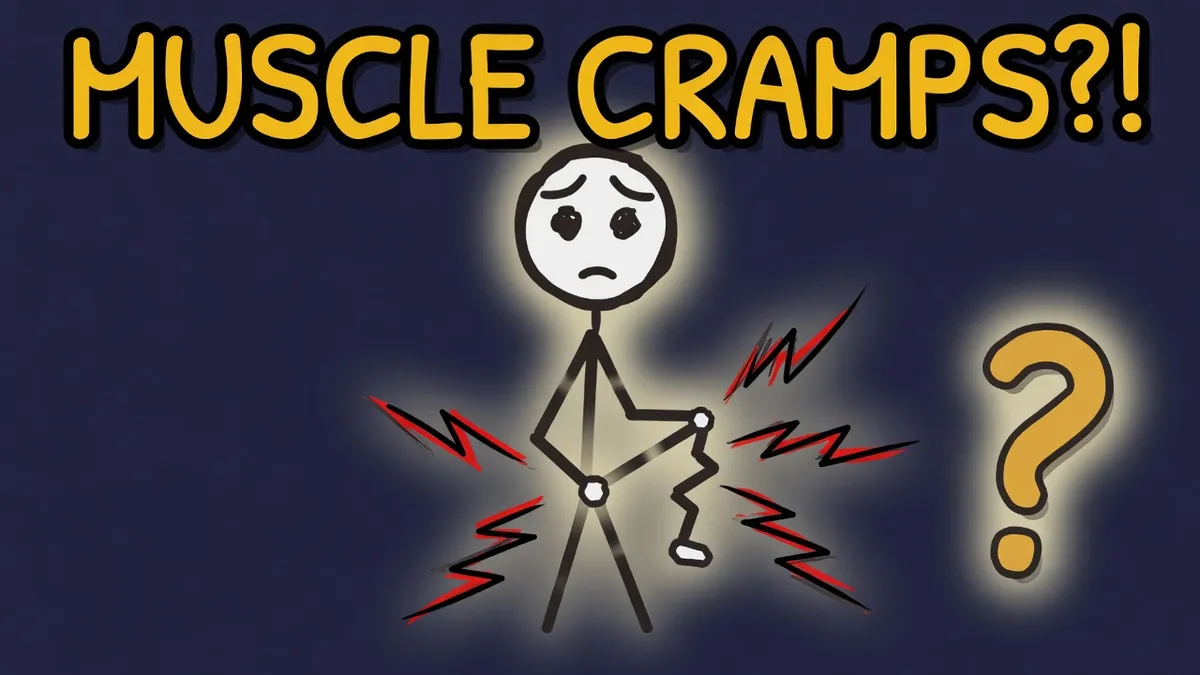
It's 3am and your calf has just turned to stone. The muscle has clenched into a hard, screaming knot and it will not, no matter how you plead with it, let go. Everyone "knows" what this means: you're dehydrated, you're low on salt, drink more water, eat a banana. It's the advice on every sports drink and every locker-room wall. And the surprising truth is that it's probably wrong.
01 · What a cramp actually is
Strip away the folklore and a cramp is simple to describe: a sudden, involuntary, sustained contraction of a muscle. Normally your muscles run a tidy contract-then-relax cycle. In a cramp, the fibres lock into a hard knot and refuse to release, sometimes for seconds, sometimes for agonising minutes. The calf is the classic victim (a knotted calf cramp even has a nickname, the “charley horse”), followed by the foot and thigh. You can often feel the muscle bunched up rock-hard under the skin, and it can ache for a day afterwards.
02 · The story we all got told
For decades the standard explanation was dehydration and electrolytes: sweat out too much water and sodium, potassium, magnesium or calcium, and your muscles seize. It’s intuitive, it sells sports drinks, and it’s repeated everywhere. But it has a glaring problem. A cramp almost always strikes one specific working muscle, your right calf, not your whole body. A genuine salt or fluid shortage is a whole-body problem. It has no reason to politely confine itself to a single muscle while leaving the rest of you fine. And when researchers actually measured blood chemistry in athletes who cramped, they were often perfectly within normal limits.
03 · The better answerA nerve-control glitch
So what’s really happening? The best-supported explanation for exercise cramps is called the “altered neuromuscular control” theory. The idea: as a muscle fatigues, the reflexes that govern it go haywire. Excitatory input from the muscle spindles (which sense stretch) ramps up, while the calming, protective input from the Golgi tendon organs (which sense tension and normally tell the muscle to release) gets turned down. The motor neuron driving the muscle becomes hyperexcitable and fires in a runaway loop, and the muscle clamps shut. In this picture, the trigger is nerve control, not a chemistry shortage.
Pickle juice stops a cramp, but almost certainly not because of its salt. In lab tests a swig relieved an induced cramp about a minute faster than water, yet far too quickly for any sodium to reach the muscle. The likely reason: the sharp sour vinegar hits sensory receptors in your mouth and throat, firing a reflex that dials down the over-firing motor neuron. The cure is a nerve trick triggered by taste, which is a strong hint the cramp was a nerve problem all along.
04 · Why stretching works
The neuromuscular theory also explains the oldest cure in the book: stretching it out. When you stretch a cramped muscle, you load its tendon, and that reactivates the Golgi tendon organ, the very sensor whose “let go” signal had dropped out. Reawaken it, and it sends the inhibition back, shutting the runaway contraction down. This is exactly why the fix for a calf cramp is to pull your toes up toward your shin: you’re stretching the muscle, waking the tendon sensor, and restoring the brake. It works in seconds, faster than any drink could be absorbed.
05 · The 3am specialWhy night cramps love a pointed toe
Nocturnal leg cramps, the 3am specials that hit up to 60 percent of adults, fit the same story. Lying in bed, a slack, shortened calf held in a toes-pointed position is dangerously easy to trip into that hyperexcitable state. Which is why dorsiflexing the foot (toes back toward the shin) usually breaks the cramp fast. Age, pregnancy (which affects around 40 percent of pregnant people), and some medications like statins raise the risk. Most night cramps, honestly, have no identifiable cause at all, they just happen, like a stitch.
06 · The payoffAn honest unsettled answer
Here’s the fair conclusion, and it’s more honest than the banana advice. The science of cramps genuinely isn’t settled. The nerve-control theory is the best-supported explanation for exercise cramps, and the pickle-juice trick is compelling evidence for it, but most researchers now treat cramps as multifactorial: fatigue, nerve control, and yes, sometimes hydration, all able to play a part. So drink water, sure, it’s good for you anyway. But when that calf turns to stone at 3am, don’t reach for salt. Reach for your toes, pull them toward your shin, and let the tendon sensor do what a bottle of electrolytes never could.
Quick questions
What causes muscle cramps?
A cramp is a sudden, involuntary, sustained muscle contraction. For exercise-related cramps the best-supported cause is altered nerve control of a fatigued muscle rather than simple dehydration, though experts consider it multifactorial and not fully settled.
What is a charley horse?
Charley horse is a nickname for a painful cramp, most often in the calf, where the muscle knots up hard and locks. It is the same phenomenon as a leg cramp and can leave the muscle sore for up to a day.
Why do I get leg cramps at night?
Nocturnal leg cramps hit at rest or during sleep, often when a slack calf is held in a toes-pointed position that makes the muscle's nerve control easy to trip into a cramp. Many nighttime cramps have no identifiable cause, and up to 60 percent of adults experience them.
Is dehydration really the cause of muscle cramps?
Dehydration can contribute, but it is probably not the main driver of exercise cramps. Cramps strike one local muscle rather than the whole body, and studies often find crampers' hydration and electrolytes are normal.
Do electrolytes stop muscle cramps?
Electrolyte drinks may help some people, but the evidence that low electrolytes cause most cramps is weak. Relief from things like pickle juice happens too fast to be electrolyte replacement, suggesting a nerve reflex is involved instead.
Why does stretching stop a cramp?
Stretching the cramped muscle loads its tendon and activates the Golgi tendon organ, the sensor that tells the muscle to relax. This restores the inhibitory signal that had dropped out, shutting down the runaway contraction.
How do I get rid of a cramp fast?
Gently stretch and massage the muscle, and put weight on the leg or walk. For a calf cramp, pull your toes up toward your shin. Heat can relax the muscle, and afterward ice or a painkiller can ease soreness.
Why does pickle juice help with cramps?
The sour vinegar appears to stimulate receptors in the mouth and throat that trigger a reflex reducing the over-firing of the nerve driving the cramp. It works far too quickly to be from the salt it contains.
Does dehydration cause charley horses at night?
It can play a part, but most nocturnal leg cramps have no clear cause and are linked to muscle position, ageing and nerve activity rather than dehydration alone. Staying hydrated is still sensible general advice.
Can statins cause leg cramps?
Yes, statins are among the medications commonly associated with muscle cramps, along with diuretics and some blood-pressure drugs. Tell your doctor if cramps started after a new prescription.
Why are leg cramps common in pregnancy?
Leg cramps affect roughly 40 percent of pregnant people, especially in the second and third trimesters. The exact reason is not certain but likely involves changes in circulation, load and mineral demands.
Are muscle cramps a sign of something serious?
Usually cramps are harmless and brief. See a doctor if they are frequent, severe, last a long time, disturb your sleep regularly, or come with swelling, numbness or muscle weakness.
What is the Golgi tendon organ and why does it matter for cramps?
The Golgi tendon organ senses tension in the tendon and normally signals the muscle to relax when tension is high. In the neuromuscular theory, its calming signal drops during fatigue, so the motor neuron fires unchecked and the muscle cramps.
How can I prevent muscle cramps?
Regular stretching (especially calf stretches), staying reasonably hydrated, easing into exercise, and supportive footwear all help. Health services often suggest calf-stretching a few times a day for people with frequent night cramps.
Why do cramps happen during or after exercise?
Muscle fatigue is the key trigger: as a working muscle tires, its reflex control becomes unbalanced, with more excitatory and less inhibitory input, tipping the muscle into a sustained contraction.
Our sources 8 checked
// every claim on this page was checked before it went up