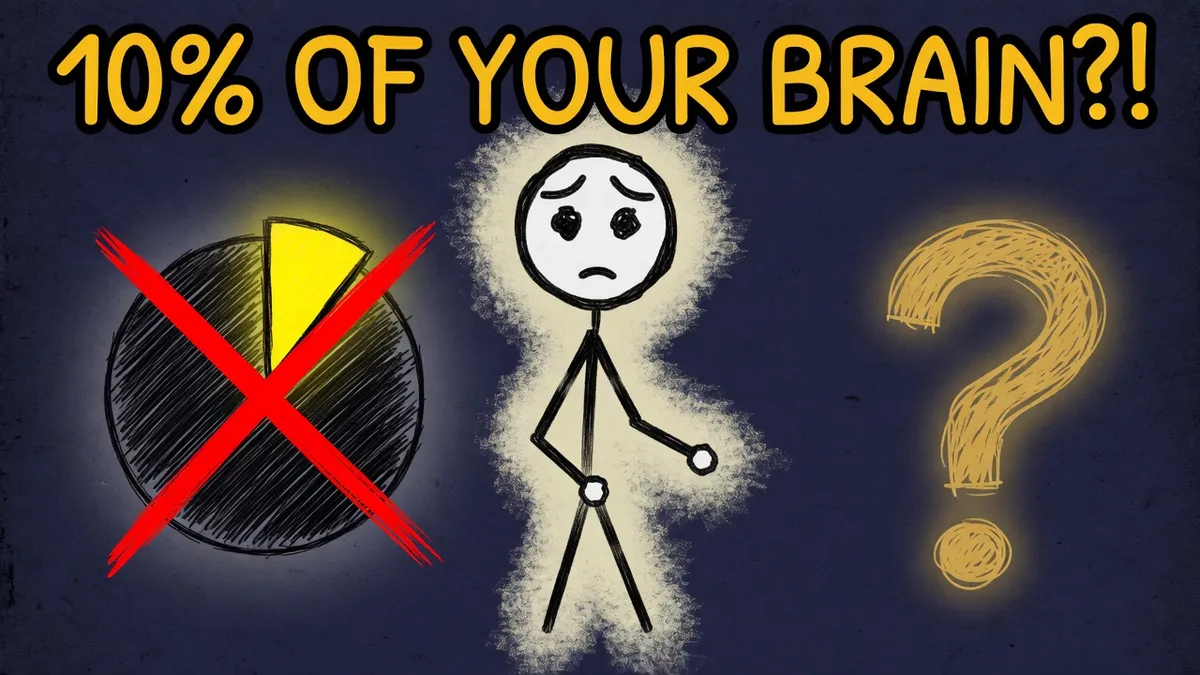
It's one of the most beloved "facts" about the human mind: we only use 10 percent of our brains, and somewhere in the other 90 percent lies a dormant reservoir of untapped genius, telekinesis, photographic memory, superhuman potential, just waiting for the right trick to switch it on. Entire films are built on it. Self-help empires run on it. And it is completely, thoroughly false. The real story is almost the exact opposite, and it's arguably more amazing: your brain is a ferociously expensive, always-on organ with essentially no idle parts at all.
01 · Look inside a working brainThe lights are all on
The simplest way to kill the myth is to just watch a brain work, which, thanks to modern scanning, we can. Techniques like fMRI and PET let scientists see activity ripple through the living brain in real time. And what they show is unambiguous: activity spread throughout the brain, not confined to some special tenth. At any single instant, sure, some regions are busier than others, that’s how a brain is supposed to work. But over the course of even simple tasks, and certainly over a whole day, essentially every region gets used. As one Mayo Clinic neurologist put it, over the span of a day you use 100 percent of your brain. There is no dark, silent 90 percent. The building has no unused floors.
02 · The energy argumentEvolution doesn't feed the idle
Here’s a killer piece of logic that doesn’t even need a brain scan. Your brain is a tiny organ, only about 2 percent of your body weight. Yet it devours roughly 20 percent of all the energy your body uses, an enormous, disproportionate share of your oxygen and glucose. Now think like evolution, which is utterly ruthless about waste. It would never build, and then constantly feed, an organ this metabolically expensive if 90 percent of it were dead weight doing nothing. Idle tissue that burned that much fuel would have been trimmed away long ago. The very fact that your brain is such an energy glutton is proof that it’s earning its keep, all of it. And tellingly, that energy demand stays high and steady even while you sleep.
03 · The evidence from damageThere is no spare part
If 90 percent of your brain really were unused, there’d be an obvious, testable consequence: you could damage that 90 percent with no ill effects. A stroke or injury in the “spare” region would cost you nothing. But that is emphatically not what neurology finds. There is almost no part of the brain you can damage without losing something, a movement, a memory, a sense, a word, a skill. Every region, when hurt, takes an ability with it. That’s the anatomy of an organ with no waste, no reserve, no dead zone. If nine-tenths of your brain were truly unused, brain injury would often be harmless. Instead, it almost never is.
So where did such a persistent, specific number come from? Not from science. It's traced to a misreading of the psychologist William James, who around 1907 wrote that we make use of only a small part of our mental potential, meaning our willpower, drive and untapped ambition, not our brain tissue. He never gave a percentage. Then in 1936, a journalist writing the foreword to Dale Carnegie's mega-selling "How to Win Friends and Influence People" paraphrased James as saying the average person develops only "10 percent" of their latent ability. That hard number, riding one of the best-selling books in history, escaped into the world. It's often pinned on Einstein to borrow his authority, but he never said it. A motivational pep talk about human potential got mistaken, for a century, for a fact about neuroanatomy.
04 · What "100%" would really look likeNot superpowers
The films love to imagine what would happen if you finally used your whole brain: enlightenment, super-intelligence, mind control. But the fantasy misunderstands how brains work. You do use your whole brain, just not every part firing maximally at the same moment, because that’s not a superpower, it’s a malfunction. When huge swathes of the brain do all fire at once, uncontrolled and synchronised, that has a name: a seizure. Your brain’s brilliance comes precisely from not blazing everywhere at once, but from the exquisite coordination of different regions switching on and off in the right patterns. “Using 100 percent” the way movies mean it wouldn’t make you a genius. It would put you on the floor.
05 · Why the myth won't dieA flattering lie
If it’s this thoroughly debunked, why does the myth cling on, with surveys finding a majority of people still believe it? Because it tells a story we desperately want to hear. “You’re only using 10 percent” is an intoxicating promise: that hidden inside your ordinary skull is a vast dormant genius, and greatness is just a matter of unlocking it. That’s far more seductive than the truth, “you’re already running at full capacity, this is what you’ve got.” Self-help gurus, advertisers and screenwriters all love the myth because it sells hope. The reality asks you to make the most of a brain that’s already fully switched on, which is a less thrilling sales pitch, and happens to be correct.
06 · The payoffSo do we really only use 10% of our brain?
No. We use very nearly all of it, all the time. Scans show the whole organ lighting up, its enormous energy appetite proves nothing’s coasting, and the fact that damaging almost any part costs you an ability proves there’s no spare reserve to unlock. The myth was never science; it was a misquoted pep talk about human potential that got a number bolted onto it and went supernova through self-help books and Hollywood. The genuinely wondrous truth is that your brain isn’t a mostly-empty mansion with a locked wing full of superpowers. It’s a fully-occupied, endlessly busy, staggeringly expensive machine, every part of it working, right now, including the part reading this sentence.
Quick questions
Do we only use 10% of our brain?
No. This is a myth with no scientific support. Brain imaging shows activity throughout the whole brain, and over the course of a day virtually every region is used. There is no idle 90%.
How much of our brain do we actually use?
Effectively all of it. Not every region fires at the same instant, but across a normal day the entire brain is active. Even a single simple task engages large areas at once.
Where did the 10% brain myth come from?
It grew from a misreading of psychologist William James, who in 1907 wrote that we use only a small part of our mental potential, meaning willpower and motivation, not brain tissue. In 1936 Lowell Thomas turned that into a specific '10 percent' figure in the foreword to Dale Carnegie's famous self-help book, and it stuck.
Did Einstein say we only use 10% of our brain?
No. The quote is often pinned on Albert Einstein to make it sound credible, but researchers found no record of him ever saying it. It is a misattribution.
What would happen if we used 100% of our brain?
You already do, just not every region at the exact same moment. The films that imagine unlocking 100% granting superpowers are fiction. In reality, having your entire brain fire simultaneously and continuously is closer to what happens in an epileptic seizure than to genius.
Is any part of the brain unused?
No. Clinical evidence shows almost no area can be damaged without some loss of ability, which means there is no spare, unused reserve. There is no anatomical dead zone.
Does brain imaging prove we use more than 10%?
Yes. fMRI and PET scans track the living brain and consistently show widespread activity, not activity limited to a tenth. Some regions are busier than others at any moment, but none simply switch off.
How much energy does the brain use?
A lot for its size. The brain is only about 2% of body weight but consumes roughly 20% of the body's energy. That heavy, steady demand makes no evolutionary sense if most of the organ were idle.
Why do so many people still believe the 10% myth?
Because it is an appealing story about hidden potential, and it has been repeated for decades in self-help books and films like Limitless and Lucy. A 2013 survey found around 65% of Americans still believed it.
Can you unlock the other 90% of your brain?
There is no locked 90% to unlock. The premise is false. You can improve skills, memory and focus through learning and healthy habits, but not by switching on dormant brain tissue that does not exist.
Is the 10% brain myth true in any way?
No, not as usually stated. The kernel of truth is only that we all have untapped potential to learn and grow, which is a point about motivation and effort, not about unused brain matter. The anatomical claim is simply false.
What do neuroscientists say about the 10% myth?
They reject it flatly. Neurologists point out that over a day you use the whole brain, and that scans, energy data and brain-injury evidence all agree. As one MIT researcher put it, the idea is 100% a myth.
Our sources 7 checked
// every claim on this page was checked before it went up