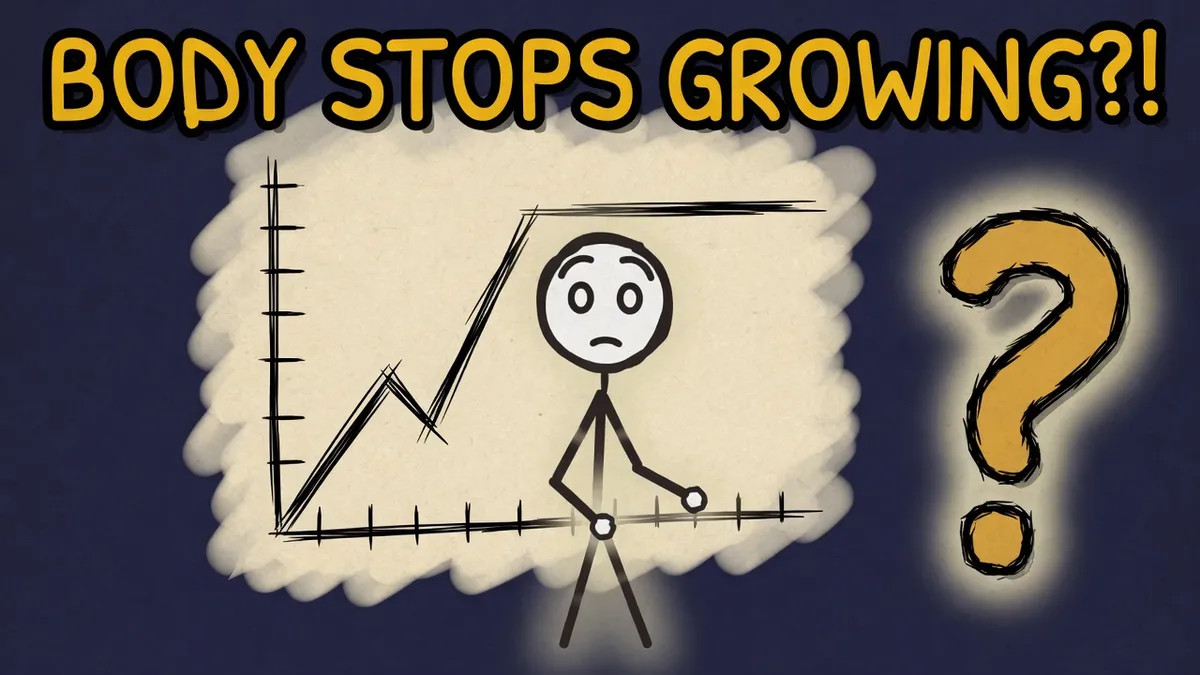
For the first eighteen or so years of your life, you are quietly getting bigger. You need new shoes, new trousers, a higher mark on the doorframe. And then, without any announcement, it stops. You reach a height and stay there for the rest of your life. Nobody flips a switch, you don't feel a thing, but somewhere in your teens your body simply decides it is done. So what actually ends it?
01 · The factoriesWhere height actually comes from
Here is the thing most people get wrong: your bones don’t grow all over, like a balloon inflating. A long bone, like the one in your thigh, gets longer at just a couple of specific spots, thin bands of cartilage near each end called growth plates (doctors call them epiphyseal plates). Inside each plate, cartilage cells line up, multiply, swell, and then get replaced by hard bone, pushing the ends of the bone further apart. As long as those little factories keep running, you keep getting taller. So the real question was never why bones stop. It’s why the factories shut down.
02 · The triggerPuberty lights the fuse
The answer starts with puberty. That flood of sex hormones is what drives the famous growth spurt, the year or two where you shoot up and can’t keep clothes for a season. Your growth plates go into overdrive. It feels like the beginning of something. It is actually the beginning of the end.
03 · The twistThe accelerator is also the brake
Because the very same hormone doing the accelerating is quietly working the brake. That hormone is oestrogen, and this is where it gets genuinely surprising. Oestrogen drives the growth plate to mature, and in doing so it slowly uses up the plate’s stock of fresh, dividing cells. And this happens in boys too. Even though boys are flooded with testosterone, their bodies convert some of it into oestrogen right inside the bone tissue, and it’s that oestrogen that seals the deal. Because girls make more oestrogen, earlier, they typically finish growing a couple of years before boys.
The hormone that makes you shoot up is the exact same one that shuts you down. Puberty is both the accelerator and the brake, pressing both pedals at once. It just so happens the brake wins.
04 · The shutdownRunning out of parts
Over the final stretch of puberty, the growth plate goes through something scientists call senescence. Its supply of resting cells, the ones that could still divide and make new cartilage, gets used up and cannot be topped up. Once those cells are gone, the leftover cartilage is replaced entirely by solid bone, and the two ends of the bone fuse together. And here’s a subtle but important detail: the fusion doesn’t cause you to stop growing. By the time the plate seals over, growth has already slowed to almost nothing. The sealing is just the tombstone, not the cause of death.
05 · The locked doorWhy growth hormone can't help
This is why the “growth hormone makes you taller” idea only half works. Growth hormone (and its partner IGF-1) is the throttle that drives the plates all through childhood, and in a child with open plates, it genuinely adds height. But once the plates have fused, that throttle is connected to nothing. The hardware of puberty finished its job and locked the door behind it. Extra growth hormone in an adult won’t add a single millimetre of height. It just helps maintain the body you already have. The door is closed, and there is no key.
06 · The afterlifeThe parts that never quite stop
So your skeleton settles at its final length, usually by the early twenties, and that number is yours for life. Almost. Bone never becomes truly frozen: it keeps quietly remodelling, and the skull and pelvis subtly shift shape over decades. And there’s one last illusion worth clearing up. People swear their ears and nose keep growing forever, and you can see why they’d think so. But those aren’t growing either. That’s cartilage sagging under a lifetime of gravity, an entirely different trick. Real growth, the kind that made you taller, ended the day those little factories ran out of parts and closed their doors for good.
Quick questions
Why does your body stop growing?
You stop growing when the growth plates near the ends of your long bones run out of dividing cartilage cells and fuse into solid bone. Sex hormones, especially oestrogen, drive this shutdown during the final stages of puberty. Once the plates close, there is nowhere left for bones to add length.
At what age do girls stop growing?
Most girls reach their final height around ages 14 to 16, usually within a couple of years of their first period. Growth slows sharply after the puberty spurt as oestrogen closes the growth plates, though some plates fully fuse a little later.
At what age do boys stop growing?
Boys typically finish growing between about 16 and 18, a couple of years later than girls. Their growth spurt starts and ends later, and the final growth plates may not fully seal until the early twenties.
What are growth plates?
Growth plates, or epiphyseal plates, are thin layers of cartilage near the ends of long bones. They are the only place a long bone can add length, and they harden into solid bone as you finish growing.
What hormone stops you from growing?
Oestrogen is the main hormone that stops growth by maturing and closing the growth plates. It does this in both sexes, because male bodies convert some testosterone into oestrogen inside the bone tissue itself.
Does estrogen stop growth in boys too?
Yes. Even though boys make more testosterone, their bodies convert some of it into oestrogen right inside the growth plate, and it is that oestrogen that closes the plates. Rare cases where this conversion is missing produce unusually tall adults whose plates never fully close.
Can you still grow after your growth plates close?
No. Once a growth plate has fused into solid bone, there is no cartilage left to add length, so you cannot grow taller. Extra growth hormone will not reopen a closed plate.
Does human growth hormone make you taller as an adult?
Not once your growth plates have fused. In children with open plates, growth hormone promotes height, but in adults it only helps maintain body structure and metabolism. It does not add inches.
Why do girls stop growing before boys?
Girls produce higher levels of oestrogen earlier in puberty, and oestrogen is what closes the growth plates. That earlier hormone surge seals their plates sooner, so they finish growing before boys.
Do your bones ever stop growing completely?
Your bones stop getting longer once the growth plates fuse, usually by the early twenties. But bone never becomes truly static: it keeps remodelling throughout life, and the skull and pelvis can subtly change shape into old age.
Why do old people seem to have bigger ears and noses if growth has stopped?
Their ears and noses are not actually growing. The cartilage loses collagen and elastin with age and sags under gravity, so ears and noses stretch and look larger over time. It is drooping, not growth.
What makes growth plates close?
Growth plates close when their supply of resting cartilage cells runs out, a process called senescence that oestrogen speeds up. When the cells are depleted, the cartilage is fully replaced by bone and the plate fuses.
How do doctors tell if you can still grow taller?
Doctors take an X-ray of the hand and wrist to estimate bone age and see whether the growth plates are still open. Open plates mean growth potential remains, while fully fused plates mean height is finished.
Our sources 8 checked
// every claim on this page was checked before it went up