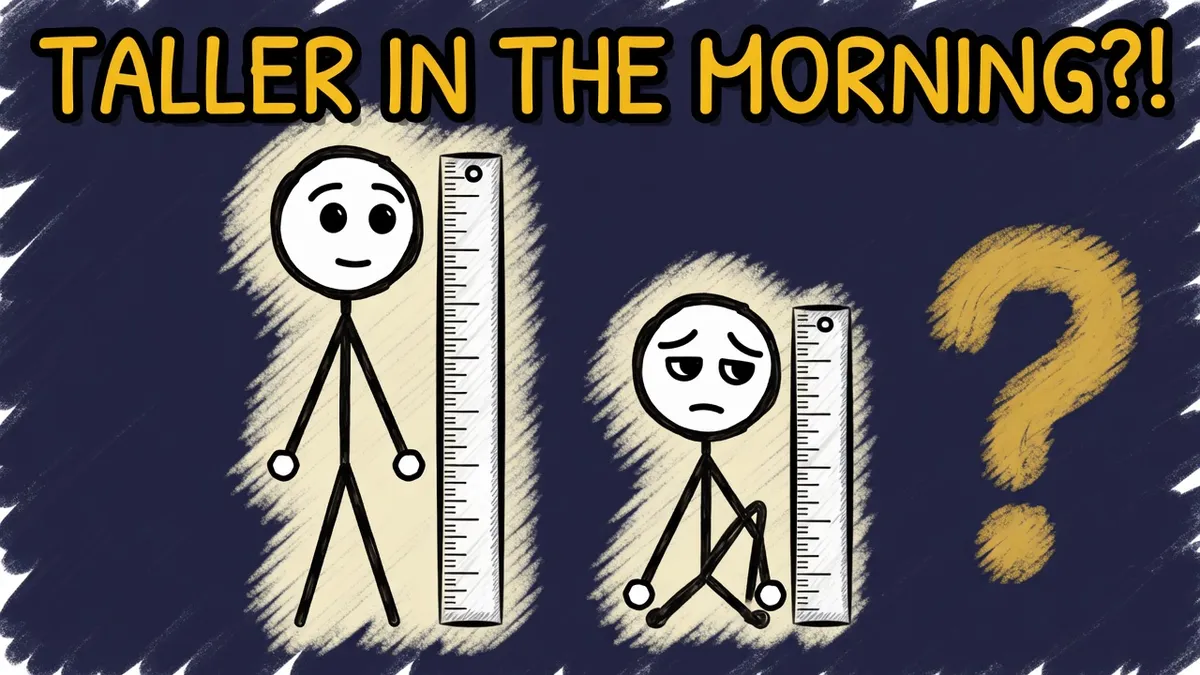
Here is a small experiment you can run on yourself. Measure your height first thing tomorrow morning, before you have really been on your feet. Then measure again just before bed. The evening number will be smaller, by a centimetre or even two. You did not do anything wrong with the tape measure. You genuinely shrank over the course of the day, and tonight, while you sleep, you will get all of it back.
01 · The cushionsWhat sits between your bones
Your spine is not one solid rod. It is a stack of 24 bones, the vertebrae, and between each pair sits a little cushion called an intervertebral disc. Each disc has a tough outer ring of collagen wrapped around a soft, gel-like core known as the nucleus pulposus. And that core is mostly water, somewhere around 70 to 85 percent of it, held in place by sponge-like molecules called proteoglycans that pull fluid in and keep the disc plump. These discs are what let your back bend and twist, and they double as shock absorbers every time you walk, jump or land.
02 · The villainGravity never clocks off
Now bring in gravity. Every hour you spend upright, whether you are standing in a queue or slumped at a desk, your own body weight is pressing straight down through that stack of discs. And slowly, quietly, that pressure squeezes water out of the watery core of each disc, out into the surrounding tissue. Each disc loses only a fraction of a millimetre of height. But you have 23 of them, and the losses stack up. By the end of the day, your whole spine is measurably shorter than it was at breakfast.
03 · The refillWhy lying down fixes it
So why do you wake up tall again? Because the moment you lie down, the load comes off. With your body weight no longer pressing down through the spine, those thirsty proteoglycans get to work and pull water back into the discs (a process called imbibition). Through the night the discs re-swell to their full size, and by morning your height is restored. It is a simple fill-and-drain cycle, running every single day of your life without you ever noticing.
Nothing about you is actually growing or shrinking. Your bones stay exactly the same length. The entire daily swing is just water moving in and out of a couple of dozen little cushions in your back.
04 · The numbersHow big is the swing
It is small, but it is real, and people have measured it carefully. Most of us lose somewhere around 1 to 2 cm from morning to night, roughly 1 percent of total height. When researchers used MRI to watch just the lower spine, they found the lumbar region alone shortened by about 2 percent over a normal day, as water visibly drained out of the disc cores. Taller people, and people with more disc tissue, tend to swing a little more, because there is simply more water to squeeze out and soak back up.
05 · The extremeWhat happens with no gravity at all
If a daily dose of gravity costs you a centimetre or two, what happens when you remove gravity completely? You get astronauts. In orbit, with nothing pressing down on the spine, the discs swell to their full natural size and keep going, and the spine stretches out. Astronauts can grow up to about 3 percent taller in space: for a six-footer, that is as much as two extra inches. Scott Kelly came back from a year on the space station noticeably taller than he launched. The catch is that it is not free. That stretched-out spine is linked to back pain and a higher risk of slipped discs, and, just like your morning height, it all disappears again once real gravity gets hold of it. Within a few months back on Earth, the astronauts are their old height once more.
06 · The payoffA tide that goes in and out
So you are not imagining it, and you are not growing. You are tidal. Every day your spine very slightly deflates under the weight of simply existing on a planet, and every night it fills back up. The same effect that makes you a fraction taller at breakfast is the same one that very slowly loses the battle over a lifetime, as the discs stop refilling quite so completely. But that is decades away. Tomorrow morning, for a little while, you will be the tallest version of yourself there is. Enjoy it before gravity clocks back on.
Quick questions
Are you really taller in the morning?
Yes. Most people are measurably taller just after waking, typically by about 1 to 2 cm, because the discs in the spine rehydrate and expand overnight while you lie down. The height is lost again over the day as gravity compresses them.
How much taller are you in the morning than at night?
Usually around 1 to 2 centimetres, or roughly 1 percent of your total height. Taller people and those with more disc tissue tend to see a slightly bigger swing.
Why am I taller in the morning and shorter at night?
During the day, being upright lets gravity press your body weight through the spine, squeezing water out of the discs so they flatten a little. At night, lying down removes that load and the discs soak the water back up, restoring your height by morning.
Do you shrink during the day?
Yes, everyone does. Standing and sitting compress the water-filled discs in your spine, so you gradually lose a little height as the day goes on. It is completely normal and reverses overnight.
What makes you lose height over the course of a day?
Gravity acting on your body weight slowly presses fluid out of the intervertebral discs, mostly out of the watery core in the middle of each one. As every disc loses a fraction of a millimetre, the effect adds up across the whole spine.
How does sleeping make you taller again?
When you lie down, the squeezing load on your spine comes off. Molecules called proteoglycans in the disc core pull water back in, so the discs re-swell to full size overnight and give back the height you lost during the day.
What are the discs in your spine made of?
Each disc has a soft, gel-like core called the nucleus pulposus, which is roughly 70 to 85 percent water, wrapped in tough rings of collagen called the annulus fibrosus. Proteoglycan molecules in the core attract and hold the water.
Why do astronauts get taller in space?
In microgravity there is no downward force compressing the spine, so the discs absorb fluid and swell to their natural size. Across all the discs together this lengthens the spine, and astronauts can grow up to about 3 percent taller.
How much taller do astronauts get in space?
Up to about 3 percent. For a six-foot person that can mean as much as two extra inches (about 5 cm) while living in orbit. It reverses within a few months of coming home.
What time of day are you tallest?
First thing in the morning, right after your discs have had all night to rehydrate without your body weight pressing down on them.
Should I measure my height in the morning or at night?
Measure at the same time each day, since your height changes by 1 to 2 cm from morning to night. Morning readings come out tallest and evening readings shortest, so pick one and stick to it.
Does being taller mean you lose more height during the day?
Often, yes. People with longer spines and more total disc tissue have more water that can be squeezed out and reabsorbed, so their day-to-night swing tends to be a little larger.
Does the daily height change affect your actual bones?
No. Your bones do not change length at all. The whole effect comes from the water-filled discs between the vertebrae compressing and rehydrating, not from the bones themselves.
Our sources 8 checked
// every claim on this page was checked before it went up