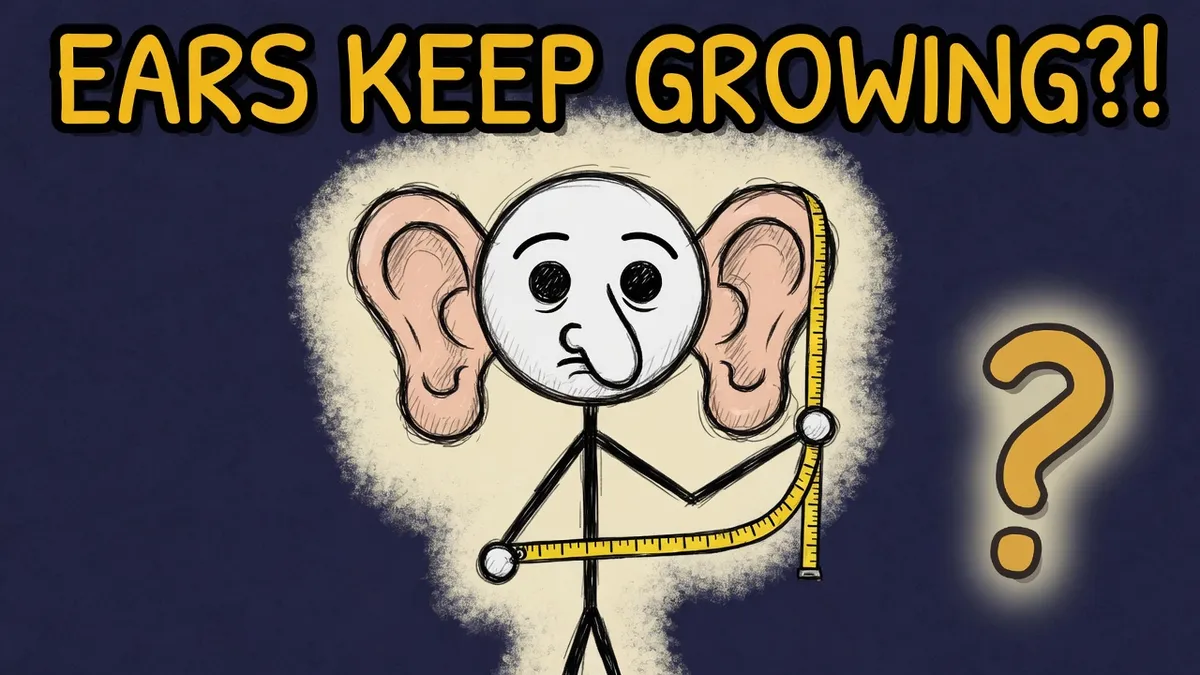
Look at a very old face, then a young one, and the same thing tends to jump out: big ears, long nose. It's so consistent that almost everyone has heard the same tidy explanation, that your ears and your nose are the two parts of you that just keep growing, all your life, and never stop. It's a lovely little fact. It's also completely wrong. Your ears and nose stopped growing decades ago.
01 · The measurementSomeone actually checked
This isn’t just a vibe. In 1995, a British GP named James Heathcote and some colleagues sat down and measured it, the ears of 206 people, aged 30 all the way up to 93. And sure enough, a clear pattern fell out: on average, an ear gets about 0.22 millimetres longer every single year, roughly 2 mm a decade. The paper, published in the BMJ under the title “Why do old men have big ears?”, was delightful enough that it later won an Ig Nobel Prize. So the ears really do get bigger. The myth isn’t that, it’s the why.
02 · The twistThey stopped growing decades ago
Here’s the catch. Your ears and the end of your nose actually stopped growing back when the rest of you did, in your late teens or twenties. The cartilage isn’t adding new material; there’s no growth spurt quietly running for eighty years. Which leaves a genuinely odd question hanging: if they’re not growing, how are they getting bigger?
03 · The materialIt's cartilage, not bone
The secret is what they’re made of. Your ears and the tip of your nose aren’t bone, they’re cartilage, that soft, bendy, springy stuff. And cartilage gets its shape from an internal scaffold: a mesh of fibres called collagen and elastin that holds everything taut and in place. It’s less like a rigid frame and more like a tent held up by tension. And a tent, over enough time, is exactly the kind of thing that can slowly sag.
04 · The breakdownThe scaffold quietly fails
As you age, that scaffold starts to give. Your body makes less and less fresh collagen and elastin, and the old fibres already in place begin to weaken and break. And here’s the cruel bit: unlike most of your body, cartilage has almost no blood supply reaching into it. Its cells are fed only by slow diffusion, which is why cartilage injuries famously take forever to heal. So once that mesh starts to sag, there’s very little coming to fix it. At the same time, the skin stretched over it is thinning and losing its bounce. You end up with a weak, loosening frame wrapped in loose, slack skin, everything going soft at once. The same soft-tissue surrender shows up elsewhere too, from height loss with age to the quiet day your body stops growing for good.
Nothing about your ears is growing. What you're watching, over decades, is a very slow, very quiet act of surrender, to a force that never once takes a day off.
05 · The culpritGravity does the rest
And that’s when the real villain steps in: gravity. The same steady downward pull on everything, all the time. With the scaffold weakened and the skin loose, there’s nothing left to resist it, so gravity just very, very slowly drags your ears and the tip of your nose downward. Earlobes stretch and droop (the lobe has no cartilage at all, so it goes especially easily). The nose tip sags and lengthens. Millimetre by millimetre, year after year, which is precisely the 0.22 mm that Heathcote’s tape measure caught.
06 · The illusionThe face deflates around them
There’s one final trick making it look more dramatic than it is. While your ears and nose are drooping, the rest of your face is quietly deflating. You lose fat and volume in your cheeks and midface as you age, so the whole face gets smaller and flatter. Against that shrinking backdrop, those sagging ears and that drooping nose look bigger still: part of the “big ears” effect is simply everything else getting smaller around them.
07 · The payoffA slow surrender, not a growth spurt
So the big ears of old age were never a story about growth at all. Nothing grew. Your ears and nose simply spent a lifetime very slowly giving in, cartilage weakening, skin slackening, gravity winning by a fraction of a millimetre a year, decade after decade. Which is oddly poetic, when you think about it. A person’s ears are a quiet little record of exactly how long they’ve stood upright on this planet, being gently pulled toward the ground the entire time. Nobody grows bigger ears. We just, very slowly, let them fall.
The animated version
Same answer, told as a little animated story with the strange little stickman acting it out. Dry, quick, and, obviously, correct.
Quick questions
Do your ears and nose really never stop growing?
No, that's a myth. The cartilage in your ears and the tip of your nose stops growing in early adulthood, along with the rest of your skeleton. They keep getting longer as you age, but that's sagging and stretching, not new growth.
How much do ears grow with age?
A 1995 study in the BMJ measured 206 people and found ear length increases by about 0.22 mm a year on average, roughly 2 mm per decade. Over 60 or 70 years that's well over a centimetre of visible elongation. The study won an Ig Nobel Prize in 2017.
Why do ears and noses sag with age?
They're made of cartilage, held in shape by a scaffold of collagen and elastin fibres. With age you produce less of both, existing fibres break down, and, because cartilage has almost no blood supply, there's little repair. The overlying skin also thins and slackens, so gravity slowly drags the whole loosening frame downward.
Does losing facial fat make ears and nose look bigger?
Yes. As you age you lose fat and volume in the cheeks and midface, so the face looks smaller and flatter. Against that, the sagging ears and drooping nose stand out even more: part of the effect is relative, not just the ears and nose themselves changing.
Is it the ears or the earlobes that get longer?
Mostly the soft parts. The fleshy earlobe has no cartilage at all, so it stretches and droops especially easily, while the cartilage frame of the outer ear weakens and elongates. Together they make the whole ear look noticeably longer with age.
At what age do your ears and nose stop growing?
Broadly, in your late teens to early twenties, along with the rest of your skeleton. Nasal growth tends to finish around 16 to 18 in females and 18 to 20 in males; ear cartilage is similar. After that, no new cartilage is being laid down: everything you see later is the sagging-and-stretching of tissue that already exists, not fresh growth.
Does cartilage keep growing throughout life?
No. This is the heart of the myth. The cartilage in your ears and nose stops growing in early adulthood and doesn't restart. What changes over the decades is the quality of that cartilage and the skin around it: collagen and elastin break down, the framework slackens, and gravity pulls it longer. The structure elongates, it doesn't grow.
Can you slow down or prevent your nose from drooping with age?
Not really prevent, but you can slow the skin side of it. Nasal drooping usually starts in the late thirties to forties as tip cartilage and ligaments loosen. The things that protect skin collagen, daily sunscreen, not smoking, limiting alcohol, genuinely help slow that decline, but there's no evidence a diet or supplement stops the droop. Once it's pronounced, only fillers or surgery actually lift it. Treat prevention claims with caution.
Do other body parts keep getting bigger with age too?
Your feet are the classic example, many people go up a shoe size in later life. But, exactly like the ears and nose, it isn't growth: the ligaments and tendons that hold the arch lose their spring, so the foot flattens and spreads, getting longer and wider. It's the same story everywhere: soft-tissue support giving way, not new bone or cartilage.
Can a growing nose ever be a sign of a health problem?
Usually it's just normal ageing, but rarely it isn't. Acromegaly, a pituitary tumour causing excess growth hormone in adulthood, can genuinely enlarge the nose, jaw, hands and feet. And rhinophyma, a late stage of the skin condition rosacea, thickens the nose into a red, bulbous shape (most often in older men). If a nose enlarges quickly, unevenly, or alongside other changes, that's worth a doctor's look.
Do heavy earrings stretch your earlobes?
Yes, and it's a separate effect from ageing. Because the lobe is cartilage-free, just skin and fat, heavy or dangly earrings pull it downward continuously, and over two or three decades that can visibly elongate the lobe or widen the piercing. Ageing stretches earlobes on its own; heavy earrings simply speed it up.
Is it true that your ears and nose never stop growing?
It's a popular claim, and the ears really do get longer with age (about 0.22 mm a year in one classic study). But the true part is the lengthening; the false part is the mechanism. They are not growing new cartilage. The frame weakens, the skin loosens, and gravity stretches what is already there.
What keeps growing as you age?
Almost nothing that people mean by "growth." Skeleton and ear/nose cartilage finished in early adulthood. What keeps changing is soft tissue: ears and noses elongate by sagging, feet can lengthen as arches flatten, and some medical conditions (like acromegaly) can genuinely enlarge features. Ordinary ageing is stretch and collapse, not a lifelong growth spurt.
Do ears stop growing?
Yes. Ear cartilage finishes its growth in the late teens to early twenties, along with the rest of your skeleton. After that, ears can still get longer (about 0.22 mm a year in one classic study), but that is sagging and stretching of tissue you already have, not new growth. So ears stop growing; they do not stop lengthening.
What age does your nose stop growing?
Nasal growth tends to finish around 16 to 18 in females and 18 to 20 in males. After early adulthood, the tip can droop and look longer as cartilage, ligaments and skin loosen under gravity, usually from the late thirties or forties onward. That later change is soft-tissue sag, not a second growth spurt.
Do ears keep growing?
They keep getting longer, but they do not keep growing new cartilage. Growth stops in early adulthood; the familiar lengthening of older ears (about 0.22 mm a year in Heathcote's 1995 study) is collagen loss, slack skin and gravity stretching what is already there.
Take the quiz on this
A quick 4-question check on what you just read. Get them right to earn XP: no points for just scrolling.
Our sources 12 checked
// every claim on this page was checked before it went up