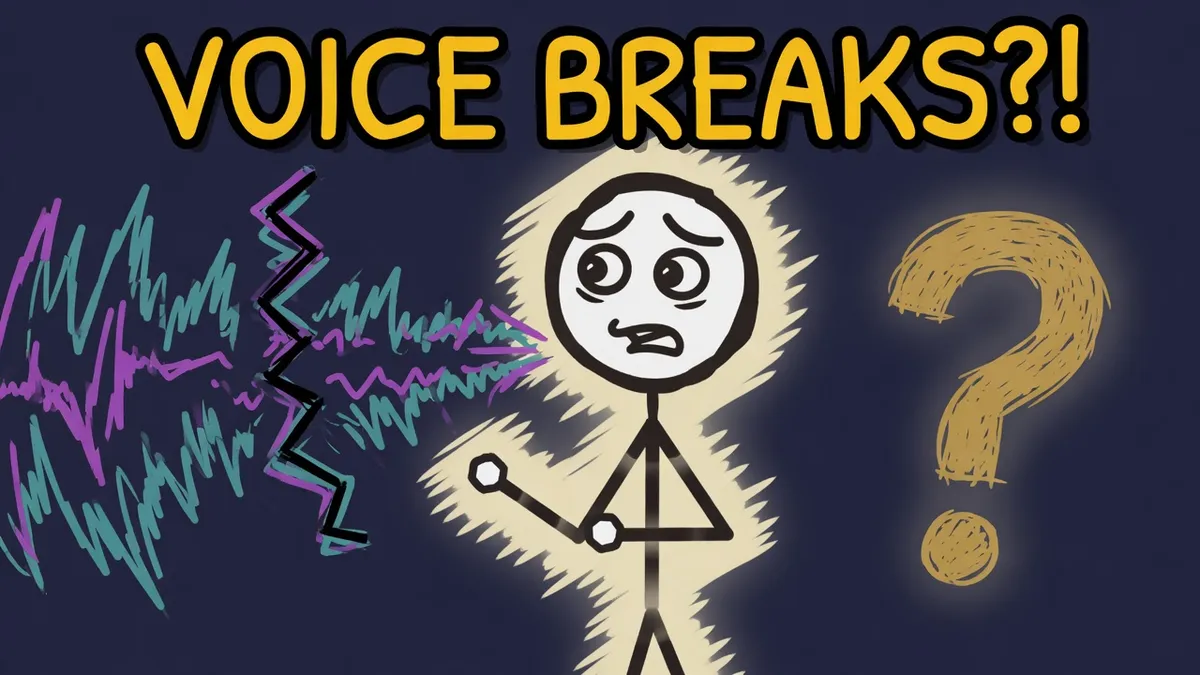
There's a specific kind of betrayal a body can commit. You're halfway through a sentence, feeling perfectly composed, and your own voice suddenly cracks upward into a squeak you did not authorise. For a lot of teenagers it's mortifying. But nothing is actually going wrong. Your voice isn't breaking down. It's being rebuilt, live, mid-sentence, and the cracks are the sound of that construction work.
01 · The instrumentHow pitch is made
Your voice starts as air. When you speak, air from your lungs rushes up past two small folds of tissue in your voice box (the larynx), and makes them vibrate. The speed of that vibration sets your pitch. Short, thin, tight folds vibrate fast and sound high; long, thick, heavy folds vibrate slowly and sound low. Before puberty, everyone’s folds are small and light, which is why children of all genders sound roughly similar, and roughly high.
02 · The rebuildTestosterone gets to work
Then puberty arrives with a flood of testosterone, and the larynx turns out to be one of its favourite targets. Testosterone latches onto receptors right in the voice box and triggers a growth spurt: the larynx enlarges, its cartilage thickens, and the vocal folds get dramatically longer and heavier, growing to around 1.6 cm in boys, roughly a 60 percent increase. Longer, thicker strings play lower notes, which is why a boy’s speaking pitch drops by about a full octave, sliding from a childlike 200-plus Hz down to around 110 to 130 Hz.
03 · The mismatchHardware faster than software
So why the cracking? Because the larynx grows fast, week to week, but the delicate muscles and nerves that fine-tune your pitch cannot recalibrate that quickly. Your brain is essentially trying to play a guitar whose strings and neck are being swapped out mid-song. It reaches for the pitch it knows and the newly-sized instrument delivers something else, so the voice slips between the new adult low and the leftover childhood high. Every squeak and sudden falsetto pop is just the control system missing its footing on hardware that won’t hold still.
The voice doesn't crack because something is broken. It cracks because the instrument is being upgraded faster than the player can learn the new controls. Nothing tears, nothing fails. It's a tuning problem, not a fault.
04 · The landmarkWhy the Adam's apple appears
All that laryngeal growth leaves a visible calling card. As the voice box enlarges, it tilts to a new angle and its front edge juts forward against the skin of the throat: the Adam’s apple. Girls go through a gentler version of the whole process (their larynx grows too, driven by far less testosterone), which is why the change is subtler and most girls never develop a prominent Adam’s apple. Their pitch drops only a few semitones, real but rarely dramatic enough to produce the famous cracking.
05 · The dark footnoteHow Europe froze the childhood voice
Once you understand that testosterone is the trigger, a grim chapter of music history clicks into place. In 17th and 18th century Europe, some boys were castrated before puberty for one specific reason: to stop this process cold. With no testosterone surge, the larynx never enlarged, the vocal cords stayed small and child-sized, and these singers, the castrati, kept a soaring high range for life, paired with adult lungs and power. It was prized on the opera stage and monstrous in every other way. It is also the clearest possible proof of the mechanism: remove the hormone, and the voice simply never breaks.
06 · The payoffThe player catches up
For everyone else, the awkward phase ends the same way. The larynx finishes growing, the muscles and nerves finally learn the dimensions of their new instrument, and the voice settles into its stable adult pitch, usually within a few months to a couple of years. The squeaks stop not because anything healed, but because the player has, at last, learned the new guitar. What sounded like your body failing you was really your voice becoming the one you’ll hear for the rest of your life, tuning itself in public, one embarrassing crack at a time.
Quick questions
Why does your voice break during puberty?
A surge of testosterone makes your larynx grow and your vocal cords lengthen and thicken. Longer, heavier cords vibrate more slowly, which lowers your pitch, and the cracking happens while your muscles learn to control the newly enlarged voice box.
At what age does your voice start to break?
For most boys the voice starts changing between about ages 11 and 15, usually shortly after the main growth spurt. The exact timing depends on when someone enters puberty.
How long does a voice take to break or fully change?
The most noticeable cracking phase often lasts only a few months. The full transition to a stable adult voice can take anywhere from several months to a couple of years.
Why does your voice crack and squeak randomly?
The larynx grows faster than the nerves and muscles that fine-tune pitch can adapt. So your voice control slips between the new lower register and the old higher one, producing sudden squeaks and pitch jumps.
Does a girl's voice change during puberty too?
Yes, but much less dramatically. A girl's larynx grows and her pitch drops by only a few semitones, because females produce far less testosterone, so cracking is usually mild or unnoticeable.
How much does the voice drop in boys during puberty?
In boys the speaking pitch typically falls by about one octave. Its fundamental frequency drops from roughly 200 to 260 Hz in childhood to around 110 to 130 Hz in adult men.
Why do boys get an Adam's apple and most girls don't?
Testosterone makes the cartilage of the larynx grow and tilt, so it protrudes at the front of the neck as the Adam's apple. A girl's larynx grows much less, so it usually does not stick out noticeably.
What actually causes the voice to get deeper?
Longer and thicker vocal cords vibrate more slowly, and a larger larynx plus expanded throat and facial cavities add more resonating space. Together these lower the pitch and deepen the tone.
Does testosterone deepen your voice?
Yes. Testosterone binds to receptors in the larynx and drives the growth of the vocal cords and voice box during puberty, which is the main reason male voices deepen so much more than female voices.
Why does my voice keep cracking even after puberty?
Occasional cracks can persist for a while as vocal control finishes maturing, and tiredness, dehydration or straining can trigger them. Persistent breaks well into adulthood are worth mentioning to a doctor or speech therapist.
What were castrati and how did they keep high voices?
Castrati were male singers castrated before puberty in past centuries. Without testosterone their larynx never enlarged, so they kept small, child-sized vocal cords and a high vocal range into adulthood.
Does everyone's voice break at the same age?
No. The onset varies widely across several years depending on individual puberty timing, so some people change voice earlier and some noticeably later.
Is voice cracking during puberty normal?
Yes, it is a completely normal and temporary part of the voice box maturing. It reflects your control catching up to a rapidly growing larynx, not a problem with your voice.
Our sources 8 checked
// every claim on this page was checked before it went up