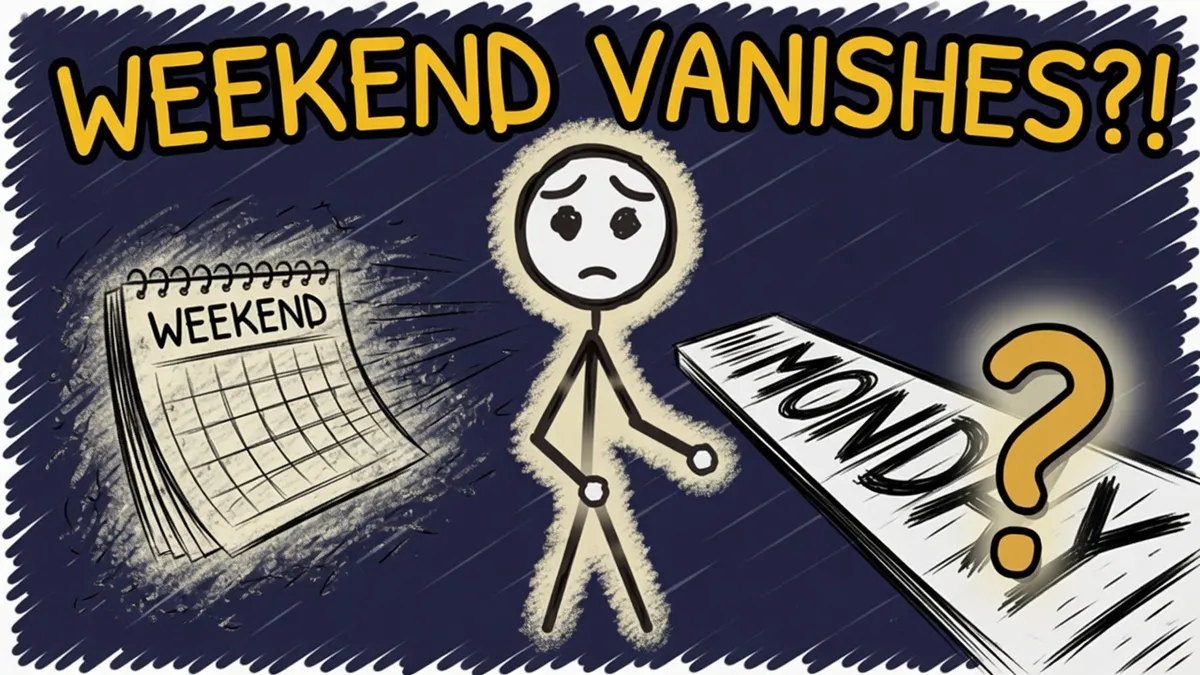
Think about last weekend. It was over in what felt like an afternoon: you blinked and it was Sunday night and the alarm was already looming. Now think about last Monday, one single Monday, which somehow contained roughly four normal days and a small ice age. Here's the strange part. If you actually count what you remember, the weekend is stuffed with moments and the Monday is a smooth grey blank. So which one was longer? The honest answer is both, and neither, because you are timing your life on two clocks that flatly disagree with each other.
01 · Two clocksThe one that ticks now, and the one that adds up later
Your brain doesn’t have a single stopwatch. It has two entirely separate ways of judging how long something took, and they run on different fuel. The first is prospective timing: how long a stretch feels while you are inside it, live, in real time. The second is retrospective timing: how long it feels when you look back on it afterward, from memory. Most of the confusion about time comes from treating these as the same thing. They aren’t. One is powered by attention. The other is powered by memory. And a weekend and a Monday push those two levers in opposite directions.
02 · The live clockAttention is the accelerator, and boredom floors it
The prospective clock runs on attention. The more of your attention lands on time itself, the slower time crawls. The less it does, the faster time flies. This is why a genuinely good weekend evaporates: you’re absorbed, in company, doing things you like, and almost none of your attention is spent monitoring the clock. The hours aren’t being counted, so they slip past uncounted.
Monday is the exact inverse. A dull, clock-watching Monday gives your attention nothing better to do than notice time. So it does, constantly, and every glance at the corner of the screen dumps another load of pure duration onto you. Boredom, it turns out, isn’t just the absence of fun. It’s attention pointed straight at time, and researchers find it’s one of the strongest things that makes time feel like it’s dragging. The old line is precisely correct: a watched pot never boils.
03 · The memory clockLooking back, you count memories, not minutes
Now flip to the other clock. When you judge how long something took after the fact, you can’t rerun the actual seconds. You have no stored footage of the clock. So your brain does something clever and slightly ridiculous: it estimates the duration from how much stuff it can remember happening. A stretch packed with new events, faces and places gets read as long. A stretch with almost nothing stored gets read as short.
This is why a novelty-rich weekend feels big in hindsight. It laid down a thick stack of fresh memories, and your brain, tallying them up later, concludes that all of that surely took a good while. The routine week does the opposite. It leaves so little behind that when you try to recall it, you reach into the drawer and find it nearly empty, so the whole week collapses into a smear. Nothing new happened, so in memory, almost no time passed.
04 · The paradoxThe same weekend, fast and long at once
Put the two clocks together and you get one of the most satisfying results in the psychology of time. Psychology writer Claudia Hammond named it the holiday paradox in her 2012 book Time Warped: a good holiday feels like it flashes past while you’re on it, yet feels long and full when you look back on it. Both are true, because the live clock and the memory clock are measuring different things.
A great weekend is the holiday paradox in miniature. Live, it’s fast: you’re absorbed, off the clock, and the hours go uncounted. Remembered, it’s long: it was crammed with novelty, so it left a pile of memories that reads as plenty of time. The weekend “vanished” and “felt long” at the very same time, and there’s no contradiction. You just asked two different clocks and got two honest answers.
The very thing that makes a stretch of time fly while you live it, being absorbed and full of novelty, is the same thing that makes it feel long when you remember it. Fast in the moment and long in memory aren't opposites. They're two readings of the identical rich experience.
05 · Under the hoodAn internal clock, a switch, and a dose of dopamine
Underneath the felt experience, the leading model of the live clock is delightfully mechanical. It’s called the pacemaker-accumulator: something in the brain ticks out pulses like a metronome, a switch decides how many of those pulses get counted, and attention controls the switch. Pay attention to time and the switch stays open, pulses pile up, and the interval feels long. Get absorbed and the switch drifts shut, fewer pulses land, and time shrinks.
And there seems to be a chemical dial on the tick rate: dopamine. Raising arousal and dopamine tends to speed the internal clock up, while fatigue and sedation slow it down, which fits why a dopey, low-arousal Monday and a keyed-up, exciting Saturday can feel so different from the inside. It’s worth flagging that the human details here are still being pinned down, so this is the best current model rather than a closed case. But the shape of it, attention as the gate and dopamine as the speed dial, is well supported. Flow states are the clean demonstration: absorbed completely in a task, people lose the sense of time entirely, because there’s simply no attention left over to feed the clock.
06 · The payoffSo why the weekend vanishes and Monday crawls
Because you never experience time once. You experience it twice, on two clocks that disagree by design. The weekend vanishes on the live clock because you’re absorbed and your attention is off the meter. Monday crawls on that same live clock because boredom nails your attention to the meter and every second gets fully counted. Then, looking back, the clocks swap verdicts: the memory-rich weekend swells into something that felt long and worth having, while the empty, routine Monday, and the whole grey week around it, shrinks to nearly nothing.
There’s a quiet piece of life advice buried in this. If you want your months to feel long and full rather than a blur that vanished, you can’t do it by watching the clock, that just makes ordinary time drag while you live it and still leaves nothing behind. You do it by feeding the memory clock: new places, new people, new firsts, real breaks in the routine. Novelty is the only thing that buys back time in hindsight. The catch, of course, is the paradox itself. The richer and more absorbing you make the time, the faster it will feel while you’re living it, and the longer it will feel once it’s gone. You genuinely cannot have both at once. You just get to choose which clock to spend your life on.
Quick questions
Why does time go faster when you're having fun?
Because fun usually means absorption, and absorption pulls your attention away from time. When you're not monitoring the clock, your brain collects fewer 'time' signals, so the interval feels shorter as you live it. The old saying is right: a watched pot never boils, and an unwatched afternoon disappears.
Why does a boring Monday feel so slow?
Because boredom does the opposite of fun: it points your attention straight at time. With nothing else worth attending to, you monitor the clock, and every check floods you with the sense of duration. Studies find boredom is one of the strongest predictors of feeling that time is crawling.
What is the holiday paradox?
It's a term coined by psychology writer Claudia Hammond in her book Time Warped. A good holiday feels like it flies by while you're on it, yet feels long when you look back on it afterward. The same is true of a great weekend, and it happens because 'time now' and 'time remembered' are calculated in different ways.
Why does a fun weekend feel long in memory but short while it happened?
Two different clocks. Live, you were absorbed and off the clock, so it flew. But a good weekend is usually full of novelty, new places, people and experiences, and your brain lays down a lot of fresh memories. When you look back, it estimates the length by how much you remember, and a rich pile of memories reads as a long stretch of time.
Why do routine weeks feel like they disappear?
Because routine produces almost no new memories. Monday looks like last Monday, the commute is the commute, the meetings blur together. When your brain later tries to gauge how long that week was, it finds very little stored, so it compresses the whole thing into a blur. Novelty is what gives a stretch of time its length in hindsight.
What's the difference between prospective and retrospective timing?
Prospective timing is judging duration as it happens, when you know in advance you'll be paying attention to time. It's driven by attention: the more you watch the clock, the longer it feels. Retrospective timing is judging duration afterward, from memory. It's driven by how many events and memories you can recall from the interval.
Does dopamine affect how we feel time?
It appears to. In the leading pacemaker-accumulator model, an internal clock ticks out pulses and the brain counts them, and dopamine seems to set the tick rate. Raising dopamine and arousal tends to speed the internal clock, while fatigue and sedation slow it. The exact human picture is still being worked out, so treat the specifics as the current best model rather than settled fact.
Why does time seem to speed up as you get older?
The leading idea ties back to novelty. Childhood is wall-to-wall firsts, so it lays down dense memories and feels vast in hindsight. Adult years, full of routine, produce fewer new memories, so they compress. Each year is also a smaller fraction of the life you've already lived. Both ideas are plausible and both are debated.
How can I make time feel slower and fuller?
Feed the memory clock. Seek out novelty: new routes, new people, new skills, real breaks from routine. New experiences lay down more memories, so in hindsight the period feels longer and richer, even without a holiday. Ironically, the same novelty makes the time fly while you're in it. You can't have long-in-memory and slow-in-the-moment at once.
Is time perception just an illusion?
Your felt duration is a construction, yes, built from attention and memory rather than read off a clock. That's why the same 48 hours can feel fast or slow depending on how you sample it. The physics of time doesn't change; your brain's estimate of it does, and it uses shortcuts that can be fooled.
Why does waiting for something make time drag?
Waiting is boredom with a target. You've got little to attend to except the clock and the thing you're waiting for, so nearly all your attention goes to monitoring time, which makes it swell. It's the same mechanism as a slow Monday: attention on time equals time slowing down.
Does being in a flow state change how time feels?
Strongly. Flow is total absorption in a task, and one of its defining features is losing track of time. With attention fully on the task and none on the clock, the internal count of time drops and hours can vanish. It's the purest version of 'time flies when you're absorbed.'
Why can the exact same afternoon feel both fast and slow?
Because you judge it twice, with two different tools. Living it, you use attention, which can make it fly. Remembering it, you use stored memories, which can make it stretch. The two verdicts genuinely disagree, and both are 'correct' for the clock they're built on.
Take the quiz on this
A quick 4-question check on what you just read. Get them right to earn XP: no points for just scrolling.
Our sources 7 checked
// every claim on this page was checked before it went up