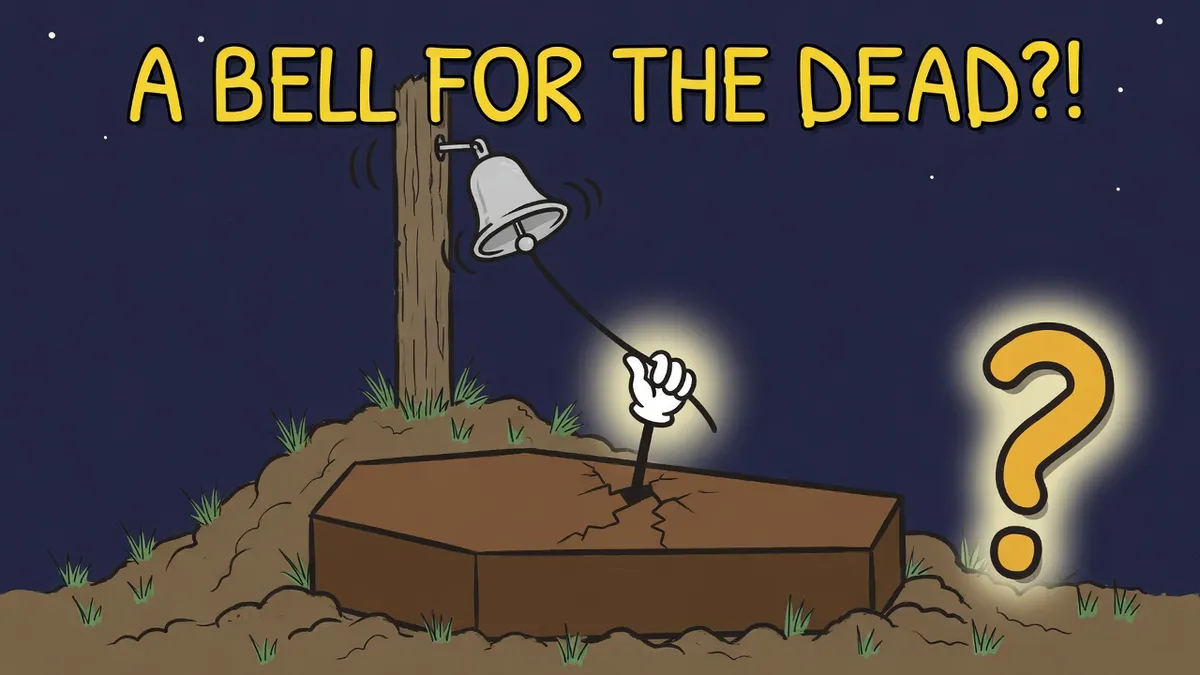
Here is a purchase people once made with a straight face: a coffin with a bell attached. The idea was simple and horrifying. If the funeral had been a mistake, if the pale, still body in the box was not actually dead, then the person would wake in the dark, underground, and their only hope was a string tied to their finger that ran up through the soil to a little bell on a post above the grave. Ring it, and pray someone was passing. For roughly two centuries, this was not a joke. It was a booming, patented industry built on one of the purest fears a human can have.
01 · The fearThe nightmare that gripped a continent
The terror even has a name: taphophobia, the fear of being buried alive. And through the 1700s and 1800s it swept Europe and America as something close to a mass anxiety. People left detailed instructions about their own funerals. They begged to be kept above ground for days, to be cut or pricked to check for a response, to be watched before they were sealed away, the same death-anxious century that also photographed the dead. Edgar Allan Poe poured the dread into story after story, and the public devoured them and grew more frightened still. It was, for a while, one of the defining fears of the age.
02 · Why it was almost reasonableWhen doctors couldn't be sure
The uncomfortable truth is that the fear was not simply hysteria. Medicine of the time genuinely could not always tell death from its convincing imitations. A deep coma, a cataleptic trance, a near-drowning, a profound faint: any of these could leave a person cold, still and apparently pulseless to an anxious relative or an overworked doctor. Add the cholera epidemics, which demanded fast burials to stop the spread, and you had the perfect recipe for a real, if rare, horror: the occasional person sealed in a box while still, somehow, alive. The risk was small. The uncertainty was not.
03 · The inventionA bell, a tube, and a thread of hope
Where there is fear and a patent office, there is industry. Inventors rushed to design the safety coffin. The details differed, but the essentials repeated: a tube running to the surface so the buried person could breathe, and a cord or wire tied to the hand or a finger, connected to a bell, a flag, or a light above the grave. The theory was that any twitch of a reviving body would ring the bell and bring a rescuer running. Some designs added speaking tubes to call for help, or spring-loaded lids for tombs. It was ingenious, earnest engineering aimed squarely at a nightmare.
04 · The catchNobody was ever saved
And here is the quiet punchline to the whole industry. For all the patents, the sales and the elaborate machinery, there is no documented case of a safety coffin ever saving a single person. Not one verified ring of the bell, not one exhumed survivor. The devices were, in the end, a technology sold against a fear rather than a real and present danger. They soothed the living, who could bury a loved one, or arrange their own funeral, with a little less dread. The dead, mistaken or otherwise, never had a use for them.
The bell in the coffin was never really rescue equipment. It was a comfort blanket for the anxious living, dressed up as a lifeline for the dead.
05 · The phrases that lieNot saved by the bell
The coffins left behind a second, sneakier legacy: a set of catchy word-origin stories that are all completely false. You have surely heard that “saved by the bell” comes from a lucky corpse ringing for help, that a “dead ringer” was a body twitching the string, that even “graveyard shift” refers to someone watching over the bells at night. Every one of these is a myth. “Saved by the bell” is from boxing, where the bell ending a round rescues a battered fighter. “Dead ringer” is from horse racing, a fraudulent look-alike horse. “Graveyard shift” just means working through the eerie small hours. The coffin story is so tidy that it swallowed three unrelated phrases whole, which is a neat little lesson in how a good tale outruns the truth.
06 · The payoffSo why the bell?
Because people were terrified of a real uncertainty, and a bell on a string was the most human possible answer to it. When medicine could not promise you were truly dead before it put you in the ground, a cord tied to your finger felt like the difference between a fate and a fighting chance. That the coffins never actually saved anyone almost misses the point. They were built to quiet a fear, not to solve a problem, and at that they worked beautifully. The next time you hear that “saved by the bell” came from a graveyard, you can enjoy knowing the truth: the bells were real, the terror was real, and the rescue, as far as history records, never once came.
Quick questions
Were people really buried with bells?
Yes. From the late 1700s into the 1800s, inventors patented 'safety coffins' fitted with a cord tied to the buried person's hand or finger, running up to a bell (or flag, or light) on the surface, so someone mistakenly buried alive could signal for rescue.
Why were people so afraid of being buried alive?
Because the fear was not entirely irrational. Medicine of the time could not reliably distinguish death from deep unconsciousness. Comas, cataleptic states, drowning and fainting could all look like death, and cholera epidemics led to hurried burials, feeding a genuine terror of waking up underground.
How did a safety coffin work?
Designs varied, but the core idea was a breathing tube to the surface for air, and a cord or wire connecting the body (often the hand or a finger) to an above-ground bell, flag or light. Any movement by a revived 'corpse' would ring the bell and summon help.
How many safety coffins were made?
A great many were designed and patented, over thirty different designs in Germany alone during the second half of the 19th century, plus others across Europe and America. Actual widespread use was far more limited than the patents suggest.
Did a safety coffin ever actually save anyone?
There is no documented case of anyone being saved by one. Despite the hysteria, the patents and the sales, the historical record contains no verified rescue. They comforted the living far more than they ever helped the dead.
Does 'saved by the bell' come from safety coffins?
No. It is a popular myth. 'Saved by the bell' comes from boxing, where the bell ending a round can rescue a fighter in trouble. It has nothing to do with coffins, despite how neatly the story seems to fit.
What about 'dead ringer' and 'graveyard shift'?
Also myths. 'Dead ringer' comes from horse racing (a horse fraudulently substituted for another), and 'graveyard shift' just describes working through the eerie small hours. Neither phrase originates from coffin bells, even though the coffin story is often told to explain them.
How common was premature burial, really?
Almost certainly far rarer than the panic suggested. Many horror stories, corpses found turned over or with scratched coffin lids, are better explained by the natural movements of decomposition than by live burial. The fear vastly outran the actual risk.
Who feared this? Anyone famous?
The fear was widespread, and several notable figures reportedly left instructions to prevent premature burial, asking to have a vein opened, to be kept unburied for a time, or to be checked carefully before burial. The writer Edgar Allan Poe turned the terror into fiction that only fed the public dread.
What finally ended the safety-coffin era?
Better medicine. As doctors developed more reliable ways to confirm death (the stethoscope, an understanding of decomposition, and later medical standards), the underlying fear faded, and the elaborate coffins came to seem like relics of a more anxious age.
What is a safety coffin?
A coffin designed so a person buried by mistake could still signal for help. Typical features included an air tube to the surface and a cord from the hand or finger to a bell, flag or light above ground. More than thirty designs were patented in Germany alone in the later 1800s. There is no documented case of one ever saving anyone.
Did people put bells on graves?
Yes, as part of the safety-coffin craze of the late 1700s and 1800s. A string ran from the buried person's hand up to a surface bell (or flag or light), so a revived "corpse" could ring for rescue. The devices answered a real terror of premature burial more than a proven daily risk, and no verified rescue by one is known.
What is taphophobia?
The fear of being buried alive. It gripped much of Europe and America through the 18th and 19th centuries, when medicine could not always tell death from a deep faint, coma or catalepsy. That anxiety produced funeral instructions, waiting periods before burial, and the whole industry of safety coffins with bells on the surface.
Take the quiz on this
A quick 4-question check on what you just read. Get them right to earn XP: no points for just scrolling.
Our sources 6 checked
// every claim on this page was checked before it went up