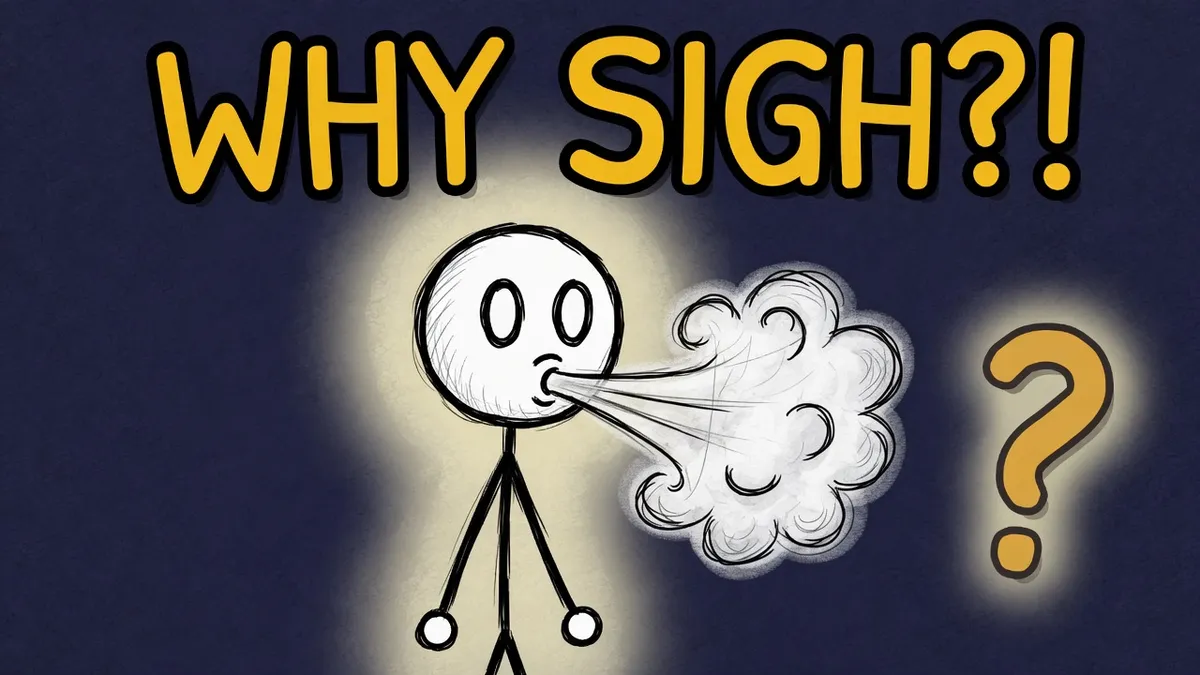
Here is something faintly absurd about your own body: you do it roughly twelve times an hour, completely unaware, and it is keeping you alive, and yet the only time anyone notices a sigh is when it looks like giving up. The long exhale at the end of a bad meeting. The one your teenager aims at you like a weapon. We've cast the sigh as the sound of boredom and defeat. It is, in fact, a life-support reflex firing on a schedule, and you've been misreading it your whole life.
01 · The shapeA sigh is not just a big breath
Watch a sigh closely and you’ll notice it has a very particular form. It isn’t one long inhale: it’s two breaths stacked. A normal inhale, and then, before you breathe out, a second shorter one piled on top, topping your lungs off past where a single breath would stop. Then the long exhale. That double intake makes a sigh roughly twice the volume of an ordinary breath, and the stacking is the whole point: filling a lung that’s already partly full stretches it far harder than a single breath from empty ever could. Scientists call this a physiological sigh, and it’s the same shape whether it’s triggered by relief, by stress, or by nothing you’ll ever feel.
02 · The jobYour lungs are quietly collapsing, all the time
To see why the double breath matters, you have to go deep into the lung, down to the alveoli, the roughly half a billion microscopic air sacs where oxygen actually crosses into your blood. They’re delicate, balloon-thin, and they have an annoying habit: during quiet, shallow breathing, some of them slowly deflate and stick shut. Doctors call a lung full of collapsed sacs atelectasis, and it makes breathing measurably less efficient: less surface area, worse gas exchange, a stiffer lung.
A sigh is the fix. That extra-big stretch reaches the sacs a normal breath leaves behind and pops the flat ones back open, refreshing the thin surfactant lining that keeps them from collapsing again. A single deep breath re-opens the sacs that were merely lazy; the double breath of a real sigh gets the stubborn, fully-collapsed ones. It is, in the most literal sense, lung maintenance.
03 · The clock200 neurons that sigh for you
You don’t decide to do any of this. Buried in your brainstem is a region called the preBötzinger complex, the same little knot of cells that sets the basic rhythm of every breath you take. In 2016, a team from UCLA and Stanford went looking inside it for the specific machinery behind sighs, and found something startlingly small: a subset of about 200 neurons that does nothing but generate sighs. They signal using two neuropeptides with unlovely names, neuromedin B and gastrin-releasing peptide. When the researchers blocked one of those signals in mice, sighing dropped by half. When they silenced both, the mice stopped sighing altogether, while breathing on, otherwise normally. A dedicated circuit, in other words, whose entire job is to interrupt ordinary breathing every few minutes and slip in a sigh.
The reason your body bothers to build a dedicated sigh circuit is blunt: go long enough without deep breaths and your lungs fail. Early ventilators that pushed in perfectly even breaths caused lungs to slowly collapse, until engineers programmed in artificial sighs.
04 · The stakesYou would, eventually, die without it
That sounds like a headline, but it’s mechanically true. Without periodic large breaths, alveoli keep collapsing and never get re-opened; the lung stiffens, gas exchange degrades, and things go downhill. This is a genuine problem in intensive care. Push air into someone’s lungs at the same steady volume, breath after identical breath, and the sacs deflate over time, which is exactly why mechanical ventilation has long included occasional deep “sigh” inflations to keep the lungs open. Your brainstem has simply been running that safety protocol, unprompted, your entire life. The sigh you never notice is the reason you can afford not to think about breathing at all.
05 · The feelingThe sigh of relief is real
So where do the emotions come in? The mechanical sigh and the emotional sigh turn out to be the same event, borrowed for a second purpose. When you’re stressed, your breathing tends to go shallow, fast and ragged, and your sigh rate climbs. The leading idea, call it the resetter hypothesis, is that a sigh acts as a manual reset on a breathing pattern that’s drifted into a bad state, stretching the system and restoring a healthy, flexible variability. Studies bear out the folk wisdom: a spontaneous sigh is typically preceded by rising tension and irregular breathing, and followed by falling tension and steadier breath. The sigh of relief isn’t just a sound you make when the pressure lifts. It’s part of how your body lets the pressure go.
06 · The hackTwo inhales, one long exhale
Here’s the practical payoff, and it comes with an honest caveat. Because the sigh sits at the junction of breathing and calm, you can borrow it deliberately. In 2023, a Stanford team tested a technique they called cyclic sighing, two inhales through the nose, the second a short top-up, then a long exhale through the mouth, for five minutes a day. Over a month, it beat mindfulness meditation for lifting mood and slowing the breath. But note what actually did the work: the long exhale. Slow, exhale-heavy breathing calms you; simply gulping big deep breaths on command can, oddly, interfere with your body’s own stress recovery. The sigh works because of the way it ends, not because it’s large.
07 · The payoffSo, why do you sigh?
Because your lungs are always, quietly, falling apart at the smallest scale, and a sigh is the repair. First and foremost it’s a mechanical act: a double breath that reaches deep and re-inflates the air sacs shallow breathing lets collapse, run automatically by a couple hundred neurons every five minutes for as long as you live. That the same reflex also happens to reset a rattled nervous system, and to carry the unmistakable sound of relief, is a lovely bonus laid over the top of pure engineering. So the next time someone sighs at the end of a long day and you read it as defeat, you’ve got it exactly backwards. That’s the sound of a body refusing to give up, one breath at a time, twice at once.
Quick questions
Why do you sigh?
For a mechanical reason first, an emotional one second. Deep in your lungs, tiny air sacs called alveoli slowly collapse when you breathe shallowly. A sigh, a second inhale stacked on top of a normal one, pops them back open before too many go flat. Your brainstem fires one automatically every few minutes to keep your lungs from stiffening. On top of that, sighs also seem to help reset your breathing after stress or relief.
What is a physiological sigh?
It's the actual shape of a sigh: a normal inhale, then a second shorter inhale stacked on top of it, followed by one long exhale. That double intake is what makes a sigh roughly twice the volume of an ordinary breath, enough to reinflate air sacs a single breath would miss. It's the same pattern whether the sigh is triggered by your brainstem's clockwork or by a wave of relief.
How often do you sigh?
On average, about every five minutes, roughly 12 spontaneous sighs an hour, most of them without you noticing. Mice sigh far more often, around 40 times an hour. The general rule across mammals is that the smaller the animal, the more frequent the sighing, because tinier air sacs collapse more easily.
What happens if you don't sigh?
Your lungs gradually stiffen. Without periodic deep breaths, more and more alveoli collapse, a state called atelectasis, and gas exchange gets less efficient. It's a real clinical problem: early mechanical ventilators that pushed in perfectly even breaths caused lungs to collapse over time, which is why occasional large "sigh" inflations are used to keep them open. The reflex genuinely helps keep you alive.
What part of the brain controls sighing?
A tiny cluster of neurons in the brainstem, in a region called the preBötzinger complex, the same area that sets your basic breathing rhythm. A 2016 study identified roughly 200 neurons there that generate sighs specifically. They use signalling molecules called neuropeptides (NMB and GRP); block those signals in mice and sighing drops, silence them entirely and it stops.
Why do you sigh when you're sad or stressed?
Sighing rate goes up during mental stress, and the leading idea is that a sigh acts as a kind of "reset" for a breathing pattern that's become too shallow, too fast, or too irregular. The sigh stretches the respiratory system and nudges your breathing back toward a stable, flexible baseline. So a stressed sigh isn't just an expression of feeling: it may be your body actively trying to regulate itself.
Is sighing a lot a sign of anxiety or depression?
It can be. People with chronic anxiety, panic disorder and PTSD tend to sigh more often than average, and frequent sighing is a recognised feature of anxiety-related breathing patterns. That said, everyone sighs, and sighing more when you're stressed is normal and usually harmless. Very frequent, distressing breathlessness with constant sighing is worth mentioning to a doctor, mostly to rule other things out.
Why do you sigh in relief?
A "sigh of relief" seems to be the reset in action. Studies find that a spontaneous sigh is often preceded by rising tension and irregular breathing, and followed by falling muscle tension and steadier breathing, the physiological signature of relief. So the sigh both marks the moment the pressure lifts and helps settle your body back down afterward.
Does the physiological sigh actually reduce stress?
There's real evidence for a deliberate version. A 2023 Stanford trial had people do five minutes a day of "cyclic sighing", two inhales through the nose, then a long exhale, and found it improved mood and lowered breathing rate more than mindfulness meditation over a month. The catch: spontaneous sighs and slow, exhale-heavy breathing help, but simply forcing big deep breaths on demand can actually interfere with stress recovery. The long exhale matters more than the big inhale.
How do you do a physiological sigh?
Inhale through your nose, then, without exhaling, take a second short sip of air to top your lungs off, then let a long, slow breath out through your mouth. Two or three rounds is enough to feel it. It's the exhale-focused version studied for calming down, and it works because the extended out-breath nudges your nervous system toward its rest state.
Why do you sigh when you're bored or relaxed?
The best current explanation ties back to the reset idea. During monotonous, low-arousal stretches, your breathing can settle into a flat, overly regular rhythm, and a sigh appears to break it up and restore healthy variability. So a bored sigh may be less about the boredom and more about your respiratory system periodically shaking itself out. This is the leading interpretation rather than a fully settled fact.
Do animals sigh?
Yes, all mammals sigh, and it's been studied closely in rats and mice. It's the same double-breath reflex serving the same purpose: reinflating collapsing air sacs. Smaller mammals sigh more frequently than larger ones, because their smaller alveoli collapse more readily and need re-opening more often.
Why is a sigh a double breath instead of one big one?
Because stacking a second inhale on top of a lung that's already partly full generates a much bigger stretch than a single breath from empty, and it's that extra stretch that pops open air sacs that have gone flat. A single deep breath opens the ones that are still working; the double breath reaches the stubborn, collapsed ones. It's a more efficient way to reinflate the whole lung.
Can sighing be dangerous?
Ordinary sighing is not just safe but necessary. Only in unusual cases does it become a concern, for example, constant, frequent sighing tied to severe anxiety or a sense of never getting a full breath, which is uncomfortable but generally not physically harmful. The reflex itself is protective. If frequent sighing comes with genuine shortness of breath or chest symptoms, that's worth getting checked.
Take the quiz on this
A quick 4-question check on what you just read. Get them right to earn XP: no points for just scrolling.
Our sources 13 checked
// every claim on this page was checked before it went up