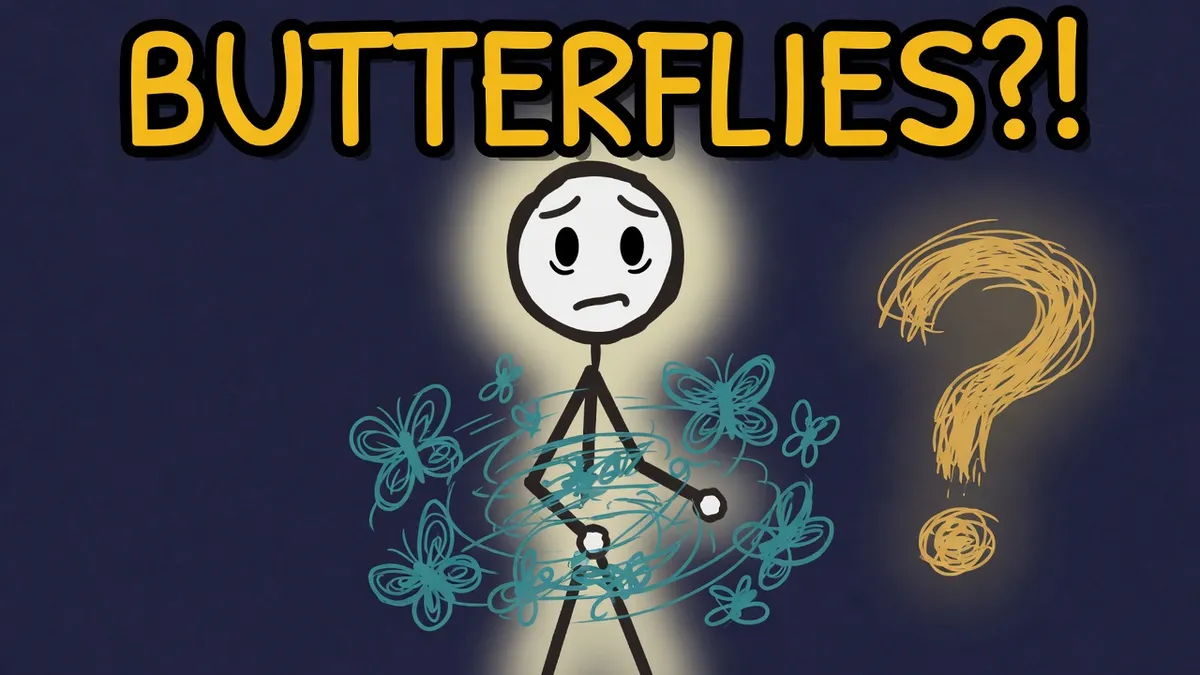
You're about to walk on stage. Or ask someone out. Or open an exam. And there it is, that light, hollow, fizzing flutter, right in the pit of your stomach. We call them butterflies. But there are no butterflies, and honestly, it's barely even about your stomach. What you're feeling is your gut reacting to an alarm, by shutting itself down. The flutter is the sensation of your digestive system being told, urgently, to stop what it's doing and get out of the way.
01 · The alarmYour brain doesn't wait to ask questions
It starts in your brain. It clocks a big moment, and, crucially, it doesn’t stop to work out whether that moment is good or bad. It just hits the alarm: the fight-or-flight system. Your adrenal glands flood your body with adrenaline and its stress companion cortisol, and the whole machine tips into emergency mode before you’ve consciously decided anything is wrong. Speed matters more than accuracy here: a body that pauses to double-check the threat is a body that gets eaten.
02 · The diversionAdrenaline has priorities
And adrenaline has priorities. In an emergency, your body wants blood in the big muscles, your legs, your arms, ready to run or to fight. So it pulls blood away from anything it considers non-essential right now. And near the very top of that “can wait” list sits digesting your lunch. Mid-crisis, breaking down breakfast is a luxury; it can be paused. So the body pauses it, hard.
03 · The flutterWhat that actually feels like
Here’s the physical mechanism. The tiny blood vessels wrapped around your stomach and intestines clamp down. Blood drains out of your gut, digestion slams to a halt, and the muscles in there, which normally squeeze in a smooth, steady rhythm called peristalsis, twitch out of time. That sudden, hollow, dropping sensation, the fizzing lightness where a moment ago there was nothing at all: that’s the butterflies. Not insects. Just your gut going quiet and out of rhythm all at once.
04 · The second brainWhy you feel it so vividly
But this is why you feel it so keenly. Your gut isn’t just plumbing. Lining it is a vast web of over 500 million neurons, more than your entire spinal cord, called the enteric nervous system. Neuroscientist Michael Gershon literally nicknamed it your second brain, and it earns the name: it can run digestion entirely on its own, without instruction from your head. So when adrenaline reorganises everything down there, it isn’t happening in dead tissue. It’s happening in something that notices absolutely everything.
05 · The gut-brain lineA gut feeling is a real message
That second brain has a private line straight to your head, a huge nerve called the vagus nerve. And here’s the twist most people get backwards: the great majority of its fibres are sensory, carrying signals up, from the gut to the brain, rather than down. Your gut is doing far more talking than listening. So a “gut feeling” isn’t just a figure of speech, it’s a genuine message travelling the wrong way up the wire, your belly reporting to headquarters. When you feel the drop, that’s your second brain filing an urgent bulletin.
06 · The mix-upExcitement and fear feel identical
And this is the strange part. Adrenaline is useless at telling excitement apart from fear. A first kiss, a rollercoaster, your dream job on the phone, to your body, they trigger the exact same surge as a charging bear. Psychologists call this misattribution of arousal; in the famous 1974 suspension-bridge study, men who’d just crossed a terrifyingly high bridge were markedly more likely to feel drawn to a woman they met at the other end, having quietly filed their leftover fear as attraction. Your body supplies the flutter; your mind supplies the label. Which is why your happiest moments and your most terrifying ones flutter in precisely the same spot.
The butterflies aren't a malfunction. They're your gut being told, in the middle of a moment that matters: put digestion down, we might need to run.
07 · The trickDon't calm down, get excited
Here’s the useful part, because the flutter isn’t just something to endure. Since the arousal is the same whether you call it fear or thrill, the smartest thing to do with butterflies isn’t to fight them, it’s to relabel them. In a neat set of studies by Harvard’s Alison Wood Brooks, people about to sing, give a speech or do pressured maths were told to say out loud either “I am calm” or “I am excited”. The ones who claimed excitement consistently did better. Trying to force yourself calm means wrestling a body that has already floored the accelerator; telling yourself you’re excited works with the surge instead of against it. Same butterflies, better outcome, just from the caption you give them.
08 · The payoffSo what are butterflies, really?
For your ancestors, a big moment usually meant danger, and when a predator appears you do not want your energy tied up digesting breakfast. You want an empty, light, ready body that can sprint. That’s the logic the flutter is running on, thousands of generations later, while you wait in the wings or hold your phone before you dial. So butterflies aren’t your nerves betraying you, they’re the opposite. They’re your body clearing the decks, dropping everything, and bracing hard for something it has decided really matters. The flutter is just proof that this moment counts. So next time your stomach flips before something big, don’t fight it. It’s a half-a-billion-neuron second brain telling you you’re finally about to do something interesting. Go.
The animated version
Same answer, told as a little animated story with the strange little stickman acting it out. Dry, quick, and, obviously, correct.
Quick questions
Why do I feel butterflies when I'm excited and not scared?
Because your body can't really tell the two apart. Excitement and fear both fire the same fight-or-flight surge of adrenaline, and it's the adrenaline, not the emotion, that pulls blood from your gut. A first kiss and a near-miss trigger nearly identical chemistry, which is why your happiest and most terrifying moments flutter in exactly the same spot.
What is actually happening in my stomach when I get butterflies?
Adrenaline redirects blood away from your digestive system toward your large muscles, so the vessels around your stomach and intestines constrict, digestion slows, and normal gut contractions (peristalsis) fall out of rhythm. That drop in blood flow and disrupted rhythm is the hollow, fluttery feeling.
Is there really a 'second brain' in my gut?
Yes, it's called the enteric nervous system, a web of over 500 million neurons lining your gut, more than your entire spinal cord. Neuroscientist Michael Gershon popularized the name "the second brain." It can run digestion on its own and registers stress shifts acutely, which is why you feel them so vividly there.
Is a 'gut feeling' a real thing or just a saying?
It's surprisingly literal. Your gut and brain are linked by the vagus nerve, and the majority of that nerve's fibres are sensory, carrying signals up from the gut to the brain rather than down. Your gut does far more talking than listening, so a gut feeling really is a message travelling to your head.
Are butterflies in the stomach bad for me?
For a big moment, no, they're a normal, temporary part of the fight-or-flight response and pass once the adrenaline clears. Persistent or severe stomach distress tied to anxiety is worth discussing with a doctor, but the occasional pre-stage flutter is just your body bracing itself. (This is general information, not medical advice.)
How do I get rid of butterflies before something big?
The counterintuitive answer is: don't try to calm down. The arousal is already running, and fighting it tends to make things worse. In a set of studies by Alison Wood Brooks, people who told themselves 'I am excited' before singing, speaking or doing maths under pressure actually performed better than those who tried to relax, because excitement and nerves are almost the same body state, and it's far easier to relabel the feeling than to switch it off. Slow breathing helps too, but reframing the flutter as readiness beats trying to kill it.
Are butterflies a sign of anxiety or excitement?
Physically they're the same thing, both run on the same adrenaline surge, so your body genuinely can't tell them apart. What differs is the label your mind puts on it, which depends on the situation and how you read it. A one-off flutter before a date or a big moment is just arousal; butterflies that are constant, or that show up with no real trigger, are more likely to be anxiety worth paying attention to.
Why do you get butterflies around someone you like?
Attraction trips the same alarm as a threat. Being near someone you're drawn to releases adrenaline and its cousin noradrenaline, plus a hit of dopamine, and that surge pulls blood from your gut exactly the way fear does. Your body supplies the flutter; because you like the person, your mind files it as thrilling rather than frightening. Same chemistry as a fright, opposite caption.
Why does your stomach 'drop' on a rollercoaster or a fall?
That one isn't the adrenaline flutter, it's physics. During a sudden drop, your body and your loosely-anchored organs briefly fall at the same rate, so for a moment there's almost no force pressing your stomach and intestines into place, a flash of near-weightlessness, like a mini version of what astronauts feel. Nerves around those organs register the strange lightness while your inner ear struggles to keep up, and that's the swoop. (The 'my stomach dropped' you feel at bad news, by contrast, really is the adrenaline version.)
Can butterflies make you feel sick or need the bathroom?
Yes, it's the same fight-or-flight plumbing turned up a notch. The adrenaline and cortisol that cause the flutter can also speed up the lower gut and raise stomach acid, which is why big nerves can tip over into nausea or an urgent dash to the toilet, the very real phenomenon of 'nervous poops.' It's your gut clearing the decks, and it settles once the stress passes.
How long do butterflies last?
Usually not long. Butterflies are a burst of the fight-or-flight response, and they fade as the adrenaline clears from your bloodstream, typically within minutes once the moment passes or you get going. If you actually do the thing you're nervous about, the feeling tends to dissolve surprisingly fast; it's the waiting beforehand that draws it out.
Are butterflies in the stomach the same as anxiety?
They share the same fight-or-flight chemistry. Adrenaline and related stress signals divert blood from the gut and change motility, which you feel as a flutter. Mild butterflies can be excitement; the same plumbing at higher gain is the gut side of anxiety.
Why does the gut feel emotions so strongly?
Because it is densely wired to the brain via the vagus nerve and the enteric nervous system, sometimes called the second brain. Stress hormones and autonomic shifts hit the stomach and intestines fast, so emotion often shows up as a physical gut sensation first.
Take the quiz on this
A quick 4-question check on what you just read. Get them right to earn XP: no points for just scrolling.
Our sources 10 checked
// every claim on this page was checked before it went up