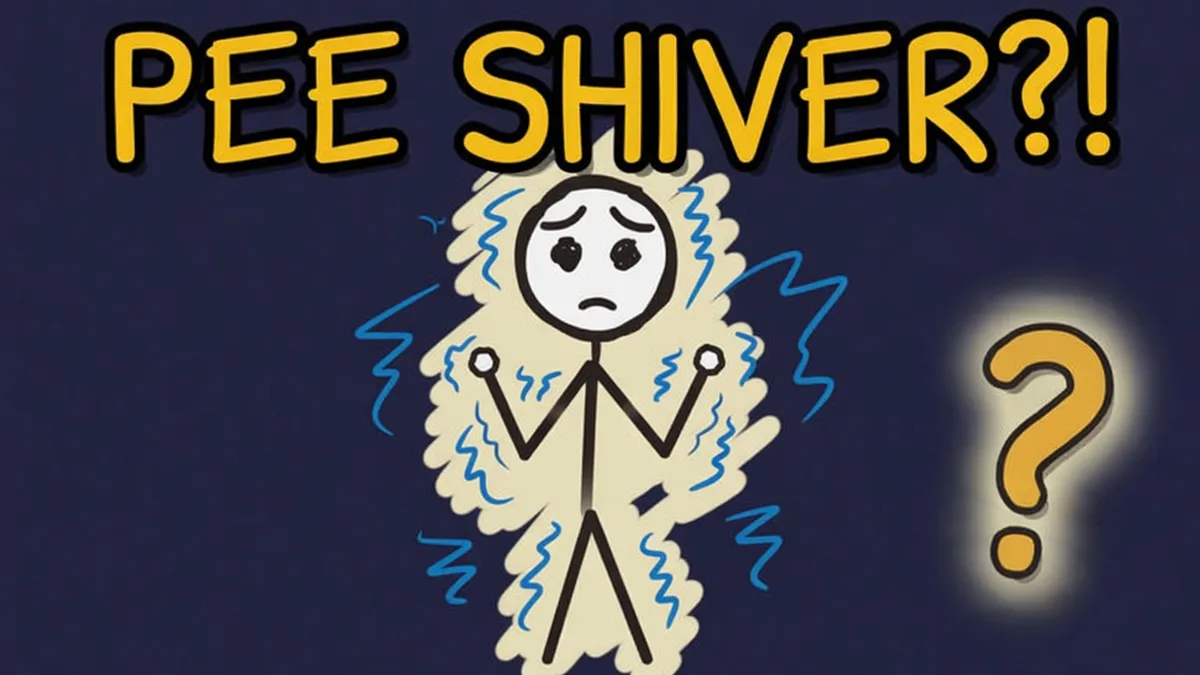
Here is a small, strange fact about being a human body: one of the most common things you do, several times a day, every day of your life, is something science genuinely cannot explain. You finish peeing, and out of nowhere a quick shudder runs through you. A full-body brr, complete with a little scrunch of the face. Almost everyone knows the feeling. And almost nobody, including the experts, knows why it happens.
01 · The shudderA tiny mystery with a very grand name
You know the one. The stream stops, and a beat later a shiver rolls through you and is gone in a second or two. It’s harmless, it’s fleeting, and it is so ordinary that most people never think to ask about it. Which makes it all the funnier that it has a name that sounds like a battlefield diagnosis: post-micturition convulsion syndrome. Strip away the Latin and “micturition” just means urination, so the whole grand phrase translates, roughly, to “the pee shivers.”
02 · The gapNobody has actually studied it
Here’s the part that surprises people. For something this common, happening this regularly to this many of us, you’d expect science to have it completely nailed down. It hasn’t. There is essentially no peer-reviewed research on the pee shiver at all: it’s one of those everyday human experiences that slipped straight through the cracks of the research world. So everything that follows is the best current thinking, honestly labelled. None of it is settled fact.
03 · The leading ideaYour autopilot at a crossroads
The most credible guess points to your autonomic nervous system, the autopilot that runs your heartbeat, your digestion and your blood pressure without asking permission. It has two modes: “rest and digest,” the calm setting, and “fight or flight,” the alert one. And going to the toilet, it turns out, sits right at the crossroads between them. Peeing is largely a calm-mode job; but the moment you finish, something happens that can flip the switch.
04 · The pressure dropEmpty the tank, drop the pressure
Here’s the key part. A full bladder is under real pressure, and that pressure quietly helps prop up your blood pressure. So the moment you empty it, that support disappears and your blood pressure can take a small dip. Your body, which strongly dislikes a falling blood pressure, scrambles to correct it, firing up the alert branch of the nervous system, releasing a burst of catecholamines (adrenaline and its relatives) to tighten your blood vessels and haul the pressure back up.
The leading idea is that this fast handbrake turn, from the calm mode running the plumbing straight into a jolt of the alert one, is what shakes the shiver loose. A crossed wire, as your body overcorrects. Plausible, tidy, and never once directly proven.
05 · The other suspectsHeat, and tangled nerves
The blood-pressure theory isn’t the only one on the board. The obvious rival is heat: you’re releasing a stream of warm liquid your body worked to bring up to temperature, so you lose a tiny bit of warmth, and shivering is your standard reflex for feeling cold. Neat, except people get the pee shivers just fine in a warm room in the middle of summer, when there’s nothing to react to. So temperature alone can’t be the whole answer.
Then there’s the wiring idea. As urine passes out, a crowd of nerves down there fire off at once, and some researchers wonder whether that flood of signals simply spills over, accidentally tripping the nearby pathways that trigger a shiver. Wires that sit close together, crossing for just a moment. It’s speculative, but it fits the theme running through every one of these theories: your nervous system briefly getting its signals tangled.
06 · The wrinkleWhy mostly men?
There’s one more curious detail. The pee shivers seem to be reported more often by men than by women, and nobody is quite sure why. The going guess is that standing to urinate, rather than sitting, might make that blood-pressure drop a touch more dramatic, and so more likely to trip the reflex. But that’s a hunch stacked on top of an already-unproven mechanism. It’s less an answer than one more question mark on a pile of them.
07 · The payoffSo why do you shiver after you pee?
The strangely lovely truth is that nobody can tell you for certain. The best available guess is that the shiver is the sound of your autopilot fumbling a fast gear change, catching a dropping blood pressure and overcorrecting with a jolt that ripples out as a shudder. Heat loss and tangled nerves may each chip in a little. But no one has ever properly tested any of it. So here you are: doing a thing, several times a day, that your own body can’t explain, a small, everyday mystery, hiding in the most ordinary moment imaginable.
The animated version
Same answer, told as a little animated story with the strange little stickman acting it out. Dry, quick, and, obviously, correct.
Quick questions
What is the pee shiver actually called?
Its semi-official name is post-micturition convulsion syndrome, a very grand label for a very small event. "Micturition" just means urination. It describes the brief, involuntary full-body shudder some people feel during or just after they pee.
Is it bad to shiver when you pee?
No. For the vast majority of people it's completely harmless, a fleeting reflex that passes in a second or two with no consequences. It's not the same as fainting during urination (micturition syncope), which is a separate, rarer event worth mentioning to a doctor if it happens to you.
Why does emptying your bladder make you shiver?
The leading hypothesis is a blood-pressure story. A full bladder is under pressure that helps prop up your blood pressure; empty it quickly and pressure can dip, so your sympathetic ("alert") nervous system fires to bring it back up. That rapid switch from calm to alert mode may be what jolts out the shiver, though it has never been directly proven.
Is the pee shiver caused by losing body heat?
Maybe a little, but it can't be the whole story. Warm urine leaving your body is a tiny heat loss, and shivering is the standard warm-up reflex, a tidy idea. But people get the shiver in a hot room in summer too, when there's no real cooling to react to. So temperature alone doesn't explain it.
Do more men than women get the pee shivers?
It appears to be reported more often by men, though the data is thin. One guess is that urinating while standing makes the blood-pressure drop a bit more pronounced than sitting does. But this is a hunch layered on top of an already-unproven mechanism, so treat it lightly.
Has anyone actually studied the pee shivers?
Barely. For something so common, it has slipped almost entirely through the cracks of research: there is essentially no peer-reviewed work on it. Everything you'll read, here included, is the best current thinking rather than established science.
Is the pee shiver a sign of something wrong, like diabetes?
No. The shiver itself isn't a symptom of diabetes or any disease: it's a harmless reflex. What can point to diabetes is a different pattern: needing to pee very frequently alongside things like constant thirst, fatigue or blurred vision. If it's just the odd post-pee shudder with no other symptoms, there's nothing to worry about.
Is 'post-micturition convulsion syndrome' a real medical diagnosis?
Not really. The name gets used semi-seriously, but it isn't a condition doctors formally recognise, and there are no controlled scientific studies behind it. It's more a tidy label for a common, harmless experience than an official diagnosis, which is part of why nobody can tell you exactly what causes it.
Can children and babies get the pee shivers?
Yes, it isn't just an adult thing. It can happen to anyone, and it's been reported in people as young as infancy. That's about as much as anyone can say with confidence, given how little the phenomenon has actually been studied.
Do dogs or other animals get the pee shivers?
There's no good evidence that they do: the human post-pee shiver hasn't really been documented in animals, and it's hard to ask a dog. If your dog shivers or shakes around peeing, that's usually something else entirely, cold, excitement, anxiety or discomfort, and if it's persistent it's worth a vet's opinion rather than being chalked up to a cute reflex.
Can you stop or prevent the pee shiver?
Not in any reliable way, and you don't need to. Since nobody has pinned down what actually causes it, there's no proven trick to prevent it, and because it's completely harmless and over in a second or two, there's nothing to treat. It's a quirk to enjoy, not a problem to fix.
What's the difference between the pee shiver and fainting while peeing?
They're not the same thing. The pee shiver is a harmless one-second shudder. Fainting during or right after urinating is a separate, rarer event called micturition syncope, an actual loss of consciousness caused by a vasovagal drop in blood pressure. It shows up most in older men (for example with an enlarged prostate), sometimes at night or after alcohol, and unlike the shiver it's worth mentioning to a doctor.
Take the quiz on this
A quick 4-question check on what you just read. Get them right to earn XP: no points for just scrolling.
Our sources 12 checked
// every claim on this page was checked before it went up