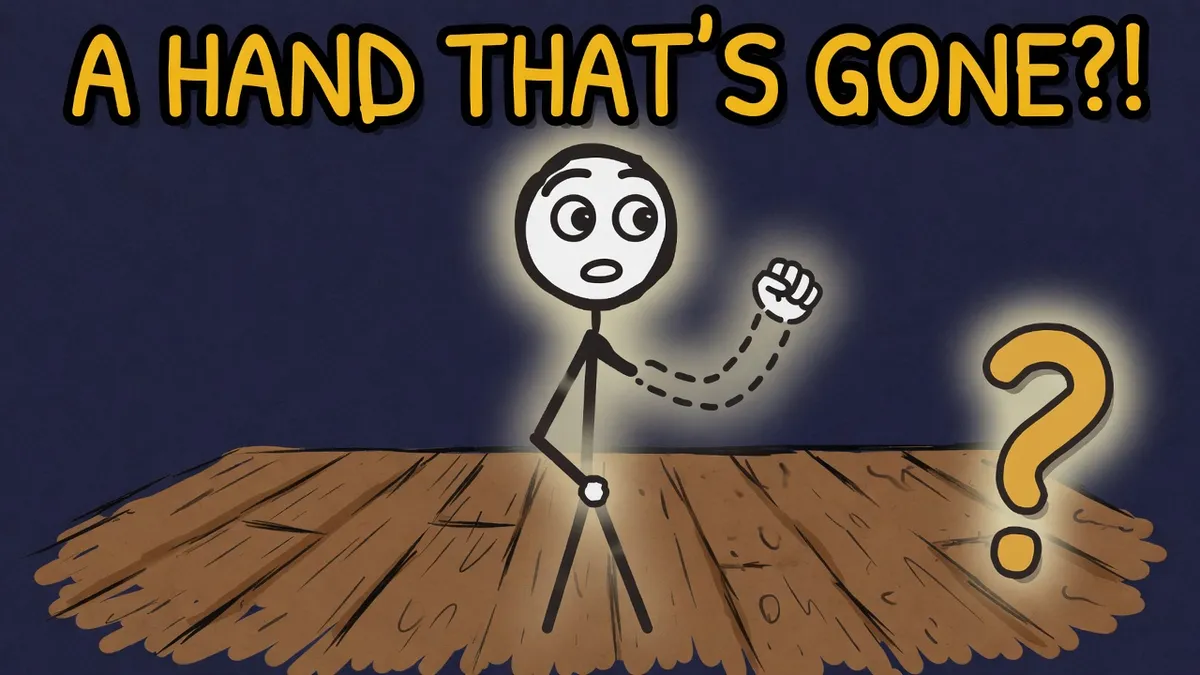
When someone loses an arm or a leg, most of them don't feel it vanish. They feel it stay. The missing limb is still vividly there: it can itch, it can feel warm or cold, it seems to move. And for a great many people, it hurts. A phantom hand can clench into a fist so tightly that the fingernails feel like they're digging into the palm, and no matter how hard the person tries, they cannot get it to open. So here is the puzzle: how do you feel genuine agony in a hand that simply isn't there?
01 · The obvious guessIt's not just the stump
The first obvious guess is the stump. The nerves that were cut are still there, frayed and firing off signals, sometimes tangling into knots called neuromas. And that is a real part of the story. But it cannot explain a whole, detailed, moving hand, one with individual fingers you can feel curl and clench. Cutting a cable doesn’t tell you why the screen still shows a picture. For that, you have to go much further up. Right into the brain.
02 · The mapThere's a little you painted on your brain
Because your brain holds a complete map of your body, spread across its surface. A scaled-down you, painted onto the strip of cortex just behind the crown of your head, the somatosensory homunculus. We know it exists because in the mid-20th century the neurosurgeon Wilder Penfield, operating on conscious patients, touched tiny points on the cortex with an electrode and asked what they felt, and built the map point by point. Your hand has its own patch of territory. Your face has another. Your feet, your lips, all of it, laid out in order like districts on a map, and sized not by how big the body part is, but by how sensitive it is, which is why the hands and lips are enormous.
03 · The vacancyThe district goes dark, and the neighbours move in
Now, amputate the hand, and its district on that map suddenly goes quiet. No more signals coming in. But brain territory doesn’t just sit empty. To some degree the neighbouring regions, starved for space, can start to creep in and take it over, a striking example of the brain’s plasticity. And here is where it gets genuinely uncanny. On that map, the patch for your hand sits right next door to the patch for your face. So in many amputees, if you gently stroke their cheek, they feel it, clear as day, on the fingers of the hand that is no longer there. The face has quietly reached across into the empty hand. Ramachandran first described this in the 1990s, and brain imaging has since confirmed it.
04 · The painA cruel little feedback loop
So what about the pain? Here the science gets less settled, so it’s worth being honest about it. The best-known explanation, from the neuroscientist V.S. Ramachandran, is a cruel little feedback loop he called learned paralysis. The brain keeps firing off commands to move the phantom hand, but no signal ever comes back to say it moved. So the brain concludes the hand is stuck, jammed, frozen in that clench. And a limb frozen tight, forever, hurts. It’s an elegant idea, and it directly inspired the treatment we’ll come to. But it’s the leading idea, not the last word.
One of the cheapest ideas in the history of medicine, a plain mirror, grew straight out of that theory. Stand it right, and the frozen fist can let go.
05 · The mirrorTwo pounds of glass against years of pain
That “learned paralysis” idea led Ramachandran, in the mid-1990s, to one of the most elegant experiments in neuroscience. A mirror. He stood a plain mirror upright beside the patient, angled so the reflection of their intact hand appeared exactly where the phantom one felt like it should be. The patient looks into the mirror and sees two whole hands again. Then they move the real one, and the brain, watching the reflection, finally sees the phantom hand do what it’s told. It opens. It unclenches. The frozen fist lets go. In Ramachandran’s early cases, patients who hadn’t been able to “move” their phantom for years suddenly felt it spring to life the moment they opened their eyes on the mirror. And for some people, the phantom pain that had haunted them quietly drained away.
06 · The honest caveatWhy nobody's fully sure it works, or why
Now, to be fair, the mirror is not a miracle cure, and it would be dishonest to sell it as one. It doesn’t work for everyone. And when researchers pool the trials, the evidence comes out genuinely mixed: some reviews find a real benefit, while reviews that include only the most rigorous, placebo-controlled studies find no clear effect. The studies tend to be small and imperfect, so the honest verdict is “promising, cheap, low-risk, and worth trying, but unproven.”
The deeper mechanism is contested too. The tidy story, amputation, the map goes dark, the neighbours invade, and that remapping causes the pain, has been challenged. Tamar Makin and colleagues found the opposite of what you’d expect: the people with the worst phantom pain tended to have a former hand-area that was remarkably well preserved, not erased. Which flips the causal arrow, and suggests the pain may keep the old map alive rather than the remapping causing the pain. Scientists are still arguing it out.
07 · The payoffYour body lives in your head
But step back, and the deeper lesson survives every one of those caveats intact. Your arm was never really in your arm. The entire feeling of your body is built, and held, inside your brain, a map that can outlive the territory it was drawn from. That’s why a limb can go on itching, moving, and aching years after it’s gone. And it’s why, at least for some people, you can soothe a limb you no longer have simply by fooling that map with two pounds of glass. Your body isn’t quite where you think it is. It’s a map, drawn in your head, and the map can outlast the limb.
The animated version
Same answer, told as a little animated story with the strange little stickman acting it out. Dry, quick, and, obviously, correct.
Quick questions
What is a phantom limb?
It's the vivid feeling that a limb is still there after it's been amputated. Studies suggest most amputees experience it, as many as around 80%. The phantom can feel like it's moving, itching, warm or cold, or held in a particular position, and for a large share of people it's painful. It usually appears within days of the amputation and can persist for years.
Why does a missing limb hurt (phantom limb pain)?
The cause is genuinely debated. The best-known idea, from V.S. Ramachandran, is a "learned paralysis": the brain keeps sending move commands to the phantom, never gets sensory confirmation it moved, and settles on the limb being stuck in a painful clench. Others link the pain to changes in the brain's body-map, and more recent work suggests the pain tracks a preserved limb representation rather than a remapped one. The peripheral nerves in the stump also contribute.
Why can stroking an amputee's face be felt in the missing hand?
Because of how the body is laid out on the brain's map. On the somatosensory cortex, the region for the hand sits right next to the region for the face. After the hand is amputated its patch goes quiet, and the neighbouring face region can effectively encroach, so touch to the cheek gets felt on the phantom fingers. Ramachandran first described this in the 1990s and it's been replicated with brain imaging.
How does a mirror help phantom limb pain?
In Ramachandran's mirror box, a vertical mirror reflects the intact hand into the position where the phantom feels like it is. The person moves the real hand and, in the reflection, watches the "phantom" move and unclench, giving the brain visual proof the limb obeyed. For some people the pain eases. But it doesn't work for everyone, and reviews of the evidence are mixed rather than conclusive.
Does mirror therapy actually work for phantom limb pain?
It helps some people, but the evidence is unsettled. Some systematic reviews find benefit; others that included only the most rigorous placebo-controlled trials found no clear effect. The studies tend to be small and methodologically weak. It's cheap and low-risk, so it's often worth trying, but it is not a guaranteed fix.
How common is phantom limb pain?
Very. Phantom sensation of some kind is nearly universal after amputation, and painful phantoms are common too: estimates for phantom limb pain generally run somewhere around 60 to 80% of amputees, though the figures vary a lot with how and when people are asked. It usually starts within the first days to weeks after surgery. So a hurting phantom isn't a rare complication; it's closer to the norm.
What does phantom limb pain actually feel like?
People describe it in strikingly physical terms: burning, shooting or electric-shock pains, stabbing, throbbing, pins-and-needles, or a deep cramp. One of the most common and distressing forms is the feeling of the missing hand or foot clenched or twisted into an impossible, locked position. It can be constant or come in bursts, and mild for some people, severe for others. Crucially, it is not imaginary: it's a genuine pain signal generated by a real, physical brain.
Can you feel a phantom limb move, or is it stuck?
Both happen. Many amputees can voluntarily 'move' the phantom, wiggle its fingers, flex it, and feel that movement clearly. But others feel the phantom frozen in one position, sometimes a painfully clenched one, unable to budge no matter how hard they try. That stuck, paralysed phantom is exactly what the 'learned paralysis' idea tries to explain, and it's the version mirror therapy is designed to release.
Do people born without a limb feel phantom limbs?
Some do, which is one of the most mind-bending facts in the whole field. Phantoms are far more common after amputation, but a minority of people born without a limb (congenital absence), who never had one to lose, still report feeling one. Estimates land around one in five, though they vary. There are documented cases of children counting on phantom fingers they were never born with. It hints that the brain arrives with some innate body-map of a two-arms-two-legs human, rather than building it purely from experience, though this is an area researchers are still working out.
How long does phantom limb pain last, does it go away?
For many people it fades. Phantom sensations and pain tend to be strongest in the first six months and often become weaker and less frequent as the brain adjusts, but there's no fixed timetable, and for a substantial minority it persists for years. In one large survey of amputee veterans, about half said their phantom pain lessened over time while the other half reported no change or worsening. Many people also experience telescoping, where the phantom seems to gradually shorten and retract toward the stump over months to years.
Is phantom limb pain 'all in your head'?
In one narrow sense the pain is generated by the brain rather than the missing limb, but that does not make it imaginary or a sign of weakness. It's a real, physical malfunction of a real, physical nervous system, exactly as real as any other pain, and it's taken seriously as a medical condition. Telling someone their phantom pain is 'just in their head' is both unkind and, technically, missing the point: all pain is ultimately in your head.
How common is phantom limb sensation after amputation?
Very common. Most amputees report some awareness of the missing limb, and a large share also get phantom pain. Rates vary by study and by how pain is defined, but phantoms are the rule rather than a rare curiosity.
What is mirror therapy for phantom limb pain?
Ramachandran's mirror box reflects the intact hand so it looks as if the phantom is moving, giving the brain visual feedback it has been missing. Some people get real relief; rigorous reviews find the evidence mixed and often low-quality, so it is a low-tech option that helps some, not a guaranteed cure.
Take the quiz on this
A quick 4-question check on what you just read. Get them right to earn XP: no points for just scrolling.
Our sources 12 checked
// every claim on this page was checked before it went up