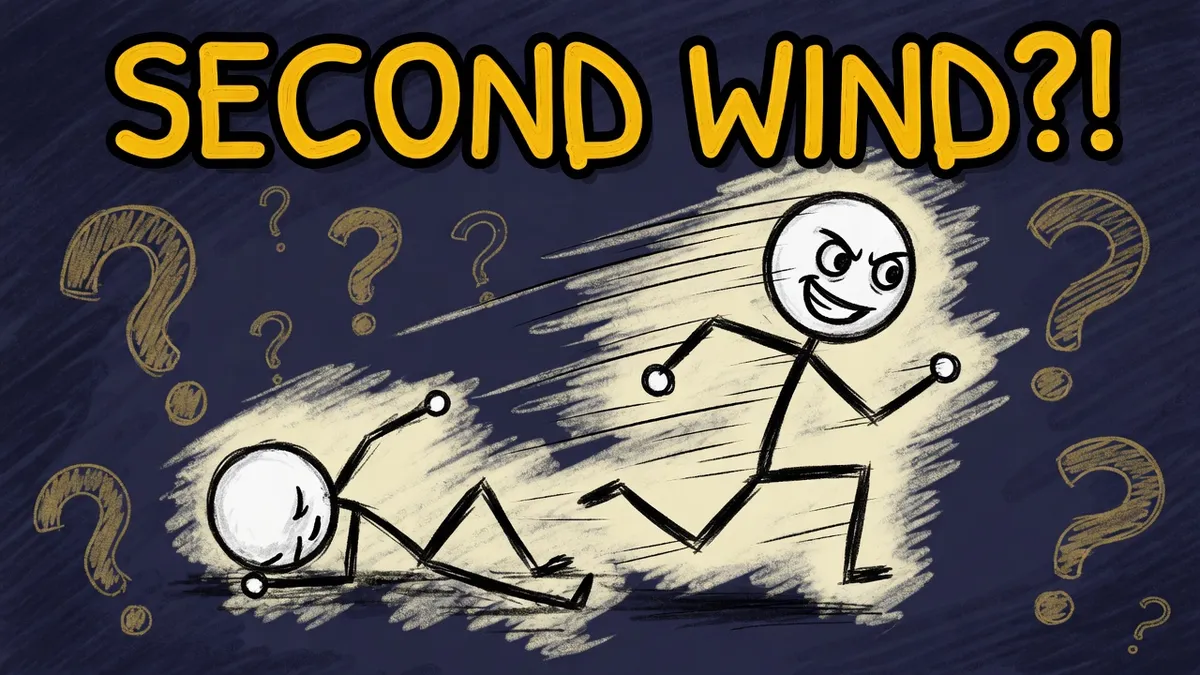
Everyone who has run for a bus knows the feeling, even if they have never had a name for it. The first minutes are miserable: your chest heaves, your legs feel like they belong to someone heavier, and every part of you is filing a complaint. And then, if you keep going, it lifts. The breathing settles, the heaviness drains away, and you drop into a rhythm that feels like you could hold it forever. We call it a second wind. And here is the genuinely surprising thing: for a phenomenon this famous, science is remarkably unsure what it actually is.
01 · The feelingWhat people actually report
Strip away the folklore and the reports are consistent. There is an early phase of breathlessness and heaviness, a sense that your body is not keeping up, and then a fairly distinct transition into comfort. The effort does not necessarily drop; what changes is how it feels. Suddenly the same pace is manageable, even pleasant.
That is about as far as the confident description goes, because the second wind in healthy people has barely been put under a microscope. It is subjective, it is hard to trigger on demand in a lab, and it varies wildly from person to person. So most of what follows is a set of plausible mechanisms, each one reasonable, none of them fully pinned to the vivid thing you feel on the road. It is worth being honest about that up front.
02 · The oxygen lagYour engine is running two minutes behind
This is the best-supported piece, so start here. When you suddenly start exercising, your muscles need energy immediately, but the aerobic system that supplies it steadily, the one that burns fuel with oxygen, does not switch on at full power instantly. It ramps up over a couple of minutes. Measured directly, oxygen uptake climbs gradually and only approaches the rate the exercise actually demands after roughly two to three minutes.
During that gap, your body has to cover the shortfall with anaerobic metabolism, the fast but messy backup system, and you build up what physiologists call an oxygen deficit. That is a lot of what the early misery is: you are running partly on your emergency generator while the main power plant spins up. Once aerobic metabolism catches up to demand, the deficit stops growing, the backup system eases off, and the whole thing settles. Tellingly, fitter people reach that steady state faster, which is one reason their rough early patch is shorter and gentler.
03 · Warming throughMuscles that work better warm
A second, plausible contributor is simply that you are warming up in real time. As those first minutes pass, working muscle heats up, blood vessels widen to deliver more blood, and the enzymes that run your energy metabolism speed up as their temperature rises. All of that should make the machinery run more smoothly and make a given pace feel easier.
It is a sensible idea and it fits the physiology neatly. The honest caveat is that “warming up helps” is well established in general, while the specific claim that this is what produces the sudden second-wind sensation has not been cleanly isolated and tested in healthy exercisers. It is a good candidate, not a proven cause.
04 · The chemistryAnd no, it is probably not endorphins
People often reach for brain chemistry to explain why exercise can suddenly feel good, and the reflex answer is endorphins. Here is where a popular fact quietly fell apart. Endorphins are large molecules, and large molecules cross the blood-brain barrier poorly, so a rise in endorphins in your blood may not do much to your brain at all. The tidy “runner’s high equals endorphins” line is now widely doubted.
The better current candidate is a different class of molecules, endocannabinoids, your body’s own versions of the active compounds in cannabis, which are small enough to reach the brain. A 2015 study found that blocking cannabinoid receptors removed the calm, pain-dulled state that running produced in mice, while blocking endorphins did not. That is a strong hint, but it is worth saying clearly: it was done in mice, and the human story is still unsettled. And in any case this is really about the mood shift of a runner’s high, which overlaps with, but is not the same as, the effort-easing of a second wind.
For all the hand-waving about the second wind in healthy runners, there is exactly one place it is documented with hard, reproducible science. And it belongs not to elite athletes, but to people with a rare muscle disease.
05 · The real oneThe second wind that is genuine textbook science
In medicine, “second wind” is not a vague feeling. It is a precise, classic sign of a condition called McArdle disease, or glycogen storage disease type V. People with it are missing an enzyme their muscles need to break down glycogen, their stored carbohydrate, so at the start of exercise their muscles cannot reach their main fuel and they fatigue fast, with pain and cramping.
And then something dramatic happens. After roughly 6 to 10 minutes, often around the eight-minute mark, the symptoms lift suddenly and measurably: heart rate drops, perceived effort falls, and exercise that was impossible becomes manageable. The reason is well worked out. In those first minutes the body mobilises other fuels, glucose released from the liver and free fatty acids from fat stores, and delivers them through the blood to the muscle, bypassing the enzyme block. It is so reliable that clinicians use it to help diagnose the disease. This, and really only this, is the second wind as rigorous, repeatable science.
06 · The healthy caseBorrowing a disease's word for a vaguer feeling
So what does that mean for you, sprinting for the bus with perfectly ordinary muscles? It means the word you are using was borrowed. Your enzymes work fine; you are not bypassing any block. Whatever eases for you in those early minutes is most likely the oxygen system catching up, your muscles warming, and your breathing finding its rhythm, a gentler, blurrier version of a switch than the sharp metabolic flip a McArdle patient feels.
That is not to say your second wind is imaginary. The oxygen-deficit part is real and measured, and the sensation of relief is real too. It is only to say that the crisp, well-evidenced phenomenon and the everyday one you feel are not quite the same thing, and that anyone claiming to know exactly what happens in a healthy runner’s second wind is going further than the evidence allows.
07 · The payoffSo why do you get a second wind?
The most likely everyday answer is undramatic: for the first couple of minutes your aerobic engine is running behind, you are partly on anaerobic backup, and it feels bad. As oxygen delivery catches up, your muscles warm, and your breathing steadies, the struggle fades and you settle into a rhythm. There may be a mood lift layered on top from brain chemistry, though probably not the endorphins you have been told about.
But the real story is the twist in the tail. The single best-documented second wind in all of physiology does not belong to marathoners or footballers. It belongs to people with a rare inherited muscle disorder, for whom that eight-minute turnaround is not a nice feeling but a reliable, diagnosable sign. It is a small, humbling lesson about how science works: the phenomenon everybody talks about is the one we understand least, and the one almost nobody has is the one we can prove.
Quick questions
What is a second wind?
The common experience of pushing through an early phase of breathlessness and heavy legs, then feeling exercise suddenly become easier and more rhythmic, as if fresh energy arrived. It usually shows up in the first several minutes of sustained effort.
Is a second wind a real physiological thing?
Parts of it are well understood, and parts are surprisingly thin on evidence. The lag between exercise starting and your aerobic system catching up is real and measurable. But the vivid, sudden 'second wind' as people describe it in healthy exercisers is not well characterised in the research. The one setting where it is rigorously documented is McArdle disease.
How long until you get your second wind?
Anecdotally, in healthy people it tends to arrive somewhere in the first 5 to 15 minutes. In McArdle disease, where it is properly measured, it appears fairly reliably after roughly 6 to 10 minutes of continued activity.
What causes the early breathlessness before a second wind?
At the start of exercise your muscles need energy faster than oxygen delivery can supply it. Your body borrows from anaerobic metabolism to cover the gap (the 'oxygen deficit'), which feels hard and breathless until oxidative metabolism ramps up to meet demand.
Does everyone get a second wind?
Not reliably, and not in the same way. Because the sensation is subjective and poorly studied in healthy people, how often it happens and how strong it feels varies a lot. Some people describe it vividly; others never notice a distinct switch.
Is a second wind the same as a runner's high?
No. A second wind is mainly about effort suddenly feeling easier, and is best explained by metabolism and breathing settling. A runner's high is a mood change, euphoria and reduced pain, tied to brain chemistry. They can overlap in time but they are different phenomena with different explanations.
Is a runner's high caused by endorphins?
That is the popular story, but it is now doubted. Endorphins are large molecules that do not cross the blood-brain barrier well, so blood levels may not explain a brain effect. A 2015 mouse study pointed instead to endocannabinoids, which can reach the brain. In humans the full picture is still unsettled.
What is the second wind in McArdle disease?
McArdle disease (glycogen storage disease type V) blocks the muscle from breaking down its own glycogen. Patients hit early fatigue, then, after about 6 to 10 minutes, feel a dramatic, well-documented second wind as blood-borne glucose and fatty acids reach the muscle and bypass the block. It is the clearest, most reproducible second wind in medicine.
Does warming up help you reach a second wind faster?
Plausibly, yes. Gentle early activity warms the muscles, widens blood vessels and speeds up the enzymes of energy metabolism, which should smooth the transition. It is a sensible idea and consistent with the physiology, though the specific claim that it triggers a 'second wind' has not been cleanly tested in healthy people.
Why does my breathing suddenly get easier during exercise?
Early on, your breathing and heart rate are still climbing to match the work, which feels laboured. As oxygen delivery catches up with demand and your breathing finds a steady rhythm, the sense of struggle fades. That settling is a real part of what people call a second wind.
Can you train to get a second wind sooner?
Fitter people reach aerobic steady state faster (their oxygen uptake kinetics are quicker), so the early struggle is shorter and milder. In that sense training can shrink the rough patch, even if the dramatic 'second wind' feeling itself is not a trainable switch.
Is second wind the same as getting past 'the wall'?
No, they are almost opposites in timing. A second wind comes early, in the first several minutes. 'Hitting the wall' comes late in long endurance events, when glycogen runs low. Confusingly, both involve a shift toward burning fat, but they are different moments with different causes.
Take the quiz on this
A quick 4-question check on what you just read. Get them right to earn XP: no points for just scrolling.
Our sources 8 checked
// every claim on this page was checked before it went up