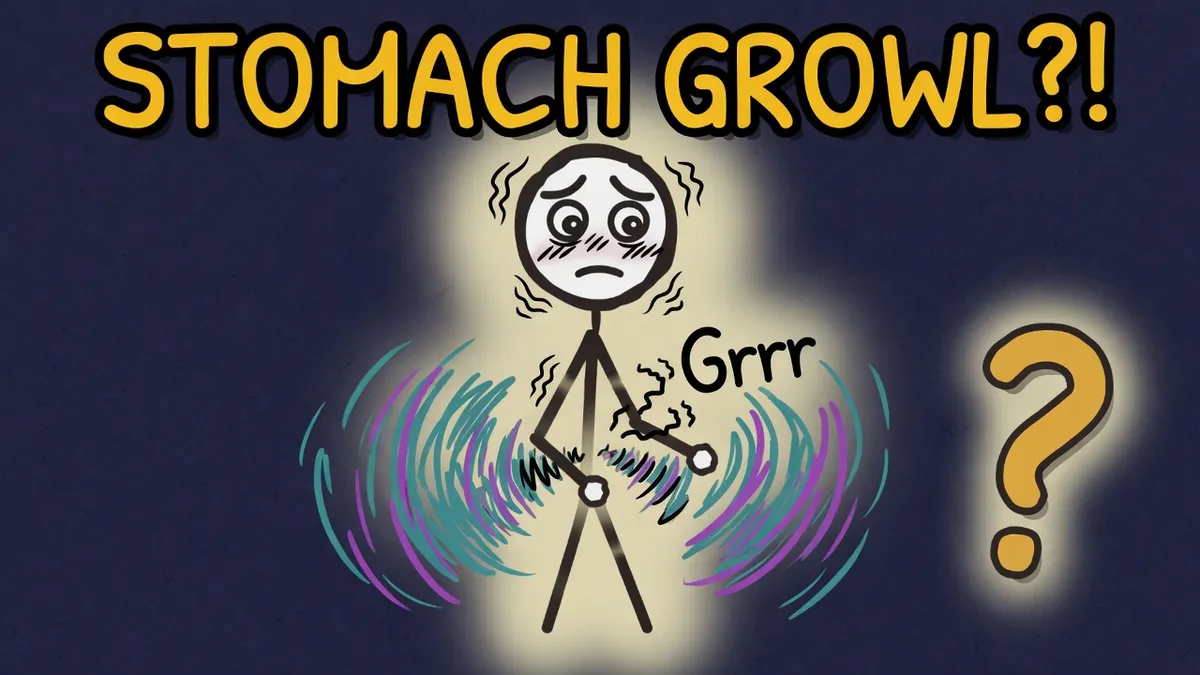
You know the exact moment. A silent room, a quiet meeting, a library, that dead pause in a conversation, and then, from somewhere deep inside you, an enormous, rolling growl. Loud enough that everyone hears it. And it always seems to strike when you're hungry and it's quiet. But here's the strange part: that noise usually isn't your stomach asking for food at all. It's something else entirely, and it's loud for a reason that has nothing to do with hunger.
01 · The soundIt has a gloriously silly name
The noise is called borborygmi, a real medical word, from a Greek term for rumbling, that basically sounds like the thing it describes. And the mechanism behind it is surprisingly plain. Your gut is one long, muscular tube, and it’s constantly squeezing itself in slow waves to push its contents along, a process called peristalsis. That growl is simply the sound of gas and liquid being squeezed and sloshed through those tubes. It’s happening all the time, quietly, whether you’ve just eaten or not. So the real question was never “why does it happen?” It’s “why does it get so loud when you’re empty?”
02 · The acousticsAn empty gut echoes like a pipe
The first reason is pure physics. When your stomach is full, all that soft, solid food acts like a sponge: it absorbs and muffles the sounds coming from inside, the way furniture and carpet deaden a room. But when you’re empty, that tube is mostly just air and liquid, with nothing to soak up the noise. So the exact same gurgle suddenly echoes and resonates, like a drum or a hollow pipe. The gut isn’t necessarily doing anything different. It’s just that there’s no longer anything in there to keep the volume down.
03 · The housekeeping waveA cleaning cycle that only runs empty
The second reason is the lovely one. When your stomach has been empty for a while, your gut switches on a special program that scientists genuinely call the “housekeeping wave.” Its formal name is the migrating motor complex, a big, powerful sweep of muscle contractions that travels all the way down from your stomach through the small intestine, from top to bottom. And crucially, this wave only runs when you’re not digesting a meal. The moment you eat again, it switches off and the ordinary digestive machinery takes over. So those strong, rolling contractions between meals are, quite literally, your gut cleaning house.
04 · The timerThe hormone that sets the schedule
The whole thing runs on a clock, and the clock is a hormone called motilin. When you haven’t eaten for a while, motilin levels climb, and roughly every 90 minutes or so (the interval varies, and can stretch out to a few hours) they trigger another one of these big cleaning sweeps. Which is exactly why an empty stomach seems to rumble on a schedule between meals, and often at its loudest at night, when there’s genuinely been nothing to digest for hours and the room is silent enough to hear the whole performance.
That embarrassing growl in the silent meeting almost certainly wasn't your stomach begging for food. It was a scheduled clean-up, the sound of your gut vacuuming out the leftovers, announced loudly at the worst possible moment.
05 · What it's really doingCleanup, not a food alarm
This completely flips what the growl means. It isn’t your stomach desperately signalling that it needs feeding. It’s a maintenance run. Those powerful waves are scrubbing the tube out, bits of undigested food, dead cells and stray bacteria all swept downstream and out, keeping everything clean and ready for the next meal. And this housekeeping genuinely matters: that regular sweep is one of the things that stops bacteria from sitting around and overgrowing in the small intestine. When the cleaning wave doesn’t work properly, people can end up with exactly that problem, an overgrowth condition doctors call SIBO. So the rumble of an empty stomach is, in a real sense, the sound of essential upkeep.
06 · The exceptionSometimes it really is hunger
Now, that isn’t the whole story. Your gut can also jump the gun. Catch the smell of lunch, walk past a bakery, or even just think hard enough about food, and your brain sends an advance order to your stomach, a reflex called the cephalic phase. It starts churning and contracting in anticipation, before a single bite has arrived. So on those occasions, the growl really is a hungry one: your digestive system revving up for a meal it’s expecting. But that’s the minority case. Most of the time, the noise is the housekeeping wave, not the hunger reflex.
07 · The payoffSo what is a growl, really?
Most of the time, that mortifying rumble in the silent room isn’t hunger at all. It’s your gut quietly vacuuming itself out, running its regular cleaning cycle exactly as it’s supposed to. And the only reason you can hear it so clearly, the only reason it’s so gloriously, cheek-reddeningly loud, is that there’s nothing left inside to muffle the sound. It’s not an alarm. It’s maintenance, doing its job, and simply making itself heard because the room, and you, are both empty.

The animated version
Same answer, told as a little animated story with the strange little stickman acting it out. Dry, quick, and, obviously, correct.
Quick questions
Why does my stomach growl when I'm not hungry?
Because the growl isn't really a hunger signal: it's the sound of your gut moving gas and liquid around, which it does constantly, whether or not you need food. Between meals your gut also runs a 'housekeeping' cleaning wave, and an empty gut is just louder because there's nothing inside to muffle the noise.
What is the medical name for stomach growling?
Borborygmi (singular: borborygmus), from a Greek word for rumbling. It's the sound of gas and liquid being pushed through your gastrointestinal tract by peristalsis, the wave-like squeezing of the gut muscles.
Why is my stomach louder when it's empty?
Two reasons. First, acoustics: a full gut is packed with soft, solid food that absorbs and muffles the sound, while an empty gut is mostly air and liquid, so it echoes like a hollow pipe. Second, the gut runs its 'housekeeping wave' of strong contractions only when you're empty, and those are the loud ones.
What is the migrating motor complex?
It's the gut's cleaning cycle, a wave of muscle contractions that sweeps from the stomach through the small intestine, but only during fasting. It clears out undigested food, debris and bacteria between meals. Because it runs when you're empty, it's a big part of why the empty-stomach growl is so loud.
Is a growling stomach always a sign of hunger?
No. Most of the time it's just normal digestion or the between-meals cleaning wave, audible only because the gut is empty. But it can be hunger-linked too: the sight, smell or even thought of food can trigger your gut to start contracting in anticipation before you take a bite.
How do you stop your stomach from growling?
The quickest fix is to put something in the gut: a small snack, or a slow glass of water, gives the contractions something to muffle and often settles the noise. Longer term: eat slowly and chew well (so you swallow less air), and ease off on things that tend to crank up gut noise, like fizzy drinks, alcohol, and very sugary or acidic foods. And because an empty gut is the loudest gut, regular smaller meals beat long gaps.
Why does my stomach growl right after I eat?
That's just digestion at work. Once food arrives, your gut muscles start squeezing it along, the same peristalsis that makes noise on an empty stomach, while gas and liquid churn through with it. Post-meal gurgling is completely normal and usually a sign the system's running fine. Louder-than-usual noise afterwards often comes from swallowed air, fizzy drinks, or foods that produce more gas.
Can a growling stomach be a sign of something wrong?
Usually not: on its own, a loud or frequent growl is almost always harmless digestion or the between-meals cleaning wave. It's worth getting checked when the noise comes bundled with other symptoms: persistent abdominal pain, bloating, diarrhoea or constipation, unexplained weight loss, vomiting, or blood in the stool. Those can point to things like IBS, an infection, or (rarely) a blockage, at which point the growl itself is the least of it.
Does drinking water stop a growling stomach?
It can, briefly. Water gives the gut something to move and helps damp the resonance of an empty, echoey tube, so a slow glass often quiets a rumble for a while, though it won't hold it off as long as actual food will. Sipping steadily through the day tends to work better than gulping a lot at once, which can add swallowed air and, ironically, more noise.
Why is my stomach growling so loudly and often?
Most often it's simply an empty, echoey gut running its regular between-meal contractions, nothing more. Swallowed air, fizzy or sugary drinks, and easily fermented foods can all turn up the volume, and stress or anxiety can rev up gut activity too, which is why nerves before a big moment sometimes come with an audible stomach. Loud and frequent on its own is normal; loud plus pain, bloating or changes in your bowel habits is worth a doctor's look.
What is borborygmi?
The medical name for gut rumbling. It is the sound of gas and liquid being pushed through the digestive tract by peristalsis. An empty gut is louder because there is little solid food to muffle the vibrations, so the tube echoes.
Can stress make your stomach growl more?
Yes. Anxiety and stress can ramp up gut motility via the brain-gut axis, so bowel sounds get more noticeable even when you are not hungry. Growling is not always a between-meal housekeeping wave; sometimes it is simply a nervous gut talking.
Take the quiz on this
A quick 4-question check on what you just read. Get them right to earn XP: no points for just scrolling.
Our sources 10 checked
// every claim on this page was checked before it went up