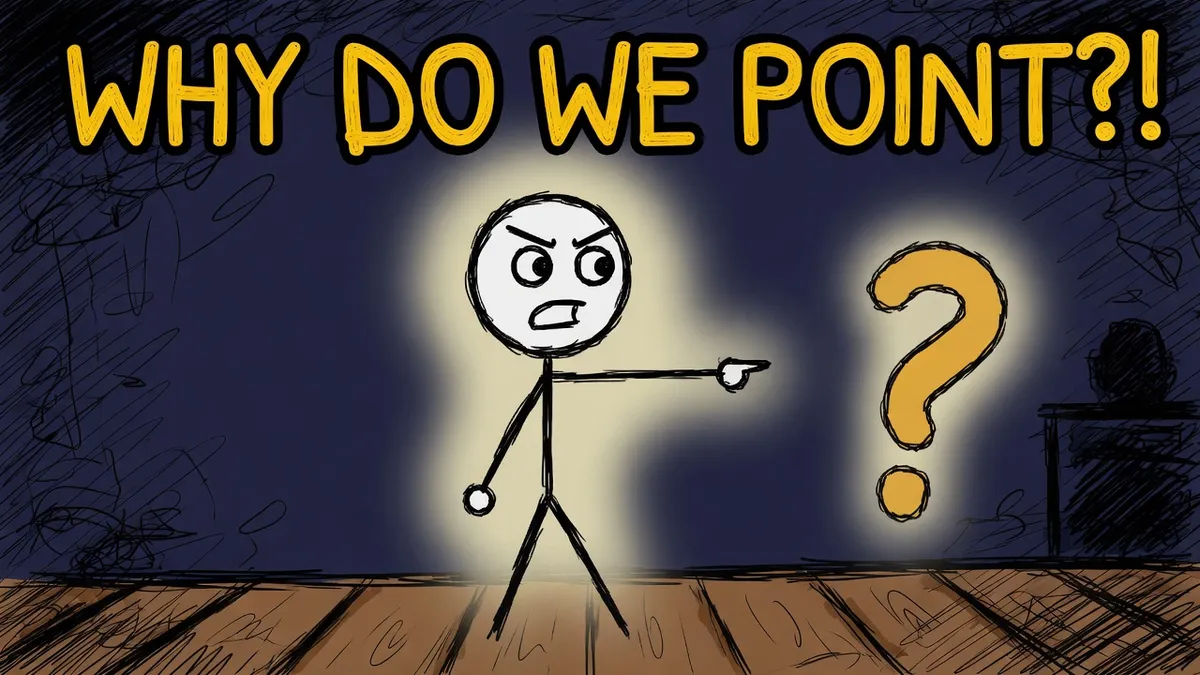
Watch a baby who cannot yet say a single word. Something catches their eye, a dog, a plane, a balloon, and they lift one arm, extend a single finger, and then do the crucial thing: they turn and check your face. Not to get the thing. Not to be handed it. Just to make sure you are looking at it too. That tiny loop, look at that, then did you see it too, is so ordinary that it slips past unnoticed. It is also one of the strangest and most important things our species does, and almost no other animal on Earth does it at all.
01 · The gestureA finger, before a word
Pointing is the first real conversation a human ever has, and it happens before language shows up to take the credit. Somewhere around 9 to 14 months, well before their first words, babies start extending that index finger at things. It is not a fluke of one culture or one parenting style: the canonical index-finger point appears at roughly the same age in societies as different as rural Papua New Guinea, Peru, Japan and Canada. Attempts to train younger babies to point tend to fail. It arrives on its own schedule, like teeth. When something universal shows up on a fixed timetable across the whole species, that is biology talking, not tutoring.
02 · The two kindsGive me that, versus look at that
Here is the distinction that turns pointing from a cute trick into a profound one. There are two reasons to point. One is imperative: you point at the cookie because you want the cookie, and you are using a nearby human as a tool to get it. Plenty of animals can manage something like this. The other is declarative: you point at the passing dog purely so the other person will look at it too, and share the moment with you. There is no cookie at the end of a declarative point. The reward is the sharing itself. Human babies do this early, lavishly, and for its own sake, which is genuinely peculiar. It means the baby is not just after an object. The baby wants your mind pointed where their mind is pointed.
03 · The ape gapWhy our closest relatives don't do it
You would expect chimpanzees, who share almost all of our DNA and gesture to each other constantly, to point. They basically don’t. Wild great apes essentially never point for one another, and they do not point declaratively to simply share interest, ever. Captive apes raised around humans sometimes learn to point, but almost always to demand something from a person, the imperative kind. The gap is not about fingers or intelligence. It seems to be about motivation. The psychologist Michael Tomasello frames the ape’s default social stance as competitive rather than cooperative, so the whole idea of “let me draw your attention to something, just so we can both enjoy it” is not part of their world. They can gesture. They do not, it seems, feel the pull to point.
04 · The deep reasonTwo minds, one thing
So what is pointing actually for. The answer is a mouthful with a simple heart: shared intentionality. It is the very human ability, and the very human urge, to lock two minds onto the same thing at the same time and think about it together. When a baby points at a ball and glances at your eyes to confirm you saw it, they are performing an act of joint attention: we are both attending to this, and we both know we are. That, and not vocabulary, is the true bedrock of language. A word is only useful if you and I can first agree on what we are both looking at. Pointing is that agreement, made flesh, before a single word exists to sit on top of it. It comes bundled with its mirror image, gaze-following: infants start tracking where you look and point at exactly the same age they begin pointing themselves. Look here, and follow my look. The same machine, running both ways.
05 · The predictionThe finger foretells the words
If pointing really is language wearing a hand instead of a mouth, then early pointing should predict later talking. It does, with almost unsettling reliability. How much a baby points at around 12 months forecasts how big their vocabulary will be many months, and even years, down the line. In one body of work, index-finger pointing at a year old accounted for something like a fifth of the variation in how many words children understood and produced at two, and still tracked their sentence skills at five and six. Flip it around and the signal is clinical: a one-year-old who points very little is at raised risk of later language delay, which is why “is your baby pointing yet?” is a real question on developmental checklists, not small talk.
Put a human point in front of a chimpanzee and it often fails to follow it. Put the same point in front of a household dog, and it usually gets it right away, roughly matching a human one-year-old. Our closest relative loses a mind-reading contest to a spaniel.
06 · The dog twistBeaten by a spaniel
This is the part that reliably breaks people’s expectations. In the “object choice” task, a person hides food under one of two cups, then points at the correct one. Human toddlers pass easily. Chimpanzees, our nearest kin, tend to flunk it. And dogs, who split from our lineage tens of millions of years ago, sail through, often as well as a one-year-old child. The favoured explanation is domestication. Over thousands of years of living alongside us, dogs were shaped to read our cooperative signals, to assume that a human gesturing at them is trying to help, not compete. Puppies show the skill early, before much training, which points to something bred-in rather than merely learned. A chimp, brilliant as it is, does not start from the assumption that you are on its side. A dog does. Cooperation, it turns out, is the whole secret of the point.
07 · The payoffSo why do we point?
Because we are the animal that wants to think together. A point is the smallest possible act of that wanting: I have noticed something, and I would like your mind here, next to mine, looking at it too. Babies reach for this before they can name anything, every culture invents it on the same schedule, and the strength of the reflex quietly predicts the words that follow. Our closest relatives, for all their cleverness, barely do it, while a dog on the sofa reads it in a heartbeat. That single lifted finger is not really about the bird, or the balloon, or the cup with the treat. It is about the extraordinary, almost invisible human assumption underneath it: that if I show you what I see, you will want to see it too.
Quick questions
At what age do babies start pointing?
The canonical index-finger point emerges at roughly 9 to 14 months, and is reliably in place by around a child's first birthday. It shows up at about the same age across a wide range of very different cultures, which is a strong sign it's built in rather than taught.
What's the difference between declarative and imperative pointing?
Imperative pointing is a request: point at the cookie so someone gets it for you. Declarative pointing is sharing: point at the dog so someone else looks at it too, for no reward beyond the shared moment. The declarative kind is the developmentally special one, because it means the baby is treating you as a mind with its own attention.
Do animals point?
Almost none do, at least not the way humans do. Great apes in the wild essentially never point for one another. Captive apes raised around humans sometimes point, usually to demand something (imperative), but declarative 'look at that together' pointing is very close to a human-only behaviour.
Why can't chimpanzees understand pointing?
In the classic 'object choice' test, a human points at one of two containers hiding food. Human toddlers and pet dogs use the point easily, but chimpanzees, our closest relatives, tend to fail. The leading idea is motivational: apes' default read of a social situation is competitive, so they don't assume a helpful, cooperative 'I'm telling you where it is' intent behind the gesture.
Is pointing really unique to humans?
Near-uniquely, yes, especially declarative pointing to share attention. It's one of the cleanest behavioural lines between us and other apes. There are rare, contested reports of wild chimps gesturing to draw a companion's attention to something, so 'never' is a slight overstatement, but as an everyday, universal, share-for-sharing's-sake gesture, pointing is a human signature.
Why is pointing a big deal for language?
Because it's the same trick language needs: two minds agreeing to attend to the same thing at the same time, so a signal can refer to it. That's called joint attention or 'shared intentionality.' A baby pointing at a ball and checking your face is running the whole machinery of reference before they have a single word to put on it.
Does pointing predict how well a child will talk?
Strikingly, yes. How much and how a baby points at around 12 months predicts their vocabulary size months and even years later. In one line of work, index-finger pointing at 12 months explained roughly a fifth of the variation in word comprehension and production at 24 months. Fewer points at a year old is a recognised early flag for possible language delay.
What is gaze-following?
It's the flip side of pointing: following where someone else is looking (or pointing) to work out what they're attending to. Infants start reliably following another person's gaze and points toward the end of their first year, right as they begin pointing themselves. Pointing and gaze-following are two halves of the same 'let's look at the same thing' system.
Why do we use the index finger to point?
The extended-index-finger shape is the human default and appears across cultures, though some cultures also point with the lips, chin, or a full hand. The precise index point seems to carry more communicative sophistication than a whole-hand reach: babies who use the crisp index point tend to be further along communicatively.
Do dogs understand pointing?
Remarkably well, often better than chimpanzees. Point at one of two cups hiding a treat and most dogs go straight to the right one, a skill roughly on par with a human one-year-old. It appears early in puppies and looks like a product of domestication: dogs have been shaped to read cooperative human signals.
What is 'shared intentionality'?
It's the psychologist Michael Tomasello's term for the distinctively human ability and drive to share mental states, to jointly attend to and think about the same thing with someone else. He argues it's the cognitive foundation that let human language, culture, and large-scale cooperation get off the ground, and pointing is its earliest visible sign.
When should I worry if my baby isn't pointing?
Pointing to share interest (declarative pointing) usually appears by around 12 to 15 months, and its absence by roughly 15 to 18 months is one of the recognised early signs worth mentioning to a paediatrician, as reduced pointing can be associated with language delay and is part of some autism screens. It's a flag to check, not a diagnosis on its own.
Did apes ever learn to point?
Captive apes with heavy human contact do sometimes point, typically to request things from people rather than to share attention with other apes. This suggests the capacity isn't wholly absent, but the spontaneous, cooperative, everyone-does-it pointing seen in human babies is not part of natural ape life.
Is pointing rude in some cultures?
Pointing at people with the index finger is considered rude or aggressive in many cultures, which is why lip-pointing, chin-pointing, or open-hand gestures are common alternatives. The underlying impulse to direct attention is universal even where the polite form of it varies.
Take the quiz on this
A quick 4-question check on what you just read. Get them right to earn XP: no points for just scrolling.
Our sources 9 checked
// every claim on this page was checked before it went up