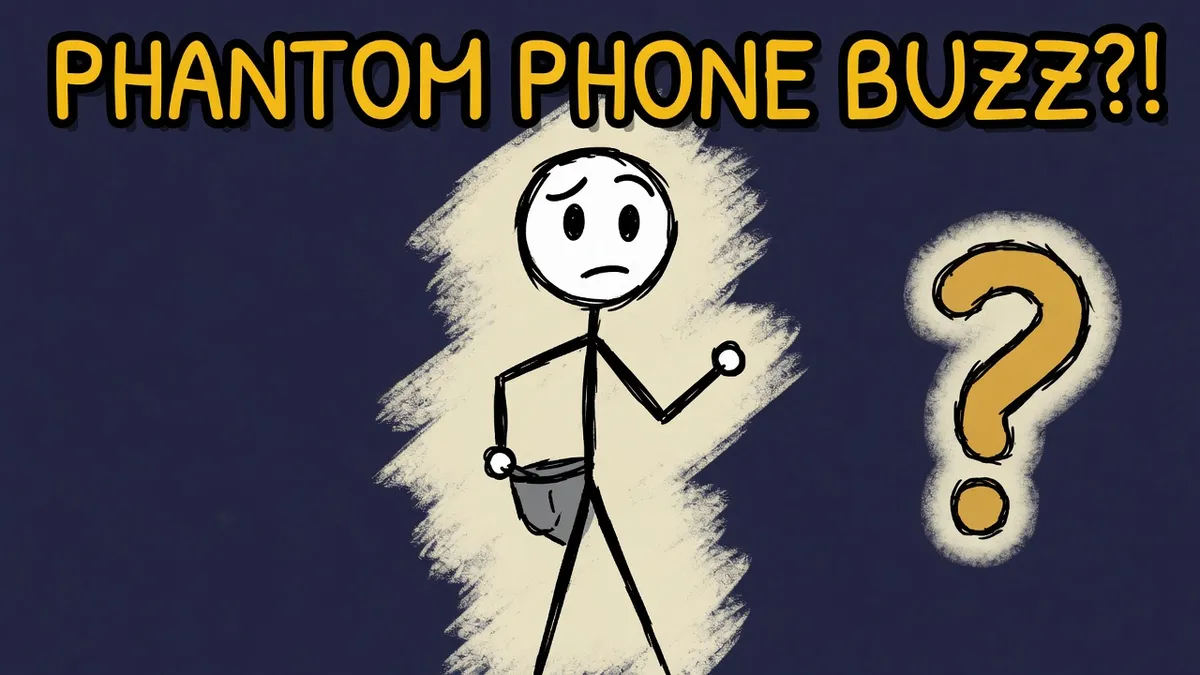
Here is a small everyday haunting. Your thigh buzzes, unmistakably, the exact double-tap of a message arriving. You reach for your phone. Nothing. No message, no call, no missed anything. The screen is dark and the phone, it turns out, was on silent the whole time, or in your bag, or in the next room. Something moved, your brain was certain of it, and it was certain it was the phone. It wasn't. So what actually happened, and why does it happen to almost everyone?
01 · The phenomenonThe buzz that never happened
It has a slightly overdramatic name, phantom vibration syndrome, but the experience is mundane and near-universal: the strong, specific feeling that your phone just vibrated, when it absolutely did not. The tell is that it doesn’t need the phone to be in your hand, or even on you. People report it from phones on silent, phones on the desk, phones in another room, and sometimes from no phone at all. Whatever is producing that buzz, it isn’t the device. It’s you.
02 · The numbersAlmost everyone, it turns out
This isn’t a fringe glitch that happens to a jittery few. When Michael Rothberg surveyed hospital staff in 2010, in the first formal study of the thing, 68% said they’d felt phantom vibrations. Two years later, Michelle Drouin’s study of 290 undergraduates put the figure at a startling 89%. Across the wider research the number tends to land somewhere between two-thirds and nine in ten of the people asked. Roughly speaking: if you own a phone that buzzes, you have probably felt it buzz when it didn’t.
03 · The mechanismYour brain is guessing, constantly
Here is the piece that makes it click. You tend to imagine perception as a camera: the world comes in through your senses and you experience it as it is. That’s not how brains work. Your brain is a prediction machine. It builds a running model of what it expects to sense next and checks incoming signals against that guess, spending far more effort on the prediction than on the raw data. Most of what you “feel” at any moment is your brain’s best-guess model, lightly corrected by reality.
Now feed that machine a phone. Carry a buzzing device in the same pocket for months and your brain learns a rule: this patch of my body is where notifications live. It starts monitoring that spot and lowers the bar for what counts as a buzz there. So when an ambiguous little signal arrives, a muscle twitch, your trousers shifting as you move, a random nerve firing, a passing itch, the brain runs it through its expectation and returns its most probable answer: notification. It fills in the rest, the double-tap, the certainty, all of it, from the model. The buzz feels real because, as far as your perception is concerned, it is.
04 · The primingWhy waiting makes it worse
If perception is expectation-driven, then anything that cranks up your expectation should crank up the phantom buzzes, and it does. The technical idea is a perceptual set: a state of readiness that biases what you’re likely to perceive. When you’re waiting on an important reply, or on call, or just anxiously wondering whether someone’s texted back, your brain raises its vigilance for a buzz. A more vigilant detector catches more real signals, but it also throws more false alarms, and a phantom vibration is exactly that: a false alarm from a system tuned to miss nothing. The more you want the phone to buzz, the more it will seem to.
The phantom buzz isn't a malfunction. It's your brain being too good at prediction: it has learned the buzz so well that it can produce the whole sensation from almost nothing, no phone required.
05 · The people who feel them mostAttachment, not madness
There’s a gentle pattern in who gets them more. Studies find that people higher in attachment anxiety, the disposition to care a lot about staying connected and to worry about missing a message, report phantom buzzes more often. This makes tidy sense under the prediction model: if being reachable matters intensely to you, your brain assigns the incoming-message prediction a high priority and watches for it harder, and a harder-watching brain finds more phantoms. It’s worth being clear about what this is not. It is not evidence of a mental illness, and it is not nerve damage. It’s a learned habit of a normal brain doing normal, expectation-driven perception, tuned by how much you happen to rely on the thing in your pocket.
06 · The payoffSo why do we feel them?
Because your brain would rather guess than wait for proof, and it has learned to guess “phone” from the faintest hint. A phantom phone buzz is not a sign that something is wrong with you: it’s a small, honest demonstration of how perception actually works, prediction first, reality second, running quietly under everything you feel. It faded in with pagers, spread with vibrate mode, and it will follow whatever we clip to ourselves next. Rothberg found that most people can shrink it by turning off vibrate or changing where they carry the phone, but most don’t bother, because 93% of them found it barely worth noticing. The next time your leg buzzes over nothing, you can enjoy the truth: your phone did nothing at all. Your brain, being brilliant and slightly overconfident, did the rest.
Quick questions
Is phantom vibration syndrome a real medical condition?
Not really. It has a catchy name, but it isn't a recognised disease or disorder in any diagnostic manual. Researchers describe it as a normal perceptual quirk, closer to a common illusion than a syndrome. The word 'syndrome' stuck mostly because it sounds good in a headline.
How common are phantom phone vibrations?
Very. In the first formal study (Rothberg, 2010) about 68% of hospital staff reported them, and a 2012 study of undergraduates (Drouin) put it at 89%. Across the literature the figure usually lands somewhere between roughly two-thirds and nine in ten people, so if you feel them, you're firmly in the majority.
What actually causes the phantom buzz?
Your brain does. Perception isn't a passive recording of the world; the brain constantly predicts what it expects to sense and checks reality against that guess. Once you've learned that a certain patch of your body is where buzzes happen, an ambiguous signal there (a muscle twitch, fabric brushing skin, a stray nerve firing) gets interpreted as a notification, because that's the brain's best bet.
Do you have to be holding the phone to feel it?
No, and that's the giveaway. People report phantom buzzes when the phone is in a pocket, in a bag, on a desk, on silent, or in another room entirely. Sometimes there's no phone on them at all. The sensation is generated by the brain, not the device.
Why does it feel like it's coming from a specific spot, like my thigh?
Because that's where your phone usually lives. The brain learns the location that reliably delivers buzzes and starts monitoring it more closely, so ambiguous sensations there get flagged as buzzes more readily. It's the same reason the sensation tends to migrate if you switch which pocket you use.
Does it mean I'm addicted to my phone or anxious?
Not by itself. But there is a modest link: people who score higher on attachment anxiety, meaning they care a lot about staying reachable and worry about missing messages, tend to report phantom buzzes more often. It's less 'you have a problem' and more 'brains that watch harder for buzzes find more of them.'
Can phantom vibrations be a sign of nerve damage?
In the ordinary case, no. A phantom phone buzz is a perceptual misfire, not a nerve injury. Genuine nerve problems (persistent tingling, numbness, buzzing unrelated to phones, or in areas with no phone) are a different thing and worth getting checked, but the classic 'my leg buzzed and it was nothing' experience is benign.
How do you make phantom vibrations stop?
In Rothberg's study the things that worked best were taking the phone off vibrate, moving where you carry it, or switching devices. Roughly three-quarters who tried turning off vibrate found it helped. Realistically, most people just live with it, since 93% in that study found the buzzes not at all or only slightly bothersome.
Is it the same as phantom ringing (thinking you heard your phone)?
Close cousin. Phantom ringing, or 'ringxiety', is the auditory version: you're sure you heard a ping, ring or notification that never happened. Same underlying mechanism, an expectation-primed brain misreading an ambiguous input, just in sound rather than touch. Some people get one, some get both.
When did people start feeling phantom vibrations?
The sensation seems to track the technology. Early reports came from people carrying pagers, then it spread with mobile phones set to vibrate. Rothberg's 2010 study found most people started feeling phantom buzzes within a month to a year of carrying a vibrating device, which fits the idea that it's a learned habit.
Do phantom buzzes happen more when you're stressed or busy?
Often, yes. When you're anticipating an important message, waiting on a reply, or on call, your brain raises its vigilance for buzzes, which lowers the threshold for a false alarm. Heightened expectation is exactly the condition that produces more phantom hits.
Does everyone feel them the same way?
No. Frequency ranges from a rare oddity to several times a week, and some people say they've never felt one at all. The variation seems to track how much you rely on and monitor your phone, plus individual differences in how strongly your perception is driven by expectation.
Is there any harm in phantom vibrations?
Almost none. In the studies, the overwhelming majority of people rate them as not or only slightly bothersome. At worst they're a small nuisance and a reminder of how attached we are to being reachable. They don't damage anything and they don't signal that anything is wrong.
Take the quiz on this
A quick 4-question check on what you just read. Get them right to earn XP: no points for just scrolling.
Our sources 8 checked
// every claim on this page was checked before it went up