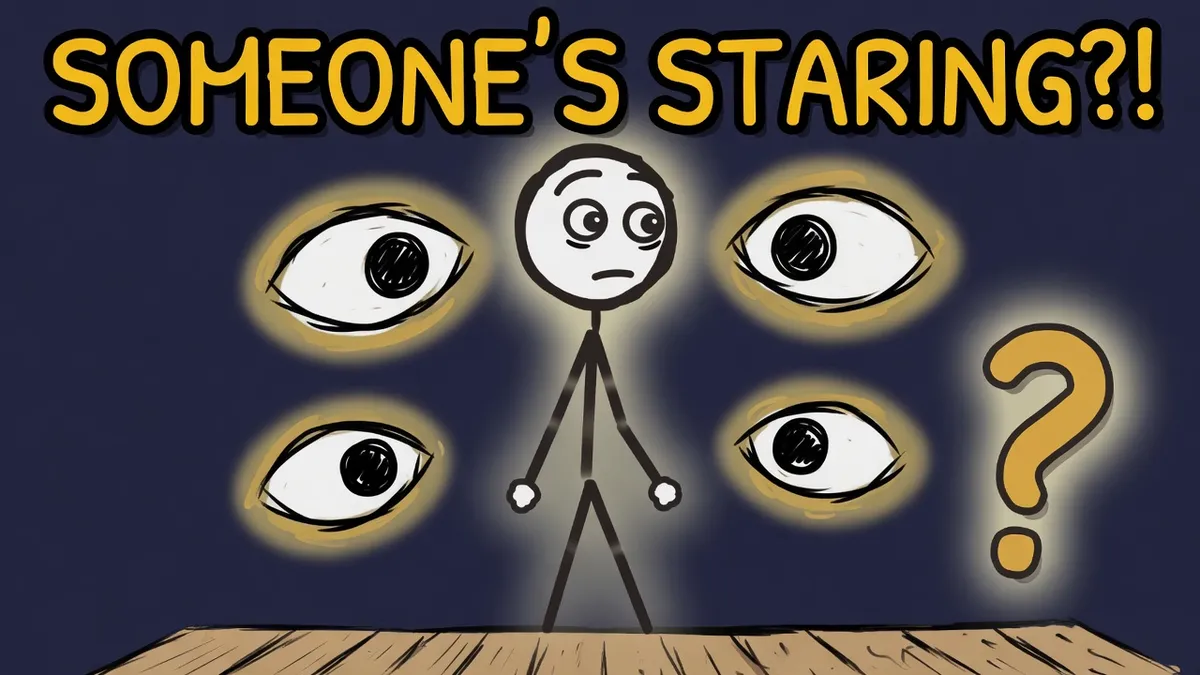
You're sitting somewhere ordinary, a café, a train, a waiting room, thinking about nothing in particular. And then, slowly, you feel it: that creeping prickle on the back of your neck, the unmistakable sense that somewhere behind you, someone is watching. So you turn. And there they are, looking straight at you. You were right. It happens often enough that it can genuinely start to feel like you've got a hidden radar for it. Which raises an awkward question: do you?
01 · The claimIt even has a proper name
The feeling is taken seriously enough to have earned scientific-sounding labels. The sense of being stared at is called scopaesthesia, and the claimed ability behind it is sometimes called the “psychic staring effect.” The interest goes back a long way: in 1898, the psychologist Edward Titchener published a note in the journal Science titled, plainly, “The Feeling of Being Stared At,” after students insisted they could feel an unseen gaze. So the obvious question is the one Titchener asked over a century ago. Is it real? Can you genuinely feel a stare you cannot see?
02 · The test1898, and a crushingly boring result
Titchener didn’t just wonder, he tested it. He had people try to sense when someone hidden was staring at them, and the results were, in his words, uniformly negative. People were no better than a coin toss at feeling an unseen stare. And rather than reach for the paranormal, he offered a tidy explanation: people turn around anyway; when they happen to catch someone looking, they remember it; when they don’t, they forget. The turning itself, he noted, can draw a nearby person’s eyes. In other words, the effect might be entirely in the bookkeeping.
03 · The rematchThe 55% that never held up
Much later, one researcher, Rupert Sheldrake, did claim to find a small effect, reporting hit rates around 55%, a whisker above the 50% you’d expect from pure guessing. It’s the number that gets quoted whenever someone wants to argue the sense is real. But his experiments were heavily criticised for how they were designed and run, and, the part that matters most, nobody else has been able to reliably reproduce them. When the psychologist Richard Wiseman repeated the test, he found nothing beyond chance. So the honest scientific answer, stacking the evidence together, is no: there’s no good support for a magic sense that reaches out behind you. And yet the feeling is completely, insistently real. So where does it actually come from?
04 · The real skillA lightning-fast detector for eyes
Here’s the first real piece. You are astonishingly good at detecting a gaze, as long as it lands anywhere in your field of view. Your brain has dedicated machinery for exactly this: a region called the superior temporal sulcus carries a remarkably fine code of gaze direction, working out very fast and automatically whether a pair of eyes has just locked onto you. In a crowd all looking away, the instant one face turns toward you, you catch it. That’s not a sixth sense. It’s an extremely good version of an ordinary one.
05 · The tellWhy human eyes give the game away
And there’s a lovely reason we’re so good at it. Look at a human eye: we have a large, bright white area, the sclera, surrounding the coloured iris. Almost no other primate does; most have dark eyes where the pupil and gaze direction are hard to read. Under what’s called the cooperative eye hypothesis, that white sclera evolved as a signpost, broadcasting exactly which way we’re looking so that we can follow each other’s attention and cooperate. It’s a leading idea rather than a settled fact, but experiments back the core of it: uniformly white sclera measurably improves how well others can read your gaze. We evolved eyes that are easy to read, and brains that are experts at reading them.
The moment you feel the prickle and turn to check, your own sudden movement catches everyone's eye, so people glance over right as you spin around. Your turn didn't catch them staring. Your turn created the stare.
06 · The leakSeeing without knowing you saw
Now, that gaze detector doesn’t only run in the sharp centre of your vision. A face turned toward you off to the side, or caught in a reflection, can register in your brain without you ever consciously clocking it. Studies of direct gaze show it’s processed preferentially, and sometimes entirely unconsciously, along fast pathways involving the amygdala. So a pair of eyes on you can trip the alarm below the level of conscious sight, and what leaks through into awareness is not “I saw a face” but a vaguer, sourceless hunch: someone’s looking at me. The information is real. It’s just arriving without a return address.
07 · The bookkeepingA memory that keeps only the hits
And your memory finishes the job. Think about all the times you’ve felt watched, turned, and found absolutely nobody there. You forget those instantly. They’re nothing. But the one time you turn and lock eyes with a stranger? That one burns in. I knew it. Over months and years you build a highlight reel of dramatic hits while the long, dull list of misses quietly evaporates. It’s the same confirmation bias Titchener pointed at in 1898, and it’s remarkably good at making a coin-flip feel like a superpower.
08 · The payoffSo can you feel someone staring?
Stack it all up. A hair-trigger detector for any eyes in your view. Eyes designed to be readable and a brain built to read them. Peripheral, half-unconscious signals that leak through as a vague feeling. A turn that summons the very stares it’s checking for. And a memory that keeps only the wins. You don’t have a sixth sense for being watched. That idea fails every honest test. What you have is a truly spectacular sense for eyes, running mostly beneath your awareness, plus a slightly flattering memory. Which, if anything, is the more impressive machine. You’re not psychic. You’re just extraordinarily good at noticing when someone is nosy, and so is everyone else, which is precisely why it works.
The animated version
Same answer, told as a little animated story with the strange little stickman acting it out. Dry, quick, and, obviously, correct.
Quick questions
Can you really sense when someone is staring at you from behind?
No, not in the way it feels. When scientists tested whether people could detect an unseen stare, results came out at chance, no better than guessing. The feeling is real, but it comes from ordinary perception and memory, not a hidden sense reaching out behind you.
What is the sense of being stared at called?
Scopaesthesia, or the 'psychic staring effect.' The psychologist Edward Titchener coined the interest in it back in 1898. Despite the fancy name, controlled experiments have never shown it to be a genuine extrasensory ability.
Why does it feel so accurate, then?
Three things stack up. Your brain detects any gaze within your visual field extremely fast, sometimes below conscious awareness. When you turn to check, your movement makes nearby people look at you. And you vividly remember the times you were right while forgetting the many times nobody was there, classic confirmation bias.
Why are humans so good at telling where someone is looking?
Because of our eyes. Humans have a large, bright white area (the sclera) around the coloured iris, which most other primates lack. Under the 'cooperative eye' hypothesis, this evolved to broadcast our gaze direction, and our brains have dedicated regions, including the superior temporal sulcus, tuned to read it.
Is scopaesthesia a real scientific thing?
The feeling is real and well-documented. The ability, sensing a stare you cannot see, is not supported by evidence. It's generally classed as a folk belief that controlled studies have failed to confirm.
Why do I feel like I'm being watched when I'm alone?
When there's genuinely no one there, there are no eyes to detect, so the feeling is your threat-detection system firing on ambiguous cues: a creak, a shadow at the edge of vision, the dark. It runs hotter when you're anxious, sleep-deprived, or fresh off a horror film, a state psychologists call hypervigilance. An occasional creepy prickle in an empty room is normal, and not a sign of psychosis. It's worth talking to someone only if it becomes constant, distressing, or hardens into a fixed conviction that you're truly being watched.
Why do I sense someone standing behind me?
Usually because your brain is picking up faint signals you never consciously notice, a shift in ambient sound, a change in air movement, a shadow, even smell, and flags 'presence' before you can say why. It can be uncannily accurate, but it's ordinary perception running below awareness, not a stare-detector in the back of your skull. Tested on sensing a genuinely unseen watcher, people score at chance.
Can animals tell when they're being watched?
They're superb at reading a stare they can see. Dogs are unusually tuned to human gaze, mutual eye contact even raises oxytocin in both dog and owner (Nagasawa et al., Science, 2015), and across the animal world a direct stare is widely read as a threat or a predator's focus, which is exactly why you shouldn't lock eyes with a strange dog or a wild predator. But that's detecting visible eyes. There's no good evidence any animal senses an unseen stare from behind, same as us.
Is feeling watched a sign of anxiety or paranoia?
An occasional prickle in a quiet room is neither, it's just normal perception. Feeling watched persistently is more often hypervigilance, a common feature of anxiety and trauma where the threat system stays switched on and scans for danger even when you're safe. That's different from paranoia, which is a fixed, specific belief that someone is watching or targeting you. The feeling itself isn't a diagnosis, but it's worth talking to someone if it's constant, exhausting, or you can't shake the conviction despite no evidence.
Why do a painting's or photo's eyes seem to follow you around the room?
That's the 'Mona Lisa effect,' and it's a quirk of flat images. A depicted face whose gaze points straight out at you keeps pointing at you from every angle, because the 2D gaze cues don't change as you move, so it reads as 'always looking at me.' (Amusingly, a 2019 Bielefeld study found the actual Mona Lisa is a poor example, she's looking about 15° past your ear.) It's the same gaze-reading machinery firing on a picture that can't see you back.
Why do some experiments claim the psychic staring effect is real?
Mostly one researcher, Rupert Sheldrake, who reported hit rates a little above chance, around 55%. Critics David Marks and John Colwell argued the result was an artefact of non-random staring sequences: if the 'stare / don't stare' order falls into a pattern, people can unconsciously learn it, and with properly randomised sequences the effect evaporates. Sheldrake disputes this, but independent replications, including Richard Wiseman's, have found nothing beyond chance, so the mainstream verdict is that it isn't real.
Is the psychic staring effect real science?
Controlled tests do not support a sixth sense for being watched. When people cannot see or hear the watcher, hit rates fall to chance. Apparent above-chance results have often been blamed on sequence patterns, weak blinding or analysis choices rather than genuine remote detection.
Why does catching someone's eye feel so automatic?
Your visual system is tuned for faces and especially for gaze. Direct eye contact is a strong social signal, so once a face is in view your attention snaps to the eyes. That is ordinary vision and social cognition, not telepathy.
Take the quiz on this
A quick 4-question check on what you just read. Get them right to earn XP: no points for just scrolling.
Our sources 12 checked
// every claim on this page was checked before it went up