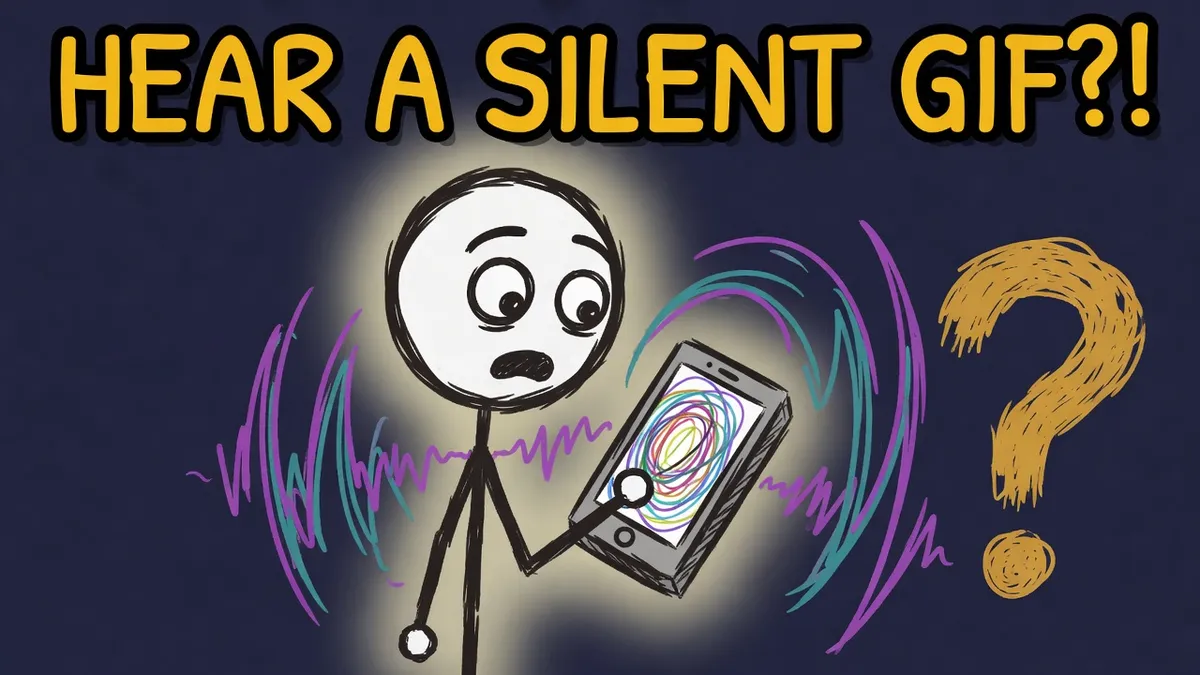
A few years ago a scrappy little animation went viral, and it started an argument that has never quite ended. It shows an electricity pylon skipping over its own power lines like a child with a jump rope, and every time it lands, the ground gives a little shudder. Millions of people insisted they could hear it, a dull, heavy thud, on every single jump. Which is a problem, because the file is completely silent. There is no sound in it at all. So what, exactly, are all these people hearing?
01 · The paradoxA picture that makes no sound
Play the pylon GIF and one of two things happens. Either it’s obviously, boringly silent, a soundless loop of a cartoon tower hopping about, or, for a great many people, it lands with an unmistakable thud you could swear you heard. Same file. Same pixels. No audio track anywhere. The people hearing it aren’t being suggestible or making it up for attention. Something in their perception is genuinely generating a sound where there is none.
02 · The nameIt's a real thing, and it has a name
The effect is called the visually-evoked auditory response, a mouthful, so researchers cheerfully shorten it to a “visual ear.” It’s a mild form of synaesthesia: the condition where stimulating one sense automatically drags along another, like tasting words or seeing letters drenched in colour. Here, strong visual motion evokes a faint sound. It’s been measured in the lab, tied to specific brain activity, and taken entirely seriously. This is not an internet myth.
03 · How commonAnd it's astonishingly common
Here’s the genuinely surprising bit. The famous synaesthesias, tasting words, seeing numbers in colour, turn up in only about 4% of people. Rare, exotic, the stuff of case studies. But when researchers at City, University of London ran a large survey of over four thousand people, around one in five reported hearing silent motion. That would make the humble visual ear not some fringe curiosity but potentially the single most common form of synaesthesia there is, hiding in plain sight in a fifth of everyone you know.
04 · The wiringForget the five tidy channels
To see why, you have to unlearn the diagram from school, the one with five separate senses in five separate lanes: eyes wired to the vision department, ears to the sound department, each running quietly in its own private channel, never touching. Inside a real head it doesn’t work like that. The vision area and the hearing area sit right next to each other, chattering constantly. Normally there’s a kind of soft barrier holding them in check, each keeping the other from bleeding over. The leading explanation is that in a visual-ear brain, that barrier is simply turned down. So when the eyes send a strong, rhythmic, thumping signal, some of it spills sideways into the hearing area, and the brain serves up a sound that was never actually there.
You can prove the phantom sound is real, because in the lab, it genuinely gets in the way of hearing a real one.
05 · The proofThe made-up sound competes with a real one
The obvious objection is that people are just imagining the thud. But there’s a clean experiment that rules that out. If researchers play a faint, real beep at the same instant as one of these visually-triggered phantom sounds, people get measurably worse at detecting the real beep. The imaginary sound is competing with actual audio for space in the hearing pathway, jamming it, essentially. You cannot do that with pure imagination; imagining a trumpet doesn’t make you deafer to a real one. So whatever the visual ear is generating, it’s a genuine signal reaching the auditory system, not a story you’re telling yourself after the fact.
06 · Everyone a bitYou already do a gentler version
And even if you swear you hear nothing from that pylon, your brain is running a quieter version of the same trick all day long. Watch someone drop a hammer with the sound off and you may still flinch for the clang. See a flash of far-off lightning and part of you is already braced for the thunder. Your senses are constantly whispering predictions to one another, sight forever nudging hearing about what’s probably coming next. The visual ear is just that everyday cross-talk turned up loud enough to become an actual heard sound.
07 · The payoffYour brain has been listening with its eyes
Which quietly flips the whole story. For years synaesthesia was filed away as rare, glitchy, crossed wiring in a handful of unusual brains. But when a single crossed-sense effect shows up in a fifth of everyone, it stops looking like a fault and starts looking like a feature, a hint that our senses were never really the separate channels we imagine. The hard line you feel between seeing and hearing is far softer, and far blurrier, than it seems. For an awful lot of people, a picture can genuinely be loud. And your brain, very quietly, has been listening with its eyes this whole time.

The animated version
Same answer, told as a little animated story with the strange little stickman acting it out. Dry, quick, and, obviously, correct.
Quick questions
What is the visual ear (vEAR)?
vEAR stands for visually-evoked auditory response: seeing motion or flashes evokes a faint sound, even when there's no audio at all. It's considered a mild form of synaesthesia, where stimulating one sense automatically triggers another. The classic trigger is a silent, rhythmic animation like the skipping-pylon GIF, but flashing lights, bouncing objects and even other people's movements can set it off.
How many people can hear silent GIFs?
In a large online survey of over 4,000 people run by researchers at City, University of London, around 21%, roughly 1 in 5, reported hearing sounds from silent visual motion. That's far higher than classic synaesthesias like tasting words or seeing coloured numbers, which show up in around 4% of people. (An informal viral poll of the pylon GIF got an even higher figure, but that sample was self-selected, so the ~1 in 5 from the survey is the more reliable number.)
Does hearing silent GIFs mean something is wrong with my brain?
No. If anything it's a sign of how normally connected your senses are. The leading idea is disinhibition, the vision and hearing areas sit right next to each other and normally hold one another in check, but in some people that dampening is a little weaker, so signals cross over. Because a fifth of people report it, researchers increasingly see it as the loud end of ordinary brain wiring, not a defect.
Is the sound real or just imagined?
It behaves like a real sensory signal, not pure imagination. In lab tests, the phantom sound triggered by a visual flash measurably interferes with people's ability to detect a real, faint sound played at the same moment. Imagination doesn't compete for auditory processing that way, so something genuinely sound-like is being generated in the hearing pathway.
Why can I 'hear' a hammer drop in a silent video?
Because your brain constantly predicts sound from sight, whether or not you have a strong visual ear. Watch someone drop a hammer with the sound off and you may still flinch for the clang; see distant lightning and part of you braces for thunder. Your senses are always whispering predictions to each other, vEAR is just a louder, more literal version of that everyday cross-talk.
What is the skipping pylon GIF, and who made it?
It's a short, silent animation of an electricity pylon hopping over its own power lines, made by the digital artist known as @IamHappyToast, originally for a photo-editing challenge on the site b3ta, years before it went viral. It exploded in December 2017 when psychologist Lisa DeBruine posted it on Twitter and asked whether people could hear it; a clear majority said they heard a thud. Tellingly, the effect seems to ride on the little camera-shudder each time the pylon lands, not the cartoon itself, versions showing just the shaking ground still trigger the phantom sound.
Is hearing silent GIFs a superpower or a glitch?
Closer to a mild quirk than either. It doesn't harm anything, and there are hints it can be a small advantage: musicians are significantly more likely to report the visual ear, and a small early study found people with the trait did better at spotting rhythmic visual patterns, because they could effectively 'hear' the rhythm they were watching. So it's less a glitch than an unusually chatty link between sight and sound. Just don't oversell it as a superpower; the evidence for real-world benefits is still thin.
Are some people more likely to hear it than others?
Yes. Beyond musicians, researchers have found the visual ear tends to travel with a couple of other traits: people who report it are also more likely to experience tinnitus (phantom ringing) and vivid musical imagery (tunes playing clearly in the mind). The common thread may be a generally more excitable auditory system. These are associations from survey data, though, not a diagnosis, plenty of people with none of those traits still hear the pylon land.
Can you turn the visual ear off, or learn to hear it?
Not really, on either count. For people who have it, the sound arrives automatically and involuntarily, it isn't a switch you can flip. And if you don't have it, you generally can't concentrate it into existence. In the lab, researchers have nudged the effect up and down using gentle electrical stimulation of the brain, which supports the idea that it depends on the balance of signals between the visual and auditory areas, but that's a controlled experiment, not something you can manage by force of will.
What does it mean if you can't hear the silent GIF?
Nothing worrying at all, you're in the majority. Only around one in five people report hearing silent motion, so roughly four out of five hear nothing, which is completely normal. Not having a strong visual ear simply means the crosstalk between your visual and auditory systems is quieter than average. You're not missing a sense; you're experiencing the animation exactly as the file is, silent.
Is the visual ear the same as tinnitus or 'musical ear syndrome'?
No, though they can travel together. Tinnitus and musical ear syndrome are phantom sounds that arise spontaneously, with no external trigger, a ringing, or a phantom tune, generated inside the auditory system on its own. The visual ear is different: its phantom sound is specifically evoked by something you see, like the pylon's shudder, and stops when the motion stops. They may share a more excitable auditory system, which is likely why people who report one are somewhat more likely to report the others, but the visual ear is its own, vision-triggered effect.
How common is hearing silent GIFs?
Roughly one in five people report some sound with silent motion, so most people hear nothing. The trait varies, and a strong 'visual ear' is the minority experience rather than the default.
Why would a silent animation make a sound in your head?
Because vision and hearing share predictive machinery. When motion looks like it should make a thud or whoosh, some brains fill in a matching auditory prediction. The ears hear nothing; the association is generated inside the head.
Take the quiz on this
A quick 4-question check on what you just read. Get them right to earn XP: no points for just scrolling.
Our sources 14 checked
// every claim on this page was checked before it went up