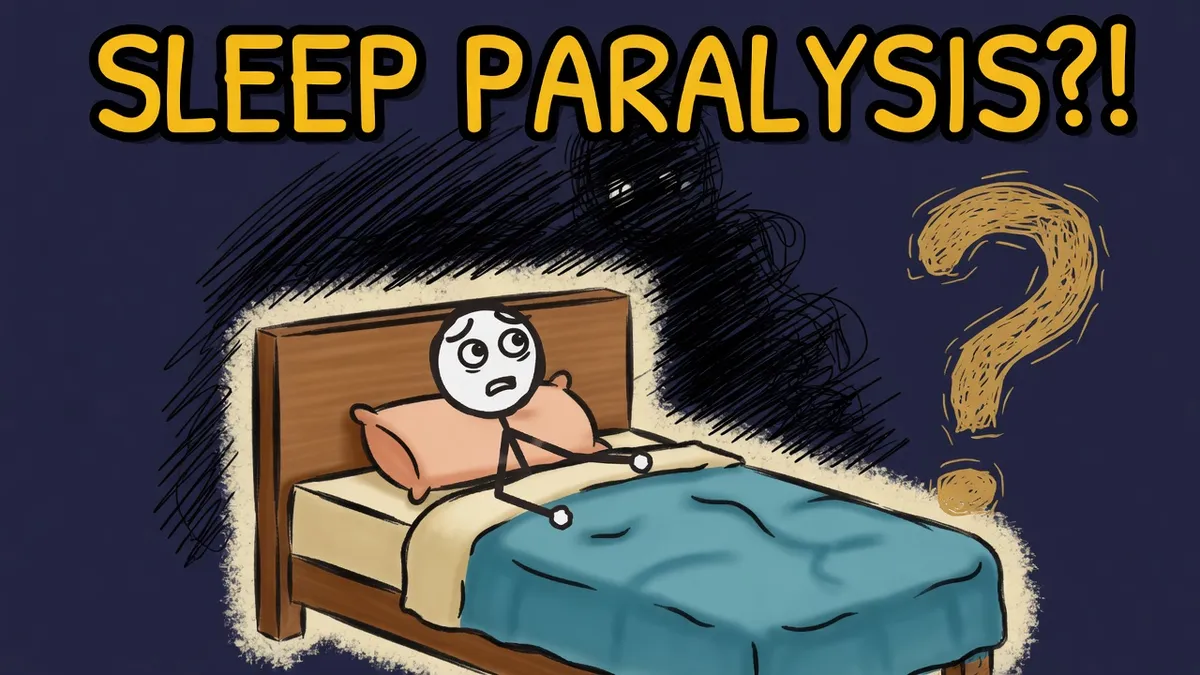
You surface out of sleep in the middle of the night. Your mind clicks on. Your eyes might even be open. But your body will not respond: you can't move, you can't speak, you can't cry out. And worst of all, you are certain there is something in the room with you. Something dark, watching. Maybe pressing down, right on your chest. This is sleep paralysis, and it is one of the strangest things a healthy human brain does to itself. It happens because two parts of you woke up at completely different times.
01 · The setupYour body paralyses itself every single night
Here’s the thing most people never learn about their own sleep: every night, when you dream, your brain does something clever and slightly alarming. It paralyses your entire body. On purpose. During REM sleep, the stage where the vivid dreams happen, the brain switches your voluntary muscles off so that you can’t physically act out whatever you’re dreaming. You don’t sprint out of bed to flee a nightmare or throw a punch at a dream attacker. It’s a safety catch, and it’s called REM atonia. Deep in the brainstem, a circuit running from the pons down into the medulla uses the neurotransmitters GABA and glycine to clamp down on the motor neurons in your spinal cord. Your body goes limp and stays that way until the dream is done.
02 · The glitchWhen the timing slips
Normally that paralysis lifts a split second before your mind wakes up, and you never notice the handover. But every so often the timing slips. Your mind boots up, fully awake, fully aware, while your body is still locked down in dream-paralysis. Sleep scientists call this a REM-wake dissociation: a state where you’re genuinely conscious, but the machinery of REM sleep hasn’t switched off yet. So for a few endless seconds, you are wide awake, trapped inside a body that will not move. Conscious, inside a dream. It usually lasts anywhere from a few seconds to about two minutes, and, this is worth holding onto, it is completely harmless. It’s also surprisingly common: estimates suggest around one in twelve people experience it at least once.
03 · The weightWhy it feels like something is crushing your chest
Now for the weight on your chest, because that part is real physiology, not imagination. When REM atonia switches off your muscles, it’s careful not to switch off the one muscle you can’t live without: the diaphragm. Your breathing keeps running, but it’s run almost entirely by the diaphragm alone. The muscles around your chest wall, the ones that help you take a big, deep breath, go slack with everything else. So you wake into shallow, restricted, automatic breathing. And your alarmed brain, hunting for an explanation, reads that tightness as something heavy pressing down. Something sitting on you. This is what researchers call the “incubus” sensation, and it’s one of the most consistent features of an episode.
04 · The alarmAwake, frozen, and unable to breathe properly
So take stock of the situation you’re in. You are awake. You cannot move. And you cannot take a proper breath. To a brain, that is a five-alarm emergency, every ingredient of mortal danger, all at once. Your threat-detector, the amygdala, roars to life, utterly convinced that you are in peril. And it does what a threat system does: it starts scouring the dark room for whatever the danger must be, lowering its thresholds, primed to see menace in anything. Researchers call this a threat-activated vigilance system, and it’s the engine that turns a strange physical state into pure terror.
05 · The demonWhere the figure in the corner comes from
But remember, you are still half inside REM sleep, still churning out vivid, dreamlike imagery. So here’s the leading idea for the demon: your terrified brain takes that overwhelming sense of there is a threat in here, and the dream-imagery it’s already producing, and it fuses them into a single, solid figure. A shadow. A hag. A presence in the corner of the room. Your mind conjures a monster, purely to explain a terror it can’t otherwise place.
Now, this fusion account is the leading explanation rather than a settled fact, you can’t run a controlled experiment on someone’s private hallucination, but it fits the pattern remarkably well. When researchers catalogued thousands of episodes, the hallucinations sorted cleanly into three families: the intruder (a menacing presence and shadowy figures), the incubus (that crushing chest weight and suffocation), and the vestibular-motor (floating, flying, or feeling yourself lift out of your body). The first two, the presence and the weight, travel together, exactly as you’d expect if both are being generated by the same frightened, threat-hunting brain.
This exact experience, the presence, the crushing weight, the dread, turns up in every culture on Earth. And that's the clue that unlocks the whole thing.
06 · The monster, everywhereWhy every culture met the same figure
In Newfoundland, it’s the Old Hag, who sits on your chest and steals your breath as you sleep. The phenomenon was studied so widely there that “Old Hag Syndrome” made it into the medical literature. In Japan, it’s kanashibari, a word meaning to be bound as if by invisible metal. Across old Europe, it was a witch or demon crouching on the sleeper’s chest, the mare, a night-spirit that rides you in your sleep, and whose name is buried right there in the word nightmare. Same figure. Same weight. Same dread. Everywhere, independently, across cultures that never spoke to one another.
And this is the crucial bit, and it runs opposite to how you’d guess. It is not the folklore creating the experience. It’s the exact reverse. The brain-state is identical inside every human skull, so it generates the very same core hallucination, the same lurking intruder, the same crushing weight, all over the world. And then each culture simply hands that one universal monster a local name and a local costume.
07 · The payoffSo what is the thing on your chest?
The demon on your chest is real, in the only sense that actually matters. It is a genuine, built-in experience, stitched together by your own brain out of paralysis, shallow breath, raw fear, and a few leftover scraps of dream. Not a visitor. A remarkably convincing, home-made ghost that human beings have been meeting, and naming, for thousands of years. So if you ever wake up frozen with a shadow on your chest, try to remember, in the moment, that it will pass in seconds. It isn’t a demon. It’s just your body, running a little late.
The animated version
Same answer, told as a little animated story with the strange little stickman acting it out. Dry, quick, and, obviously, correct.
Quick questions
Is sleep paralysis dangerous?
No. It's frightening but physically harmless, and it passes on its own, usually within seconds to about two minutes. It's a normal quirk of how sleep and wakefulness overlap, not a sign of anything wrong with your brain. It's also common: estimates suggest around 8% of the general population experience it at least once, and it's far more frequent in students and in people with anxiety or panic disorders.
Why do I feel a weight on my chest during sleep paralysis?
During dream sleep the muscles of your chest wall go slack, and your breathing is run almost entirely by your diaphragm, shallow and automatic. If you wake into that state, your alert brain interprets the restricted, shallow breathing as something heavy pressing down. That's the "incubus" sensation, and it's one of the most common features of an episode.
Why do I see a demon or a figure when I can't move?
You're awake but still partly in REM, so your brain is still generating vivid, dreamlike imagery. Being frozen and struggling to breathe fires your threat-detection system, the amygdala, which scours the dark for danger. The leading explanation is that this hypervigilance fuses with the leftover dream imagery into a coherent menacing figure: an intruder, a shadow, a hag.
Why does every culture have a sleep paralysis demon?
Because the underlying brain-state is the same in every human. Newfoundland has the Old Hag, Japan has kanashibari (being bound as if by metal), and medieval Europe had the demon crouching on the sleeper's chest, the "mare" that survives in the word nightmare. The folklore doesn't create the experience; the experience creates the folklore, and each culture just gives the same monster a local name.
What causes sleep paralysis?
It's a REM-wake dissociation, the paralysis and imagery of REM sleep bleeding into wakefulness. It's linked to disrupted sleep, sleep deprivation, irregular schedules, sleeping on your back, stress, and conditions like narcolepsy and anxiety. Improving sleep habits reduces how often it happens for most people.
How do you stop sleep paralysis, or snap yourself out of an episode?
You can't force it to end instantly, but a few things reliably help. Because the paralysis never touches your breathing or your eyes, the trick most people find works is to stop fighting the big muscles and pour all your effort into one tiny movement, wiggling a single finger or toe, or moving your eyes, which tends to break the spell. Slow, deliberate breaths help too, both to calm the panic and to nudge your brain toward full wakefulness. And the most important part is the least intuitive: remind yourself what it is. Struggling and panicking can drag an episode out; relaxing into it, knowing it passes in seconds, tends to end it faster. A partner touching or speaking to you can also bring you round.
Can sleep paralysis kill you?
No. However much it feels like suffocation, you're not actually being starved of air: your diaphragm keeps your breathing running automatically the whole time, and your heart keeps beating normally. The suffocation is a misperception, not real oxygen loss, and every episode ends on its own. There's no documented case of sleep paralysis itself killing a healthy person; the old folklore of people 'dying in their sleep from the hag' is exactly that, folklore. It's terrifying, not dangerous.
What is the 'shadow figure' people see during sleep paralysis?
The shadow figure, a tall, dark, faceless human shape standing in the corner or looming over the bed, is one of the most commonly reported sleep-paralysis hallucinations, and it's the 'intruder' type in action. Two things build it: your threat system is screaming that someone is there, and your visual brain, primed to find human shapes, fills the dark with one (the same face-in-the-shadows pattern-spotting called pareidolia). That so many strangers independently describe the same faceless silhouette is strong evidence it's made by the brain, not met in the room.
Is sleep paralysis caused by stress or sleep deprivation?
They're among the biggest triggers. Sleep deprivation, jet lag, shift work and irregular bedtimes all disrupt the normal march through sleep stages and make a botched REM-to-wake handover more likely. High stress, anxiety and panic disorder are strongly associated with it, and some of the highest rates of all show up in people with post-traumatic stress disorder. None of these guarantee an episode, plenty of well-rested, calm people still get them, but clearing sleep debt and managing stress is the most effective lever most people have.
Does sleeping on your back make it more likely, and can you prevent it?
Sleeping on your back does seem to raise the odds, most people report their episodes while lying face-up, so simply switching to your side is the cheapest thing to try. Beyond that, the prevention playbook is really just good sleep hygiene: a regular sleep schedule, enough hours, easing off caffeine, big late meals and alcohol before bed, and keeping stress in check. It won't necessarily stop episodes entirely, but for most people it makes them rarer.
Is sleep paralysis a sign of narcolepsy or something serious?
Usually not. A one-off or occasional episode in an otherwise healthy sleeper is common and benign. But sleep paralysis is also one of the classic features of narcolepsy, a neurological disorder of REM regulation, and studies suggest up to around half of people with narcolepsy experience it. So if episodes are frequent, or come alongside daytime sleep attacks, sudden muscle weakness when you laugh (cataplexy), or dream-like hallucinations as you drift off, that's worth raising with a doctor rather than shrugging off.
How common is sleep paralysis?
Roughly 8% of the general population report at least one lifetime episode, with much higher rates in students (around 28%) and psychiatric patients (around 32%). Many people have only one or a few episodes; frequent, sleep-wrecking runs are less common.
Why do people see figures or feel a presence during sleep paralysis?
Because REM dreaming is still running while the body stays locked. The brain tries to interpret threat and ambiguous sensations with dream imagery, which is why cultures worldwide report old hag, shadow people or bedroom intruders during episodes.
Take the quiz on this
A quick 4-question check on what you just read. Get them right to earn XP: no points for just scrolling.
Our sources 10 checked
// every claim on this page was checked before it went up